

16.2 14-Membered Macrocyclic Lactones
16.2.1 (–)-Chlorothricolide
As most macrolactonizations are nontrivial, ambitious reactions and the best performance are often cumbersome which can exemplarily be seen in the total synthesis of (–)-chlorothricolide 207 [134] (Scheme 58). Not until after attentive
investigations, eventually Roush and coworkers recognized that only by using
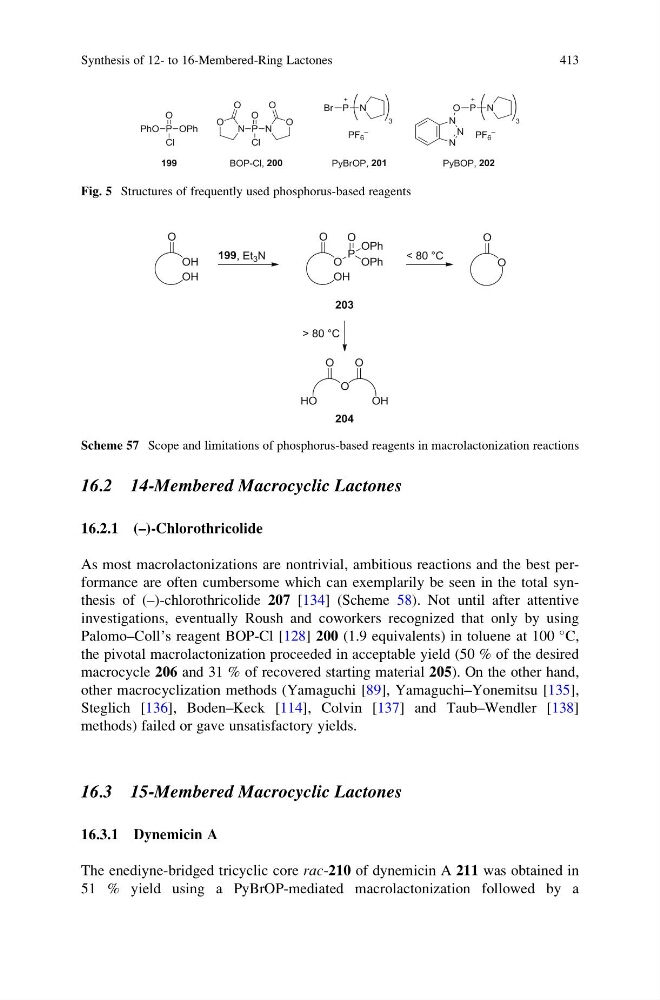
Palomo–Coll’s reagent BOP-Cl [128] 200 (1.9 equivalents) in toluene at 100
C,
the pivotal macrolactonization proceeded in acceptable yield (50 % of the desired
macrocycle 206 and 31 % of recovered starting material 205). On the other hand,
other macrocyclization methods (Yamaguchi [89], Yamaguchi–Yonemitsu [135],
Steglich [136], Boden–Keck [114], Colvin [137] and Taub–Wendler [138]
methods) failed or gave unsatisfactory yields.
16.3 15-Membered Macrocyclic Lactones
16.3.1 Dynemicin A
The enediyne-bridged tricyclic core rac-210 of dynemicin A 211 was obtained in
51 % yield using a PyBrOP-mediated macrolactonization followed by a
Fig. 5 Structures of frequently used phosphorus-based reagents
Scheme 57 Scope and limitations of phosphorus-based reagents in macrolactonization reactions
Synthesis of 12- to 16-Membered-Ring Lactones
413
16.2.1 (–)-Chlorothricolide
As most macrolactonizations are nontrivial, ambitious reactions and the best performance are often cumbersome which can exemplarily be seen in the total synthesis of (–)-chlorothricolide 207 [134] (Scheme 58). Not until after attentive
investigations, eventually Roush and coworkers recognized that only by using
Palomo–Coll’s reagent BOP-Cl [128] 200 (1.9 equivalents) in toluene at 100
C,
the pivotal macrolactonization proceeded in acceptable yield (50 % of the desired
macrocycle 206 and 31 % of recovered starting material 205). On the other hand,
other macrocyclization methods (Yamaguchi [89], Yamaguchi–Yonemitsu [135],
Steglich [136], Boden–Keck [114], Colvin [137] and Taub–Wendler [138]
methods) failed or gave unsatisfactory yields.
16.3 15-Membered Macrocyclic Lactones
16.3.1 Dynemicin A
The enediyne-bridged tricyclic core rac-210 of dynemicin A 211 was obtained in
51 % yield using a PyBrOP-mediated macrolactonization followed by a
Fig. 5 Structures of frequently used phosphorus-based reagents
Scheme 57 Scope and limitations of phosphorus-based reagents in macrolactonization reactions
Synthesis of 12- to 16-Membered-Ring Lactones
413