

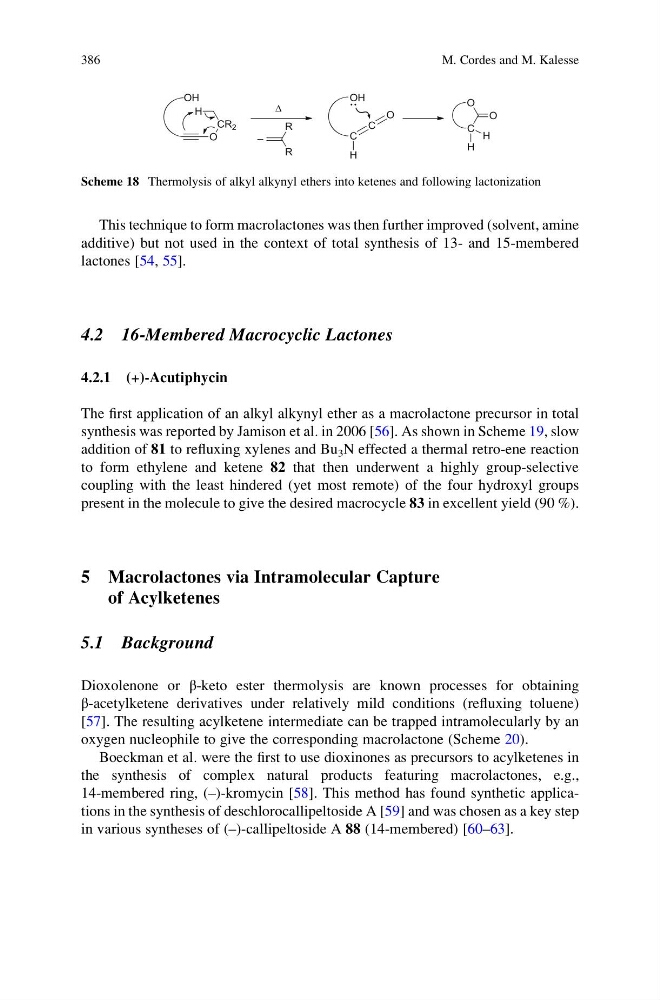
This technique to form macrolactones was then further improved (solvent, amine
additive) but not used in the context of total synthesis of 13- and 15-membered
lactones [54, 55].
4.2 16-Membered Macrocyclic Lactones
4.2.1 (+)-Acutiphycin
The first application of an alkyl alkynyl ether as a macrolactone precursor in total
synthesis was reported by Jamison et al. in 2006 [56]. As shown in Scheme 19, slow
addition of 81 to refluxing xylenes and Bu 3 N effected a thermal retro-ene reaction
to form ethylene and ketene 82 that then underwent a highly group-selective
coupling with the least hindered (yet most remote) of the four hydroxyl groups
present in the molecule to give the desired macrocycle 83 in excellent yield (90 %).
5 Macrolactones via Intramolecular Capture
of Acylketenes
5.1 Background
Dioxolenone or β-keto ester thermolysis are known processes for obtaining
β-acetylketene derivatives under relatively mild conditions (refluxing toluene)
[57]. The resulting acylketene intermediate can be trapped intramolecularly by an
oxygen nucleophile to give the corresponding macrolactone (Scheme 20).
Boeckman et al. were the first to use dioxinones as precursors to acylketenes in
the synthesis of complex natural products featuring macrolactones, e.g.,
14-membered ring, (–)-kromycin [58]. This method has found synthetic applications in the synthesis of deschlorocallipeltoside A [59] and was chosen as a key step
in various syntheses of (–)-callipeltoside A 88 (14-membered) [60–63].
Scheme 18 Thermolysis of alkyl alkynyl ethers into ketenes and following lactonization
386
M. Cordes and M. Kalesse
additive) but not used in the context of total synthesis of 13- and 15-membered
lactones [54, 55].
4.2 16-Membered Macrocyclic Lactones
4.2.1 (+)-Acutiphycin
The first application of an alkyl alkynyl ether as a macrolactone precursor in total
synthesis was reported by Jamison et al. in 2006 [56]. As shown in Scheme 19, slow
addition of 81 to refluxing xylenes and Bu 3 N effected a thermal retro-ene reaction
to form ethylene and ketene 82 that then underwent a highly group-selective
coupling with the least hindered (yet most remote) of the four hydroxyl groups
present in the molecule to give the desired macrocycle 83 in excellent yield (90 %).
5 Macrolactones via Intramolecular Capture
of Acylketenes
5.1 Background
Dioxolenone or β-keto ester thermolysis are known processes for obtaining
β-acetylketene derivatives under relatively mild conditions (refluxing toluene)
[57]. The resulting acylketene intermediate can be trapped intramolecularly by an
oxygen nucleophile to give the corresponding macrolactone (Scheme 20).
Boeckman et al. were the first to use dioxinones as precursors to acylketenes in
the synthesis of complex natural products featuring macrolactones, e.g.,
14-membered ring, (–)-kromycin [58]. This method has found synthetic applications in the synthesis of deschlorocallipeltoside A [59] and was chosen as a key step
in various syntheses of (–)-callipeltoside A 88 (14-membered) [60–63].
Scheme 18 Thermolysis of alkyl alkynyl ethers into ketenes and following lactonization
386
M. Cordes and M. Kalesse