

approaches to epothilone A 39 [31–33], the stereocontrol of the C12–C13 double
bond by using RCM is difficult; indeed, none of the catalyst used initially, 44 and
45, produced satisfactory Z selectivity. Since this serious problem arose only
toward the very end of the rather laborious synthesis and since the isomeric alkenes
could not be readily separated at this stage, it is hardly surprising that alternative
double-bond disconnections were scrutinized, ensuring better control over all
structural elements. However, alternative approaches involving the formation of
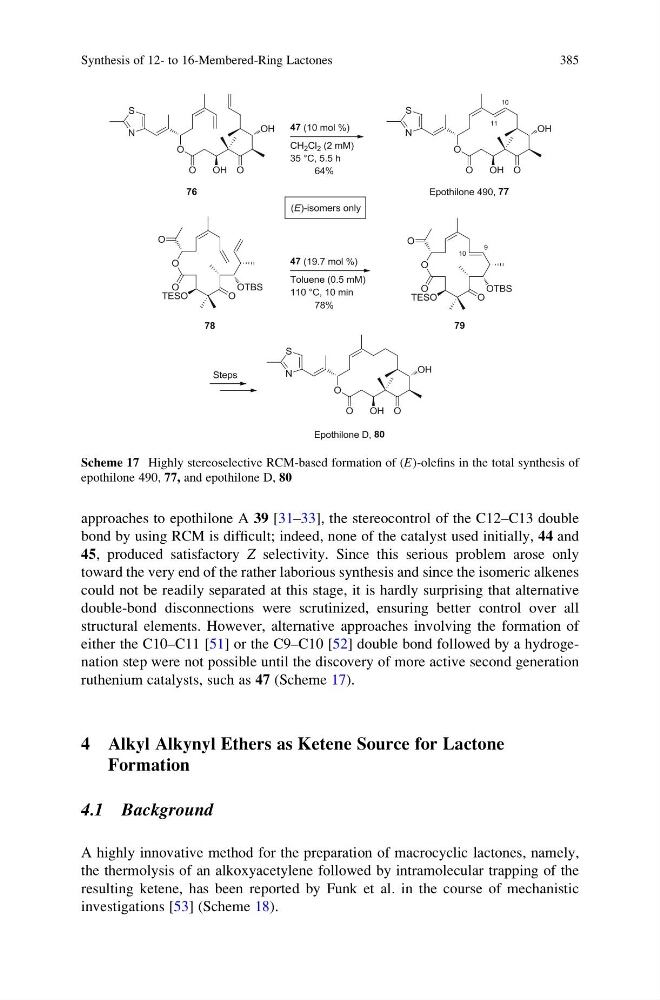
either the C10–C11 [51] or the C9–C10 [52] double bond followed by a hydrogenation step were not possible until the discovery of more active second generation
ruthenium catalysts, such as 47 (Scheme 17).
4 Alkyl Alkynyl Ethers as Ketene Source for Lactone
Formation
4.1 Background
A highly innovative method for the preparation of macrocyclic lactones, namely,
the thermolysis of an alkoxyacetylene followed by intramolecular trapping of the
resulting ketene, has been reported by Funk et al. in the course of mechanistic
investigations [53] (Scheme 18).
Scheme 17 Highly stereoselective RCM-based formation of (E)-olefins in the total synthesis of
epothilone 490, 77, and epothilone D, 80
Synthesis of 12- to 16-Membered-Ring Lactones
385
bond by using RCM is difficult; indeed, none of the catalyst used initially, 44 and
45, produced satisfactory Z selectivity. Since this serious problem arose only
toward the very end of the rather laborious synthesis and since the isomeric alkenes
could not be readily separated at this stage, it is hardly surprising that alternative
double-bond disconnections were scrutinized, ensuring better control over all
structural elements. However, alternative approaches involving the formation of
either the C10–C11 [51] or the C9–C10 [52] double bond followed by a hydrogenation step were not possible until the discovery of more active second generation
ruthenium catalysts, such as 47 (Scheme 17).
4 Alkyl Alkynyl Ethers as Ketene Source for Lactone
Formation
4.1 Background
A highly innovative method for the preparation of macrocyclic lactones, namely,
the thermolysis of an alkoxyacetylene followed by intramolecular trapping of the
resulting ketene, has been reported by Funk et al. in the course of mechanistic
investigations [53] (Scheme 18).
Scheme 17 Highly stereoselective RCM-based formation of (E)-olefins in the total synthesis of
epothilone 490, 77, and epothilone D, 80
Synthesis of 12- to 16-Membered-Ring Lactones
385