

3.3 13-Membered Macrocyclic Lactones
3.3.1 (–)-Spongidepsin
Five total syntheses of the 13-membered lactone and lactam antiproliferative
marine metabolite (–)-spongidepsin 70 have been reported to date [44–48], and
most of them use an RCM. As a general trend, when an RCM was performed on
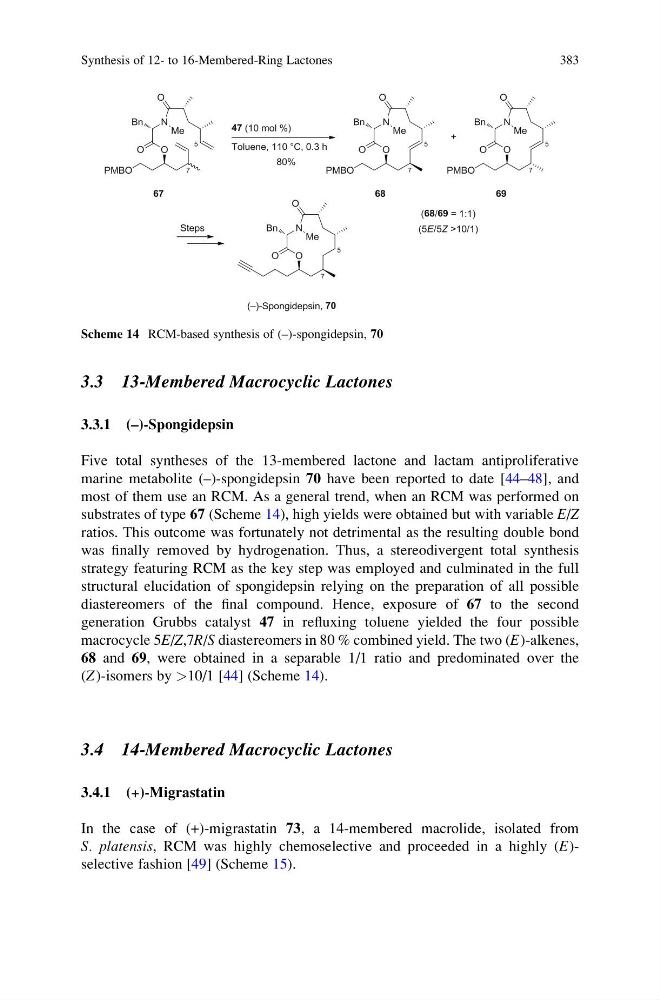
substrates of type 67 (Scheme 14), high yields were obtained but with variable E/Z
ratios. This outcome was fortunately not detrimental as the resulting double bond
was finally removed by hydrogenation. Thus, a stereodivergent total synthesis
strategy featuring RCM as the key step was employed and culminated in the full
structural elucidation of spongidepsin relying on the preparation of all possible
diastereomers of the final compound. Hence, exposure of 67 to the second
generation Grubbs catalyst 47 in refluxing toluene yielded the four possible
macrocycle 5E/Z,7R/S diastereomers in 80 % combined yield. The two (E)-alkenes,
68 and 69, were obtained in a separable 1/1 ratio and predominated over the
(Z)-isomers by >10/1 [44] (Scheme 14).
3.4 14-Membered Macrocyclic Lactones
3.4.1 (+)-Migrastatin
In the case of (+)-migrastatin 73, a 14-membered macrolide, isolated from
S. platensis, RCM was highly chemoselective and proceeded in a highly (E)selective fashion [49] (Scheme 15).
Scheme 14 RCM-based synthesis of (–)-spongidepsin, 70
Synthesis of 12- to 16-Membered-Ring Lactones
383
3.3.1 (–)-Spongidepsin
Five total syntheses of the 13-membered lactone and lactam antiproliferative
marine metabolite (–)-spongidepsin 70 have been reported to date [44–48], and
most of them use an RCM. As a general trend, when an RCM was performed on
substrates of type 67 (Scheme 14), high yields were obtained but with variable E/Z
ratios. This outcome was fortunately not detrimental as the resulting double bond
was finally removed by hydrogenation. Thus, a stereodivergent total synthesis
strategy featuring RCM as the key step was employed and culminated in the full
structural elucidation of spongidepsin relying on the preparation of all possible
diastereomers of the final compound. Hence, exposure of 67 to the second
generation Grubbs catalyst 47 in refluxing toluene yielded the four possible
macrocycle 5E/Z,7R/S diastereomers in 80 % combined yield. The two (E)-alkenes,
68 and 69, were obtained in a separable 1/1 ratio and predominated over the
(Z)-isomers by >10/1 [44] (Scheme 14).
3.4 14-Membered Macrocyclic Lactones
3.4.1 (+)-Migrastatin
In the case of (+)-migrastatin 73, a 14-membered macrolide, isolated from
S. platensis, RCM was highly chemoselective and proceeded in a highly (E)selective fashion [49] (Scheme 15).
Scheme 14 RCM-based synthesis of (–)-spongidepsin, 70
Synthesis of 12- to 16-Membered-Ring Lactones
383