

3.2 12-Membered Macrocyclic Lactones
3.2.1 Salicylihalamides
As aforementioned, RCM-based macrocyclizations are known to be reversible
processes and usually provide E/Z mixtures, often favoring the thermodynamically
more stable isomer. This issue is often the pivotal subject in order to obtain good
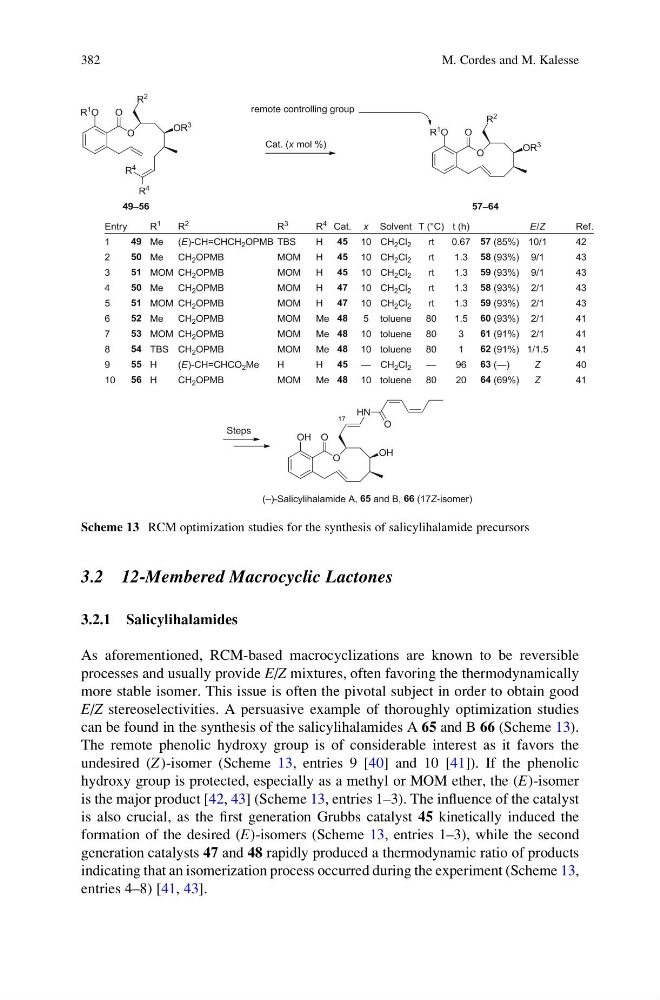
E/Z stereoselectivities. A persuasive example of thoroughly optimization studies
can be found in the synthesis of the salicylihalamides A 65 and B 66 (Scheme 13).
The remote phenolic hydroxy group is of considerable interest as it favors the
undesired (Z )-isomer (Scheme 13, entries 9 [40] and 10 [41]). If the phenolic
hydroxy group is protected, especially as a methyl or MOM ether, the (E)-isomer
is the major product [42, 43] (Scheme 13, entries 1–3). The influence of the catalyst
is also crucial, as the first generation Grubbs catalyst 45 kinetically induced the
formation of the desired (E)-isomers (Scheme 13, entries 1–3), while the second
generation catalysts 47 and 48 rapidly produced a thermodynamic ratio of products
indicating that an isomerization process occurred during the experiment (Scheme 13,
entries 4–8) [41, 43].
Scheme 13 RCM optimization studies for the synthesis of salicylihalamide precursors
382
M. Cordes and M. Kalesse
3.2.1 Salicylihalamides
As aforementioned, RCM-based macrocyclizations are known to be reversible
processes and usually provide E/Z mixtures, often favoring the thermodynamically
more stable isomer. This issue is often the pivotal subject in order to obtain good
E/Z stereoselectivities. A persuasive example of thoroughly optimization studies
can be found in the synthesis of the salicylihalamides A 65 and B 66 (Scheme 13).
The remote phenolic hydroxy group is of considerable interest as it favors the
undesired (Z )-isomer (Scheme 13, entries 9 [40] and 10 [41]). If the phenolic
hydroxy group is protected, especially as a methyl or MOM ether, the (E)-isomer
is the major product [42, 43] (Scheme 13, entries 1–3). The influence of the catalyst
is also crucial, as the first generation Grubbs catalyst 45 kinetically induced the
formation of the desired (E)-isomers (Scheme 13, entries 1–3), while the second
generation catalysts 47 and 48 rapidly produced a thermodynamic ratio of products
indicating that an isomerization process occurred during the experiment (Scheme 13,
entries 4–8) [41, 43].
Scheme 13 RCM optimization studies for the synthesis of salicylihalamide precursors
382
M. Cordes and M. Kalesse