

were realized by using ring-closing metatheses (RCM) to form the 16-membered
macrocyclic lactone [31–33]. A drawback in all these efforts was the absence of any
significant selectivity for the desired (Z )-olefin geometry at a late stage of the
synthesis.
Therefore, the epothilones serve as a valuable educational example for the
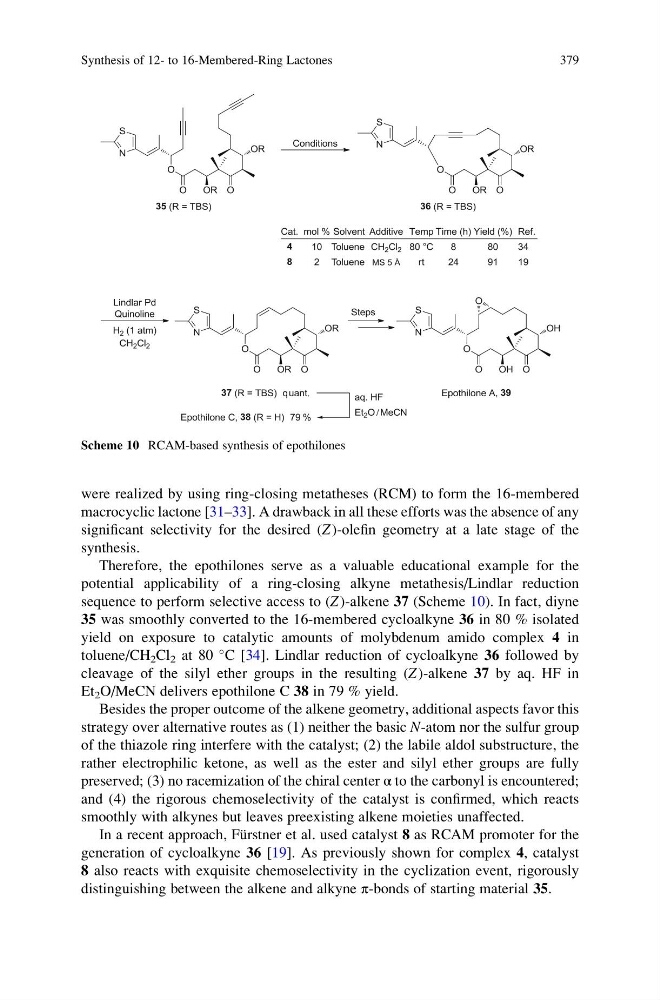
potential applicability of a ring-closing alkyne metathesis/Lindlar reduction
sequence to perform selective access to (Z )-alkene 37 (Scheme 10). In fact, diyne
35 was smoothly converted to the 16-membered cycloalkyne 36 in 80 % isolated
yield on exposure to catalytic amounts of molybdenum amido complex 4 in
toluene/CH 2 Cl 2 at 80
C [34]. Lindlar reduction of cycloalkyne 36 followed by
cleavage of the silyl ether groups in the resulting (Z )-alkene 37 by aq. HF in
Et 2 O/MeCN delivers epothilone C 38 in 79 % yield.
Besides the proper outcome of the alkene geometry, additional aspects favor this
strategy over alternative routes as (1) neither the basic N-atom nor the sulfur group
of the thiazole ring interfere with the catalyst; (2) the labile aldol substructure, the
rather electrophilic ketone, as well as the ester and silyl ether groups are fully
preserved; (3) no racemization of the chiral center α to the carbonyl is encountered;
and (4) the rigorous chemoselectivity of the catalyst is confirmed, which reacts
smoothly with alkynes but leaves preexisting alkene moieties unaffected.
In a recent approach, Fu ¨rstner et al. used catalyst 8 as RCAM promoter for the
generation of cycloalkyne 36 [19]. As previously shown for complex 4, catalyst
8 also reacts with exquisite chemoselectivity in the cyclization event, rigorously
distinguishing between the alkene and alkyne π-bonds of starting material 35.
.
/
Scheme 10 RCAM-based synthesis of epothilones
Synthesis of 12- to 16-Membered-Ring Lactones
379
macrocyclic lactone [31–33]. A drawback in all these efforts was the absence of any
significant selectivity for the desired (Z )-olefin geometry at a late stage of the
synthesis.
Therefore, the epothilones serve as a valuable educational example for the
potential applicability of a ring-closing alkyne metathesis/Lindlar reduction
sequence to perform selective access to (Z )-alkene 37 (Scheme 10). In fact, diyne
35 was smoothly converted to the 16-membered cycloalkyne 36 in 80 % isolated
yield on exposure to catalytic amounts of molybdenum amido complex 4 in
toluene/CH 2 Cl 2 at 80
C [34]. Lindlar reduction of cycloalkyne 36 followed by
cleavage of the silyl ether groups in the resulting (Z )-alkene 37 by aq. HF in
Et 2 O/MeCN delivers epothilone C 38 in 79 % yield.
Besides the proper outcome of the alkene geometry, additional aspects favor this
strategy over alternative routes as (1) neither the basic N-atom nor the sulfur group
of the thiazole ring interfere with the catalyst; (2) the labile aldol substructure, the
rather electrophilic ketone, as well as the ester and silyl ether groups are fully
preserved; (3) no racemization of the chiral center α to the carbonyl is encountered;
and (4) the rigorous chemoselectivity of the catalyst is confirmed, which reacts
smoothly with alkynes but leaves preexisting alkene moieties unaffected.
In a recent approach, Fu ¨rstner et al. used catalyst 8 as RCAM promoter for the
generation of cycloalkyne 36 [19]. As previously shown for complex 4, catalyst
8 also reacts with exquisite chemoselectivity in the cyclization event, rigorously
distinguishing between the alkene and alkyne π-bonds of starting material 35.
.
/
Scheme 10 RCAM-based synthesis of epothilones
Synthesis of 12- to 16-Membered-Ring Lactones
379