

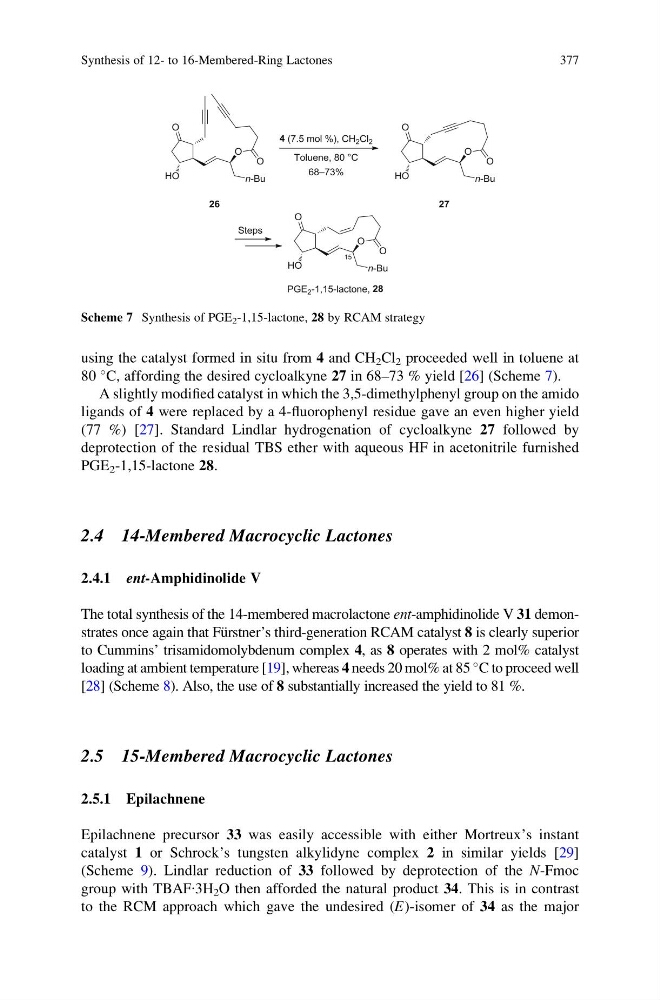
using the catalyst formed in situ from 4 and CH 2 Cl 2 proceeded well in toluene at
80
C, affording the desired cycloalkyne 27 in 68–73 % yield [26] (Scheme 7).
A slightly modified catalyst in which the 3,5-dimethylphenyl group on the amido
ligands of 4 were replaced by a 4-fluorophenyl residue gave an even higher yield
(77 %) [27]. Standard Lindlar hydrogenation of cycloalkyne 27 followed by
deprotection of the residual TBS ether with aqueous HF in acetonitrile furnished
PGE 2 -1,15-lactone 28.
2.4 14-Membered Macrocyclic Lactones
2.4.1 ent-Amphidinolide V
The total synthesis of the 14-membered macrolactone ent-amphidinolide V 31 demonstrates once again that Fu ¨rstner’s third-generation RCAM catalyst 8 is clearly superior
to Cummins’ trisamidomolybdenum complex 4, as 8 operates with 2 mol% catalyst
loading at ambient temperature [19], whereas 4 needs 20 mol% at 85
C to proceed well
[28] (Scheme 8). Also, the use of 8 substantially increased the yield to 81 %.
2.5 15-Membered Macrocyclic Lactones
2.5.1 Epilachnene
Epilachnene precursor 33 was easily accessible with either Mortreux’s instant
catalyst 1 or Schrock’s tungsten alkylidyne complex 2 in similar yields [29]
(Scheme 9). Lindlar reduction of 33 followed by deprotection of the N-Fmoc
group with TBAF∙3H 2 O then afforded the natural product 34. This is in contrast
to the RCM approach which gave the undesired (E)-isomer of 34 as the major
Scheme 7 Synthesis of PGE 2 -1,15-lactone, 28 by RCAM strategy
Synthesis of 12- to 16-Membered-Ring Lactones
377
80
C, affording the desired cycloalkyne 27 in 68–73 % yield [26] (Scheme 7).
A slightly modified catalyst in which the 3,5-dimethylphenyl group on the amido
ligands of 4 were replaced by a 4-fluorophenyl residue gave an even higher yield
(77 %) [27]. Standard Lindlar hydrogenation of cycloalkyne 27 followed by
deprotection of the residual TBS ether with aqueous HF in acetonitrile furnished
PGE 2 -1,15-lactone 28.
2.4 14-Membered Macrocyclic Lactones
2.4.1 ent-Amphidinolide V
The total synthesis of the 14-membered macrolactone ent-amphidinolide V 31 demonstrates once again that Fu ¨rstner’s third-generation RCAM catalyst 8 is clearly superior
to Cummins’ trisamidomolybdenum complex 4, as 8 operates with 2 mol% catalyst
loading at ambient temperature [19], whereas 4 needs 20 mol% at 85
C to proceed well
[28] (Scheme 8). Also, the use of 8 substantially increased the yield to 81 %.
2.5 15-Membered Macrocyclic Lactones
2.5.1 Epilachnene
Epilachnene precursor 33 was easily accessible with either Mortreux’s instant
catalyst 1 or Schrock’s tungsten alkylidyne complex 2 in similar yields [29]
(Scheme 9). Lindlar reduction of 33 followed by deprotection of the N-Fmoc
group with TBAF∙3H 2 O then afforded the natural product 34. This is in contrast
to the RCM approach which gave the undesired (E)-isomer of 34 as the major
Scheme 7 Synthesis of PGE 2 -1,15-lactone, 28 by RCAM strategy
Synthesis of 12- to 16-Membered-Ring Lactones
377