

Interaction of Nano-TiO 2 with Plants:
Preparation and Translocation
Kandasamy G. Moodley and Vasanthakumar Arumugam
Abstract
The application of nanotechnology is increasing at a rapid
pace in the manufacture of products for both industrial
and domestic markets. It is widely known that abundant
nanoparticles of titanium dioxide are included in house
products such as toothpaste and paints for improving a
white colour as well as used as fillers in the products.
Titanium nanoparticles are also added to food additives
for a similar reason. Once their usefulness is over, these
products will end up in water treatment plants or in solid
waste disposal sites from where they may enter water
bodies or arable land. If they enter into the edible plants,
these nanoparticles may enter into the food chain. In the
light of the above, this chapter focused on the methods of
synthesis and characterization on nano-TiO 2 by various
researchers and the results obtained with regard to the
properties of nano-TiO 2 . This was followed by summaries
of studies on the interaction of nano-TiO 2 with various
plants including the influence of these properties of
nano-TiO 2 on the type and extent of the interactions.
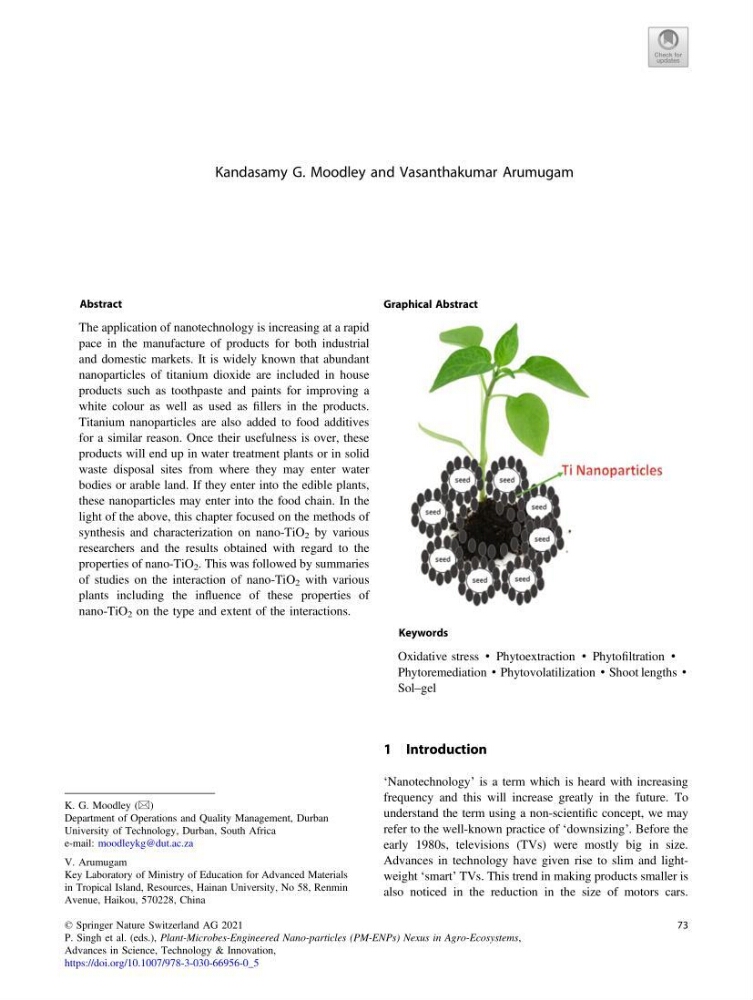
Graphical Abstract
Keywords
Oxidative stress Á Phytoextraction Á Phytofiltration Á
Phytoremediation Á Phytovolatilization Á Shoot lengths Á
Sol–gel
1 Introduction
‘Nanotechnology’ is a term which is heard with increasing
frequency and this will increase greatly in the future. To
understand the term using a non-scientific concept, we may
refer to the well-known practice of ‘downsizing’. Before the
early 1980s, televisions (TVs) were mostly big in size.
Advances in technology have given rise to slim and lightweight ‘smart’ TVs. This trend in making products smaller is
also noticed in the reduction in the size of motors cars.
K. G. Moodley (&)
Department of Operations and Quality Management, Durban
University of Technology, Durban, South Africa
e-mail: moodleykg@dut.ac.za
V. Arumugam
Key Laboratory of Ministry of Education for Advanced Materials
in Tropical Island, Resources, Hainan University, No 58, Renmin
Avenue, Haikou, 570228, China
© Springer Nature Switzerland AG 2021
P. Singh et al. (eds.), Plant-Microbes-Engineered Nano-particles (PM-ENPs) Nexus in Agro-Ecosystems,
Advances in Science, Technology & Innovation,
https://doi.org/10.1007/978-3-030-66956-0_5
73
Preparation and Translocation
Kandasamy G. Moodley and Vasanthakumar Arumugam
Abstract
The application of nanotechnology is increasing at a rapid
pace in the manufacture of products for both industrial
and domestic markets. It is widely known that abundant
nanoparticles of titanium dioxide are included in house
products such as toothpaste and paints for improving a
white colour as well as used as fillers in the products.
Titanium nanoparticles are also added to food additives
for a similar reason. Once their usefulness is over, these
products will end up in water treatment plants or in solid
waste disposal sites from where they may enter water
bodies or arable land. If they enter into the edible plants,
these nanoparticles may enter into the food chain. In the
light of the above, this chapter focused on the methods of
synthesis and characterization on nano-TiO 2 by various
researchers and the results obtained with regard to the
properties of nano-TiO 2 . This was followed by summaries
of studies on the interaction of nano-TiO 2 with various
plants including the influence of these properties of
nano-TiO 2 on the type and extent of the interactions.
Graphical Abstract
Keywords
Oxidative stress Á Phytoextraction Á Phytofiltration Á
Phytoremediation Á Phytovolatilization Á Shoot lengths Á
Sol–gel
1 Introduction
‘Nanotechnology’ is a term which is heard with increasing
frequency and this will increase greatly in the future. To
understand the term using a non-scientific concept, we may
refer to the well-known practice of ‘downsizing’. Before the
early 1980s, televisions (TVs) were mostly big in size.
Advances in technology have given rise to slim and lightweight ‘smart’ TVs. This trend in making products smaller is
also noticed in the reduction in the size of motors cars.
K. G. Moodley (&)
Department of Operations and Quality Management, Durban
University of Technology, Durban, South Africa
e-mail: moodleykg@dut.ac.za
V. Arumugam
Key Laboratory of Ministry of Education for Advanced Materials
in Tropical Island, Resources, Hainan University, No 58, Renmin
Avenue, Haikou, 570228, China
© Springer Nature Switzerland AG 2021
P. Singh et al. (eds.), Plant-Microbes-Engineered Nano-particles (PM-ENPs) Nexus in Agro-Ecosystems,
Advances in Science, Technology & Innovation,
https://doi.org/10.1007/978-3-030-66956-0_5
73