

nanoparticles enter their digestive glands and gills, ENPs
injure suspension-fed invertebrates and detritivores. ENPs
typically reach cells along endocytotic pathways, causing
damage to large tissues, particularly in tissues that contain
highly phagocytic cells (Moore 2006; Banerjee and
Choudhury 2019). The bivalve mollusk is another important
invertebrate that can be used for research into the effects of
ENPs in both fresh and coastal waters.
The oxidative stress in fish causes toxic possessions in the
liver and gills (Aschberger et al. 2011). Cu-ENP in zebrafish
triggered damage to gills and may cause severe, dangerous
effects (Griffitt et al. 2007). Gills and liver were having
Ag-ENPs as well as Cu-ENPs of main targets for accumulation as investigated by histological tests, interpreting these
nanoparticles tremendously poisonous to zebrafish as the
concentration of LC 50 was 1.5 mg L
−1 for 48 h (Bilberg
et al. 2010; Sigg et al. 2014). ZnO-ENPs and ZnO
microparticles showed a dose-dependent effect in the degree
of injury, though Al 2 O 3 and TiO 2 -ENPs did not cause any
substantial harm (Sigg et al. 2014). Nano-C 60 and nano-C 70
particles in zebrafish embryos also showed the same impacts
(Usenko et al. 2008; Vieira et al. 2009; Sigg et al. 2014).
Nanoparticle ecotoxicity on fish is significant since fish are
the primary species in the aquatic environment as well as
potent bioindicators of environmental waste and toxicology
studies. Daphnia magna can filter and feed on synthesized
particles ranging from 0.4 to 40 lm (e.g. algal cells, bacteria, and other organic or inorganic particles) (Xu et al. 2019).
Thus, it is inevitable that NPs may enter into the body of D.
magna as food. Indeed, uptake of NPs has been found in
many reports. Another comparative study reported was done
on nanotoxicity of metals on zebrafish. 48 h exposure of Cu
on zebrafish eggs revealed deformity and late hatching,
although no teratogenic effects for a similar time under Au–
NPs was observed. The indicator for toxicant contact is done
on model water fleas of genus Daphnia members. In supplement, to the entire accessibility of the comprehensive
genome sequence, Daphnia has a significant fraction of
genes familiar with humans (Sá-Pereira et al. 2018). With
the surge in TiO 2 -NP concentration, there has been a growth
in mortality rate when TiO 2 -NP was exposed to D. magna.
3.5 Toxicity to Human Health
Severe threat to human health may arise due to the direct or
indirect contact of ENPs. Due to the contact with water
comprising the residue of ENPs leads to direct contact,
which usually occurs by the use of industrial effluents
released into aquatic systems. Breathing of water aerosols,
skin, inhalation or ingestion or intake of polluted and contaminated drinking water is some of the immediate interaction practices (Daughton 2004). Predicted environmental
concentrations (PECs) of nanoparticles regularly used in
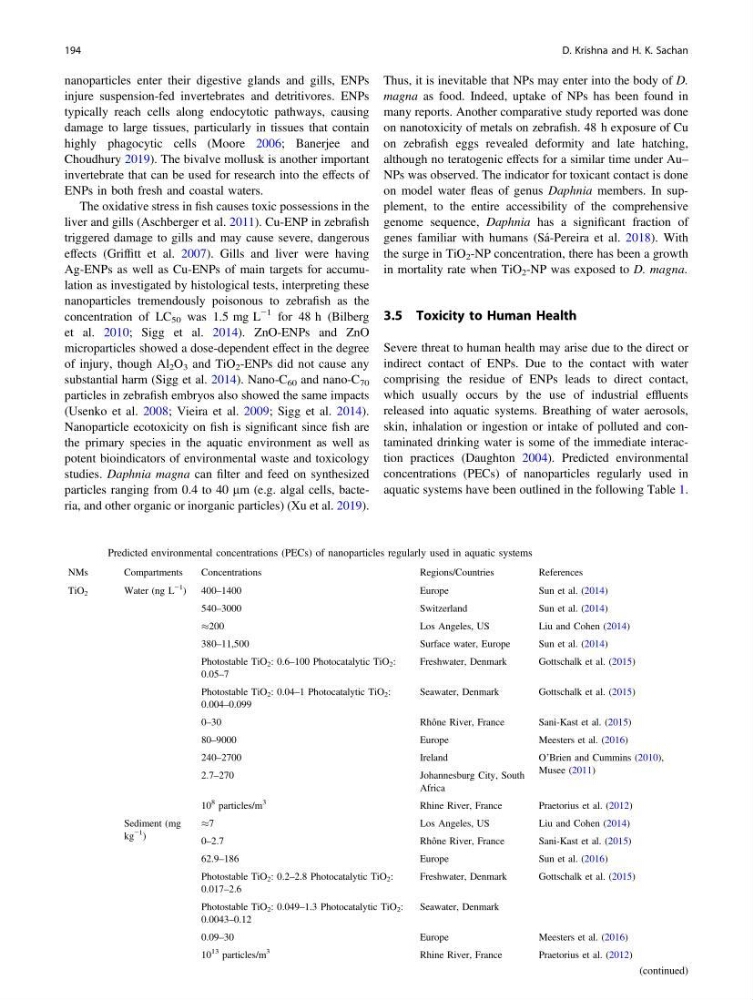
aquatic systems have been outlined in the following Table 1.
Table 1 Predicted environmental concentrations (PECs) of nanoparticles regularly used in aquatic systems
NMs
Compartments
Concentrations
Regions/Countries
References
TiO 2
Water (ng L
−1 ) 400–1400
Europe
Sun et al. (2014)
540–3000
Switzerland
Sun et al. (2014)
%200
Los Angeles, US
Liu and Cohen (2014)
380–11,500
Surface water, Europe
Sun et al. (2014)
Photostable TiO 2 : 0.6–100 Photocatalytic TiO 2 :
0.05–7
Freshwater, Denmark
Gottschalk et al. (2015)
Photostable TiO 2 : 0.04–1 Photocatalytic TiO 2 :
0.004–0.099
Seawater, Denmark
Gottschalk et al. (2015)
0–30
Rhône River, France
Sani-Kast et al. (2015)
80–9000
Europe
Meesters et al. (2016)
240–2700
Ireland
O’Brien and Cummins (2010),
Musee (2011)
2.7–270
Johannesburg City, South
Africa
10
8 particles/m
3
Rhine River, France
Praetorius et al. (2012)
Sediment (mg
kg
−1 )
%7
Los Angeles, US
Liu and Cohen (2014)
0–2.7
Rhône River, France
Sani-Kast et al. (2015)
62.9–186
Europe
Sun et al. (2016)
Photostable TiO 2 : 0.2–2.8 Photocatalytic TiO 2 :
0.017–2.6
Freshwater, Denmark
Gottschalk et al. (2015)
Photostable TiO 2 : 0.049–1.3 Photocatalytic TiO 2 :
0.0043–0.12
Seawater, Denmark
0.09–30
Europe
Meesters et al. (2016)
10
13 particles/m
3
Rhine River, France
Praetorius et al. (2012)
(continued)
194
D. Krishna and H. K. Sachan
injure suspension-fed invertebrates and detritivores. ENPs
typically reach cells along endocytotic pathways, causing
damage to large tissues, particularly in tissues that contain
highly phagocytic cells (Moore 2006; Banerjee and
Choudhury 2019). The bivalve mollusk is another important
invertebrate that can be used for research into the effects of
ENPs in both fresh and coastal waters.
The oxidative stress in fish causes toxic possessions in the
liver and gills (Aschberger et al. 2011). Cu-ENP in zebrafish
triggered damage to gills and may cause severe, dangerous
effects (Griffitt et al. 2007). Gills and liver were having
Ag-ENPs as well as Cu-ENPs of main targets for accumulation as investigated by histological tests, interpreting these
nanoparticles tremendously poisonous to zebrafish as the
concentration of LC 50 was 1.5 mg L
−1 for 48 h (Bilberg
et al. 2010; Sigg et al. 2014). ZnO-ENPs and ZnO
microparticles showed a dose-dependent effect in the degree
of injury, though Al 2 O 3 and TiO 2 -ENPs did not cause any
substantial harm (Sigg et al. 2014). Nano-C 60 and nano-C 70
particles in zebrafish embryos also showed the same impacts
(Usenko et al. 2008; Vieira et al. 2009; Sigg et al. 2014).
Nanoparticle ecotoxicity on fish is significant since fish are
the primary species in the aquatic environment as well as
potent bioindicators of environmental waste and toxicology
studies. Daphnia magna can filter and feed on synthesized
particles ranging from 0.4 to 40 lm (e.g. algal cells, bacteria, and other organic or inorganic particles) (Xu et al. 2019).
Thus, it is inevitable that NPs may enter into the body of D.
magna as food. Indeed, uptake of NPs has been found in
many reports. Another comparative study reported was done
on nanotoxicity of metals on zebrafish. 48 h exposure of Cu
on zebrafish eggs revealed deformity and late hatching,
although no teratogenic effects for a similar time under Au–
NPs was observed. The indicator for toxicant contact is done
on model water fleas of genus Daphnia members. In supplement, to the entire accessibility of the comprehensive
genome sequence, Daphnia has a significant fraction of
genes familiar with humans (Sá-Pereira et al. 2018). With
the surge in TiO 2 -NP concentration, there has been a growth
in mortality rate when TiO 2 -NP was exposed to D. magna.
3.5 Toxicity to Human Health
Severe threat to human health may arise due to the direct or
indirect contact of ENPs. Due to the contact with water
comprising the residue of ENPs leads to direct contact,
which usually occurs by the use of industrial effluents
released into aquatic systems. Breathing of water aerosols,
skin, inhalation or ingestion or intake of polluted and contaminated drinking water is some of the immediate interaction practices (Daughton 2004). Predicted environmental
concentrations (PECs) of nanoparticles regularly used in
aquatic systems have been outlined in the following Table 1.
Table 1 Predicted environmental concentrations (PECs) of nanoparticles regularly used in aquatic systems
NMs
Compartments
Concentrations
Regions/Countries
References
TiO 2
Water (ng L
−1 ) 400–1400
Europe
Sun et al. (2014)
540–3000
Switzerland
Sun et al. (2014)
%200
Los Angeles, US
Liu and Cohen (2014)
380–11,500
Surface water, Europe
Sun et al. (2014)
Photostable TiO 2 : 0.6–100 Photocatalytic TiO 2 :
0.05–7
Freshwater, Denmark
Gottschalk et al. (2015)
Photostable TiO 2 : 0.04–1 Photocatalytic TiO 2 :
0.004–0.099
Seawater, Denmark
Gottschalk et al. (2015)
0–30
Rhône River, France
Sani-Kast et al. (2015)
80–9000
Europe
Meesters et al. (2016)
240–2700
Ireland
O’Brien and Cummins (2010),
Musee (2011)
2.7–270
Johannesburg City, South
Africa
10
8 particles/m
3
Rhine River, France
Praetorius et al. (2012)
Sediment (mg
kg
−1 )
%7
Los Angeles, US
Liu and Cohen (2014)
0–2.7
Rhône River, France
Sani-Kast et al. (2015)
62.9–186
Europe
Sun et al. (2016)
Photostable TiO 2 : 0.2–2.8 Photocatalytic TiO 2 :
0.017–2.6
Freshwater, Denmark
Gottschalk et al. (2015)
Photostable TiO 2 : 0.049–1.3 Photocatalytic TiO 2 :
0.0043–0.12
Seawater, Denmark
0.09–30
Europe
Meesters et al. (2016)
10
13 particles/m
3
Rhine River, France
Praetorius et al. (2012)
(continued)
194
D. Krishna and H. K. Sachan