

intercellular space diffusion (Nowack and Bucheli 2007).
Another contaminant uptake pathway is through the food
chain, mostly via direct ingestion. The water fleas (Daphnia
magna) ingested and metabolized the lipid-coated nanotubes
present in the aquatic system as its normal feeding behaviour
(Roberts et al. 2007). Similarly, Bouldin et al. (2008)
reported the absorption of quantum dots in the water fleas
(Ceriodaphnia dubia) through dietary mechanism from an
algal food.
The toxicity of ENPs in aquatic animals is particulate
dependent and depends on how they penetrate the cells of
the organism (Singh et al. 2011). The technique of the
process of entry into the cell starts with their adhesion to the
pores of the cell membrane followed by their final entry into
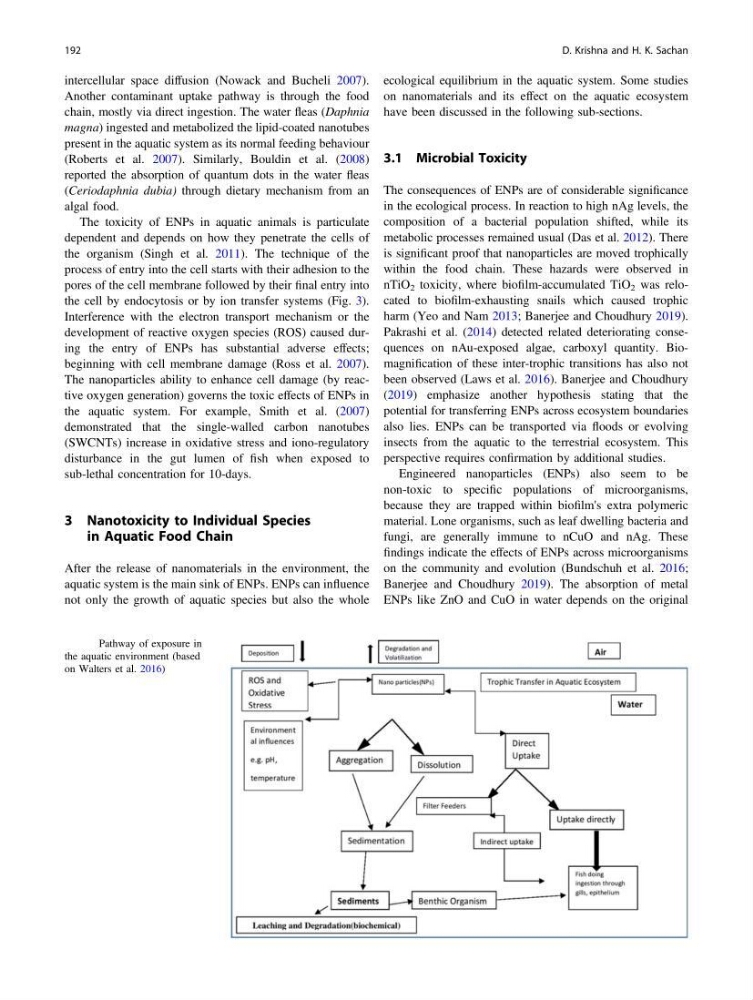
the cell by endocytosis or by ion transfer systems (Fig. 3).
Interference with the electron transport mechanism or the
development of reactive oxygen species (ROS) caused during the entry of ENPs has substantial adverse effects;
beginning with cell membrane damage (Ross et al. 2007).
The nanoparticles ability to enhance cell damage (by reactive oxygen generation) governs the toxic effects of ENPs in
the aquatic system. For example, Smith et al. (2007)
demonstrated that the single-walled carbon nanotubes
(SWCNTs) increase in oxidative stress and iono-regulatory
disturbance in the gut lumen of fish when exposed to
sub-lethal concentration for 10-days.
3 Nanotoxicity to Individual Species
in Aquatic Food Chain
After the release of nanomaterials in the environment, the
aquatic system is the main sink of ENPs. ENPs can influence
not only the growth of aquatic species but also the whole
ecological equilibrium in the aquatic system. Some studies
on nanomaterials and its effect on the aquatic ecosystem
have been discussed in the following sub-sections.
3.1 Microbial Toxicity
The consequences of ENPs are of considerable significance
in the ecological process. In reaction to high nAg levels, the
composition of a bacterial population shifted, while its
metabolic processes remained usual (Das et al. 2012). There
is significant proof that nanoparticles are moved trophically
within the food chain. These hazards were observed in
nTiO 2 toxicity, where biofilm-accumulated TiO 2 was relocated to biofilm-exhausting snails which caused trophic
harm (Yeo and Nam 2013; Banerjee and Choudhury 2019).
Pakrashi et al. (2014) detected related deteriorating consequences on nAu-exposed algae, carboxyl quantity. Biomagnification of these inter-trophic transitions has also not
been observed (Laws et al. 2016). Banerjee and Choudhury
(2019) emphasize another hypothesis stating that the
potential for transferring ENPs across ecosystem boundaries
also lies. ENPs can be transported via floods or evolving
insects from the aquatic to the terrestrial ecosystem. This
perspective requires confirmation by additional studies.
Engineered nanoparticles (ENPs) also seem to be
non-toxic to specific populations of microorganisms,
because they are trapped within biofilm's extra polymeric
material. Lone organisms, such as leaf dwelling bacteria and
fungi, are generally immune to nCuO and nAg. These
findings indicate the effects of ENPs across microorganisms
on the community and evolution (Bundschuh et al. 2016;
Banerjee and Choudhury 2019). The absorption of metal
ENPs like ZnO and CuO in water depends on the original
Fig. 3 Pathway of exposure in
the aquatic environment (based
on Walters et al. 2016)
192
D. Krishna and H. K. Sachan
Another contaminant uptake pathway is through the food
chain, mostly via direct ingestion. The water fleas (Daphnia
magna) ingested and metabolized the lipid-coated nanotubes
present in the aquatic system as its normal feeding behaviour
(Roberts et al. 2007). Similarly, Bouldin et al. (2008)
reported the absorption of quantum dots in the water fleas
(Ceriodaphnia dubia) through dietary mechanism from an
algal food.
The toxicity of ENPs in aquatic animals is particulate
dependent and depends on how they penetrate the cells of
the organism (Singh et al. 2011). The technique of the
process of entry into the cell starts with their adhesion to the
pores of the cell membrane followed by their final entry into
the cell by endocytosis or by ion transfer systems (Fig. 3).
Interference with the electron transport mechanism or the
development of reactive oxygen species (ROS) caused during the entry of ENPs has substantial adverse effects;
beginning with cell membrane damage (Ross et al. 2007).
The nanoparticles ability to enhance cell damage (by reactive oxygen generation) governs the toxic effects of ENPs in
the aquatic system. For example, Smith et al. (2007)
demonstrated that the single-walled carbon nanotubes
(SWCNTs) increase in oxidative stress and iono-regulatory
disturbance in the gut lumen of fish when exposed to
sub-lethal concentration for 10-days.
3 Nanotoxicity to Individual Species
in Aquatic Food Chain
After the release of nanomaterials in the environment, the
aquatic system is the main sink of ENPs. ENPs can influence
not only the growth of aquatic species but also the whole
ecological equilibrium in the aquatic system. Some studies
on nanomaterials and its effect on the aquatic ecosystem
have been discussed in the following sub-sections.
3.1 Microbial Toxicity
The consequences of ENPs are of considerable significance
in the ecological process. In reaction to high nAg levels, the
composition of a bacterial population shifted, while its
metabolic processes remained usual (Das et al. 2012). There
is significant proof that nanoparticles are moved trophically
within the food chain. These hazards were observed in
nTiO 2 toxicity, where biofilm-accumulated TiO 2 was relocated to biofilm-exhausting snails which caused trophic
harm (Yeo and Nam 2013; Banerjee and Choudhury 2019).
Pakrashi et al. (2014) detected related deteriorating consequences on nAu-exposed algae, carboxyl quantity. Biomagnification of these inter-trophic transitions has also not
been observed (Laws et al. 2016). Banerjee and Choudhury
(2019) emphasize another hypothesis stating that the
potential for transferring ENPs across ecosystem boundaries
also lies. ENPs can be transported via floods or evolving
insects from the aquatic to the terrestrial ecosystem. This
perspective requires confirmation by additional studies.
Engineered nanoparticles (ENPs) also seem to be
non-toxic to specific populations of microorganisms,
because they are trapped within biofilm's extra polymeric
material. Lone organisms, such as leaf dwelling bacteria and
fungi, are generally immune to nCuO and nAg. These
findings indicate the effects of ENPs across microorganisms
on the community and evolution (Bundschuh et al. 2016;
Banerjee and Choudhury 2019). The absorption of metal
ENPs like ZnO and CuO in water depends on the original
Fig. 3 Pathway of exposure in
the aquatic environment (based
on Walters et al. 2016)
192
D. Krishna and H. K. Sachan