

2018). In this chapter, we emphasize on the ecotoxicological
consequences of nanoparticles on the aquatic food chain,
especially aquatic ecosystems (in plants, marine invertebrates, and fish).
2 Nanotoxicology in the Aquatic Food Chain
Natural nanoparticles have existed in the atmosphere naturally since centuries while man-made NPs due to their
specific surface interactions and properties are related with
the design of ENPs providing them different physicochemical and toxicological characters in contrast to naturally occurring NPs (Handy et al. 2008). Nanotoxicology is a
modern and developing research field in toxicology on
nanomaterials (Walters et al. 2016; Bundschuh et al. 2018).
Evaluating toxicological assets of nanoparticles (NPs) to
know if it may pose a threat to the atmosphere or society and
its extent is covered in nanotoxicology studies. Nanoparticles toxicity is considered to have a significant impact on
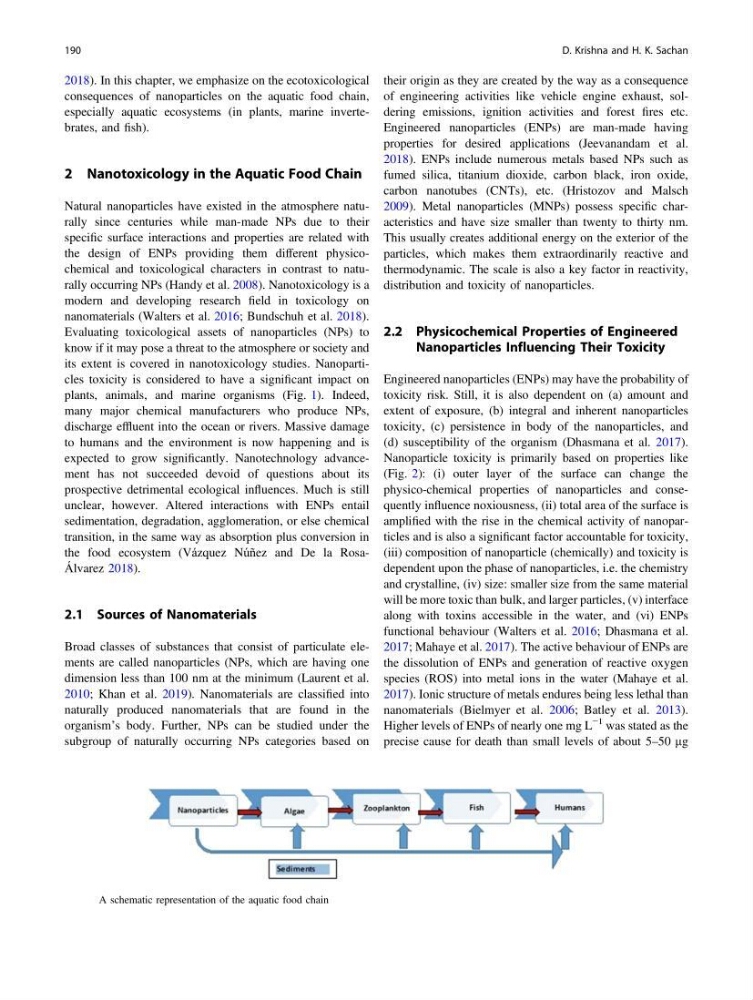
plants, animals, and marine organisms (Fig. 1). Indeed,
many major chemical manufacturers who produce NPs,
discharge effluent into the ocean or rivers. Massive damage
to humans and the environment is now happening and is
expected to grow significantly. Nanotechnology advancement has not succeeded devoid of questions about its
prospective detrimental ecological influences. Much is still
unclear, however. Altered interactions with ENPs entail
sedimentation, degradation, agglomeration, or else chemical
transition, in the same way as absorption plus conversion in
the food ecosystem (Vázquez Núñez and De la RosaÁlvarez 2018).
2.1 Sources of Nanomaterials
Broad classes of substances that consist of particulate elements are called nanoparticles (NPs, which are having one
dimension less than 100 nm at the minimum (Laurent et al.
2010; Khan et al. 2019). Nanomaterials are classified into
naturally produced nanomaterials that are found in the
organism’s body. Further, NPs can be studied under the
subgroup of naturally occurring NPs categories based on
their origin as they are created by the way as a consequence
of engineering activities like vehicle engine exhaust, soldering emissions, ignition activities and forest fires etc.
Engineered nanoparticles (ENPs) are man-made having
properties for desired applications (Jeevanandam et al.
2018). ENPs include numerous metals based NPs such as
fumed silica, titanium dioxide, carbon black, iron oxide,
carbon nanotubes (CNTs), etc. (Hristozov and Malsch
2009). Metal nanoparticles (MNPs) possess specific characteristics and have size smaller than twenty to thirty nm.
This usually creates additional energy on the exterior of the
particles, which makes them extraordinarily reactive and
thermodynamic. The scale is also a key factor in reactivity,
distribution and toxicity of nanoparticles.
2.2 Physicochemical Properties of Engineered
Nanoparticles Influencing Their Toxicity
Engineered nanoparticles (ENPs) may have the probability of
toxicity risk. Still, it is also dependent on (a) amount and
extent of exposure, (b) integral and inherent nanoparticles
toxicity, (c) persistence in body of the nanoparticles, and
(d) susceptibility of the organism (Dhasmana et al. 2017).
Nanoparticle toxicity is primarily based on properties like
(Fig. 2): (i) outer layer of the surface can change the
physico-chemical properties of nanoparticles and consequently influence noxiousness, (ii) total area of the surface is
amplified with the rise in the chemical activity of nanoparticles and is also a significant factor accountable for toxicity,
(iii) composition of nanoparticle (chemically) and toxicity is
dependent upon the phase of nanoparticles, i.e. the chemistry
and crystalline, (iv) size: smaller size from the same material
will be more toxic than bulk, and larger particles, (v) interface
along with toxins accessible in the water, and (vi) ENPs
functional behaviour (Walters et al. 2016; Dhasmana et al.
2017; Mahaye et al. 2017). The active behaviour of ENPs are
the dissolution of ENPs and generation of reactive oxygen
species (ROS) into metal ions in the water (Mahaye et al.
2017). Ionic structure of metals endures being less lethal than
nanomaterials (Bielmyer et al. 2006; Batley et al. 2013).
Higher levels of ENPs of nearly one mg L
−1 was stated as the
precise cause for death than small levels of about 5–50 lg
Fig. 1 A schematic representation of the aquatic food chain
190
D. Krishna and H. K. Sachan
consequences of nanoparticles on the aquatic food chain,
especially aquatic ecosystems (in plants, marine invertebrates, and fish).
2 Nanotoxicology in the Aquatic Food Chain
Natural nanoparticles have existed in the atmosphere naturally since centuries while man-made NPs due to their
specific surface interactions and properties are related with
the design of ENPs providing them different physicochemical and toxicological characters in contrast to naturally occurring NPs (Handy et al. 2008). Nanotoxicology is a
modern and developing research field in toxicology on
nanomaterials (Walters et al. 2016; Bundschuh et al. 2018).
Evaluating toxicological assets of nanoparticles (NPs) to
know if it may pose a threat to the atmosphere or society and
its extent is covered in nanotoxicology studies. Nanoparticles toxicity is considered to have a significant impact on
plants, animals, and marine organisms (Fig. 1). Indeed,
many major chemical manufacturers who produce NPs,
discharge effluent into the ocean or rivers. Massive damage
to humans and the environment is now happening and is
expected to grow significantly. Nanotechnology advancement has not succeeded devoid of questions about its
prospective detrimental ecological influences. Much is still
unclear, however. Altered interactions with ENPs entail
sedimentation, degradation, agglomeration, or else chemical
transition, in the same way as absorption plus conversion in
the food ecosystem (Vázquez Núñez and De la RosaÁlvarez 2018).
2.1 Sources of Nanomaterials
Broad classes of substances that consist of particulate elements are called nanoparticles (NPs, which are having one
dimension less than 100 nm at the minimum (Laurent et al.
2010; Khan et al. 2019). Nanomaterials are classified into
naturally produced nanomaterials that are found in the
organism’s body. Further, NPs can be studied under the
subgroup of naturally occurring NPs categories based on
their origin as they are created by the way as a consequence
of engineering activities like vehicle engine exhaust, soldering emissions, ignition activities and forest fires etc.
Engineered nanoparticles (ENPs) are man-made having
properties for desired applications (Jeevanandam et al.
2018). ENPs include numerous metals based NPs such as
fumed silica, titanium dioxide, carbon black, iron oxide,
carbon nanotubes (CNTs), etc. (Hristozov and Malsch
2009). Metal nanoparticles (MNPs) possess specific characteristics and have size smaller than twenty to thirty nm.
This usually creates additional energy on the exterior of the
particles, which makes them extraordinarily reactive and
thermodynamic. The scale is also a key factor in reactivity,
distribution and toxicity of nanoparticles.
2.2 Physicochemical Properties of Engineered
Nanoparticles Influencing Their Toxicity
Engineered nanoparticles (ENPs) may have the probability of
toxicity risk. Still, it is also dependent on (a) amount and
extent of exposure, (b) integral and inherent nanoparticles
toxicity, (c) persistence in body of the nanoparticles, and
(d) susceptibility of the organism (Dhasmana et al. 2017).
Nanoparticle toxicity is primarily based on properties like
(Fig. 2): (i) outer layer of the surface can change the
physico-chemical properties of nanoparticles and consequently influence noxiousness, (ii) total area of the surface is
amplified with the rise in the chemical activity of nanoparticles and is also a significant factor accountable for toxicity,
(iii) composition of nanoparticle (chemically) and toxicity is
dependent upon the phase of nanoparticles, i.e. the chemistry
and crystalline, (iv) size: smaller size from the same material
will be more toxic than bulk, and larger particles, (v) interface
along with toxins accessible in the water, and (vi) ENPs
functional behaviour (Walters et al. 2016; Dhasmana et al.
2017; Mahaye et al. 2017). The active behaviour of ENPs are
the dissolution of ENPs and generation of reactive oxygen
species (ROS) into metal ions in the water (Mahaye et al.
2017). Ionic structure of metals endures being less lethal than
nanomaterials (Bielmyer et al. 2006; Batley et al. 2013).
Higher levels of ENPs of nearly one mg L
−1 was stated as the
precise cause for death than small levels of about 5–50 lg
Fig. 1 A schematic representation of the aquatic food chain
190
D. Krishna and H. K. Sachan