

they concluded that the fungicides affected target fungi in the
variable ways such as affecting the synthesis of lipids, sterols
and other components of membrane, amino acids and protein
synthesis, respiration, signal transduction, cell division, and
mitosis, multisite fungicidal activity, etc. (Yang et al. 2011).
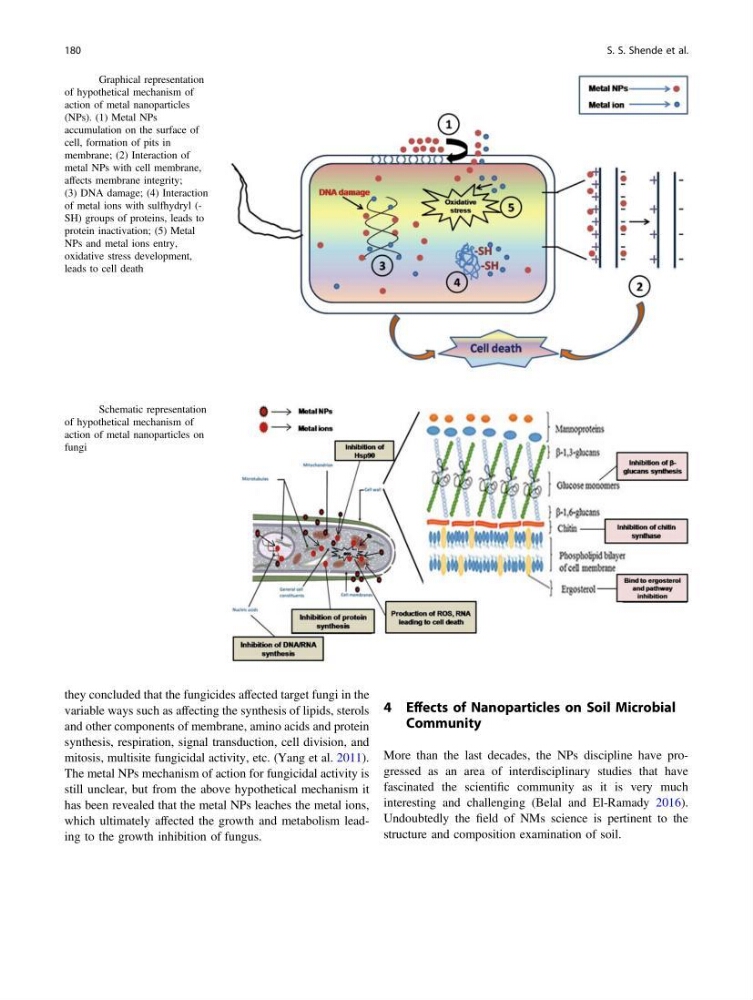
The metal NPs mechanism of action for fungicidal activity is
still unclear, but from the above hypothetical mechanism it
has been revealed that the metal NPs leaches the metal ions,
which ultimately affected the growth and metabolism leading to the growth inhibition of fungus.
4 Effects of Nanoparticles on Soil Microbial
Community
More than the last decades, the NPs discipline have progressed as an area of interdisciplinary studies that have
fascinated the scientific community as it is very much
interesting and challenging (Belal and El-Ramady 2016).
Undoubtedly the field of NMs science is pertinent to the
structure and composition examination of soil.
Fig. 1 Graphical representation
of hypothetical mechanism of
action of metal nanoparticles
(NPs). (1) Metal NPs
accumulation on the surface of
cell, formation of pits in
membrane; (2) Interaction of
metal NPs with cell membrane,
affects membrane integrity;
(3) DNA damage; (4) Interaction
of metal ions with sulfhydryl (SH) groups of proteins, leads to
protein inactivation; (5) Metal
NPs and metal ions entry,
oxidative stress development,
leads to cell death
Fig. 2 Schematic representation
of hypothetical mechanism of
action of metal nanoparticles on
fungi
180
S. S. Shende et al.
variable ways such as affecting the synthesis of lipids, sterols
and other components of membrane, amino acids and protein
synthesis, respiration, signal transduction, cell division, and
mitosis, multisite fungicidal activity, etc. (Yang et al. 2011).
The metal NPs mechanism of action for fungicidal activity is
still unclear, but from the above hypothetical mechanism it
has been revealed that the metal NPs leaches the metal ions,
which ultimately affected the growth and metabolism leading to the growth inhibition of fungus.
4 Effects of Nanoparticles on Soil Microbial
Community
More than the last decades, the NPs discipline have progressed as an area of interdisciplinary studies that have
fascinated the scientific community as it is very much
interesting and challenging (Belal and El-Ramady 2016).
Undoubtedly the field of NMs science is pertinent to the
structure and composition examination of soil.
Fig. 1 Graphical representation
of hypothetical mechanism of
action of metal nanoparticles
(NPs). (1) Metal NPs
accumulation on the surface of
cell, formation of pits in
membrane; (2) Interaction of
metal NPs with cell membrane,
affects membrane integrity;
(3) DNA damage; (4) Interaction
of metal ions with sulfhydryl (SH) groups of proteins, leads to
protein inactivation; (5) Metal
NPs and metal ions entry,
oxidative stress development,
leads to cell death
Fig. 2 Schematic representation
of hypothetical mechanism of
action of metal nanoparticles on
fungi
180
S. S. Shende et al.