

Slow release fertilizers have less control in releasing of
nutrient. Factors such as soil moisture, temperature, and pH
affect the releasing ability. In the case of controlled release
fertilizers, soil temperature only affects the nutrients release
(Haifa Group 2020).
6.2 Synthetic Polymer Coating
Polymer coated fertilizers are suitable for high-value applications because it reduces the nutrient loss. In Japan, for rice
plant more than 70% of polymer coated fertilizers are used
(out of total fertilizers utilizations). These fertilizers offer
more sophisticated nitrogen release pattern. The nutrient
release is controlled by diffusion which is constant over
time. Also, it depends on the coating thickness, chemical
constituents, temperature, and moisture. Controlled release
fertilizers release nutrients at a rate driven by temperature
and moisture of the root zone. Nutricot, osmocot, and polyon
are some of the marketed products. The coatings of these
commercial products are tough, resist to damage, and thin
(Naik et al. 2017). Subbarao et al. (2013) have mentioned in
their report about the preparation of slow release fertilizer. In
this method, potash and wet clay are mixed together. Then,
the mixture is made as pellets by casting in cylindrical
molds. Finally, these pellets are coated with polyacrylamide
to achieve slow release of potash fertilizer (Subbarao et al.
2013). Polyacrylamide is a water-soluble polymer. Damaging of this polymer plays a major role in the releasing of
potash. The hydrophilic nature of this polymer leads to the
damage.
Slow release nanocomposite nitrogen fertilizers are prepared with polyacrylamide hydrogel or polycaprolactone
(less than 4% by weight) with a high nutrient load (75% by
weight). For this preparation, plastic mixture extrusion
method is adopted. This preparation can be scaled up for
large-scale granule production without additional or
increasing costs (Pereira et al. 2015). For the controlled
release of urea fertilizers, urea is coated with sulfur. In the
next step, the coated granule is sealed by polymer coating.
The coating can be degraded by microbial, chemical, and
physical processes. The releasing time of the fertilizer is
decided by the thickness of coating and permeability. These
factors can be affected by temperature and moisture (Trenkel
2010). This technology is applicable in high-value crops,
environmentally sensitive areas, and fields highly susceptible
to N losses (Pioneer.com. 2020).
Sulfur can be sprayed in molten form over urea granules.
Then, sealant wax is applied over this to close any cracks or
imperfections present in the coating. Other polymers used in
sulfur coating include resin-based polymers, polyesters, and
low-permeability polyethylene polymers for controlled
release of fertilizers. Figure 9a shows the sulfur sprayed urea
granules and chemical structure of urea. Figure 9b explains
the urea release from sulfur and polymer coated urea. The
nutrient releasing mechanism (caused by the damaging of
the outer coating) is also explained. Pioneer (2020) reported
that addition of aldehydes with urea reduces the solubility of
urea (Pioneer.com. 2020). Aldehydes are mixed with urea to
prepare the products such as urea–formaldehyde and
methylene urea. Clapp (2001) has reported that the reaction
of aldehyde and ammonia or primary amine of excess urea
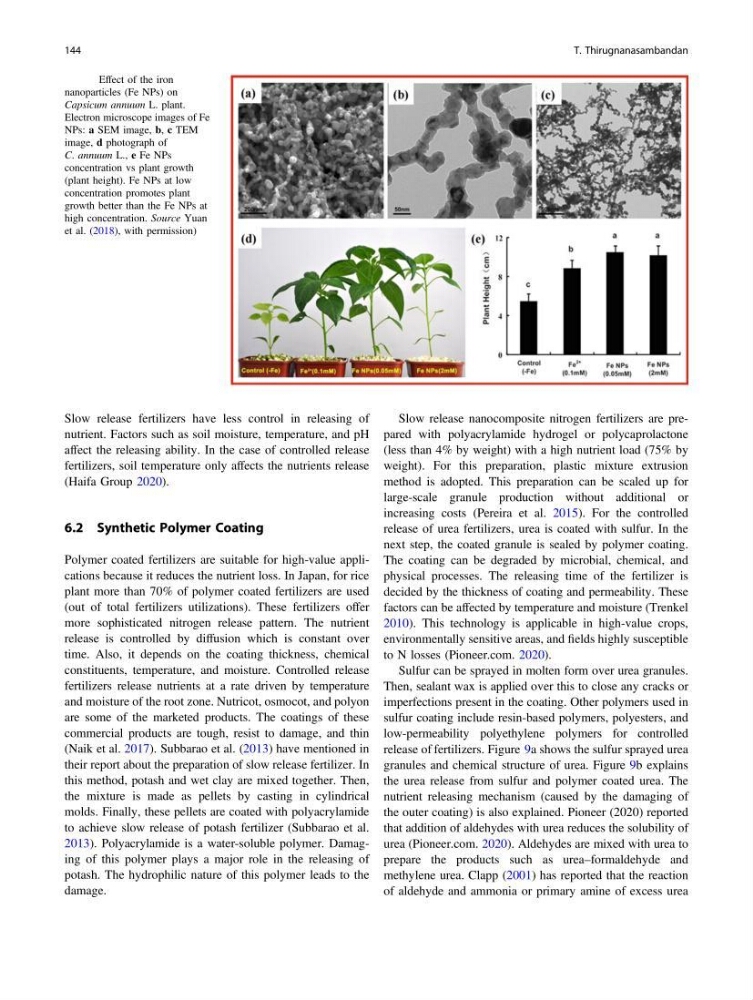
Fig. 8 Effect of the iron
nanoparticles (Fe NPs) on
Capsicum annuum L. plant.
Electron microscope images of Fe
NPs: a SEM image, b, c TEM
image, d photograph of
C. annuum L., e Fe NPs
concentration vs plant growth
(plant height). Fe NPs at low
concentration promotes plant
growth better than the Fe NPs at
high concentration. Source Yuan
et al. (2018), with permission)
144
T. Thirugnanasambandan
nutrient. Factors such as soil moisture, temperature, and pH
affect the releasing ability. In the case of controlled release
fertilizers, soil temperature only affects the nutrients release
(Haifa Group 2020).
6.2 Synthetic Polymer Coating
Polymer coated fertilizers are suitable for high-value applications because it reduces the nutrient loss. In Japan, for rice
plant more than 70% of polymer coated fertilizers are used
(out of total fertilizers utilizations). These fertilizers offer
more sophisticated nitrogen release pattern. The nutrient
release is controlled by diffusion which is constant over
time. Also, it depends on the coating thickness, chemical
constituents, temperature, and moisture. Controlled release
fertilizers release nutrients at a rate driven by temperature
and moisture of the root zone. Nutricot, osmocot, and polyon
are some of the marketed products. The coatings of these
commercial products are tough, resist to damage, and thin
(Naik et al. 2017). Subbarao et al. (2013) have mentioned in
their report about the preparation of slow release fertilizer. In
this method, potash and wet clay are mixed together. Then,
the mixture is made as pellets by casting in cylindrical
molds. Finally, these pellets are coated with polyacrylamide
to achieve slow release of potash fertilizer (Subbarao et al.
2013). Polyacrylamide is a water-soluble polymer. Damaging of this polymer plays a major role in the releasing of
potash. The hydrophilic nature of this polymer leads to the
damage.
Slow release nanocomposite nitrogen fertilizers are prepared with polyacrylamide hydrogel or polycaprolactone
(less than 4% by weight) with a high nutrient load (75% by
weight). For this preparation, plastic mixture extrusion
method is adopted. This preparation can be scaled up for
large-scale granule production without additional or
increasing costs (Pereira et al. 2015). For the controlled
release of urea fertilizers, urea is coated with sulfur. In the
next step, the coated granule is sealed by polymer coating.
The coating can be degraded by microbial, chemical, and
physical processes. The releasing time of the fertilizer is
decided by the thickness of coating and permeability. These
factors can be affected by temperature and moisture (Trenkel
2010). This technology is applicable in high-value crops,
environmentally sensitive areas, and fields highly susceptible
to N losses (Pioneer.com. 2020).
Sulfur can be sprayed in molten form over urea granules.
Then, sealant wax is applied over this to close any cracks or
imperfections present in the coating. Other polymers used in
sulfur coating include resin-based polymers, polyesters, and
low-permeability polyethylene polymers for controlled
release of fertilizers. Figure 9a shows the sulfur sprayed urea
granules and chemical structure of urea. Figure 9b explains
the urea release from sulfur and polymer coated urea. The
nutrient releasing mechanism (caused by the damaging of
the outer coating) is also explained. Pioneer (2020) reported
that addition of aldehydes with urea reduces the solubility of
urea (Pioneer.com. 2020). Aldehydes are mixed with urea to
prepare the products such as urea–formaldehyde and
methylene urea. Clapp (2001) has reported that the reaction
of aldehyde and ammonia or primary amine of excess urea
Fig. 8 Effect of the iron
nanoparticles (Fe NPs) on
Capsicum annuum L. plant.
Electron microscope images of Fe
NPs: a SEM image, b, c TEM
image, d photograph of
C. annuum L., e Fe NPs
concentration vs plant growth
(plant height). Fe NPs at low
concentration promotes plant
growth better than the Fe NPs at
high concentration. Source Yuan
et al. (2018), with permission)
144
T. Thirugnanasambandan