

et al. (2017), HA NPs can be applied as phosphorous fertilizers. They can also supply calcium in addition to phosphorous. In wet soil, urea breaks down quickly and the
formation of ammonia occurs. The ammonia enters the
atmosphere as nitrogen dioxide which is the main greenhouse gas associated with agriculture. This decomposition
limits the application of more urea as fertilizer. To avoid the
breakdown of urea, slow releasing of urea is done. For this
purpose, urea is coated with HA NPs. The HA NPs coated
urea release the nitrogen slowly, i.e., 12 times slower than
urea without HA NPs coating (Kottegoda et al. 2017). The
slow release of phosphorous helps plants to take up the
nutrient continuously as they grow. Slow release of phosphorous can be achieved with the help of HA NPs. Application of chemical fertilizers results in soil acidification.
Hence, the cost of reversing soil pH to optimal is also
extremely high. The advantage of HA NPs is that it does not
change soil pH when phosphorous is released. When plants
grow, different types of organic acids like oxalic acid and
citric acid are released. They dissolve the HA NPs which
makes the phosphorous availability to the plants (Phys.org.
2015).
Soluble phosphate salts cause surface water eutrophication. Solid phosphates supply low level nutrient P. Synthetic
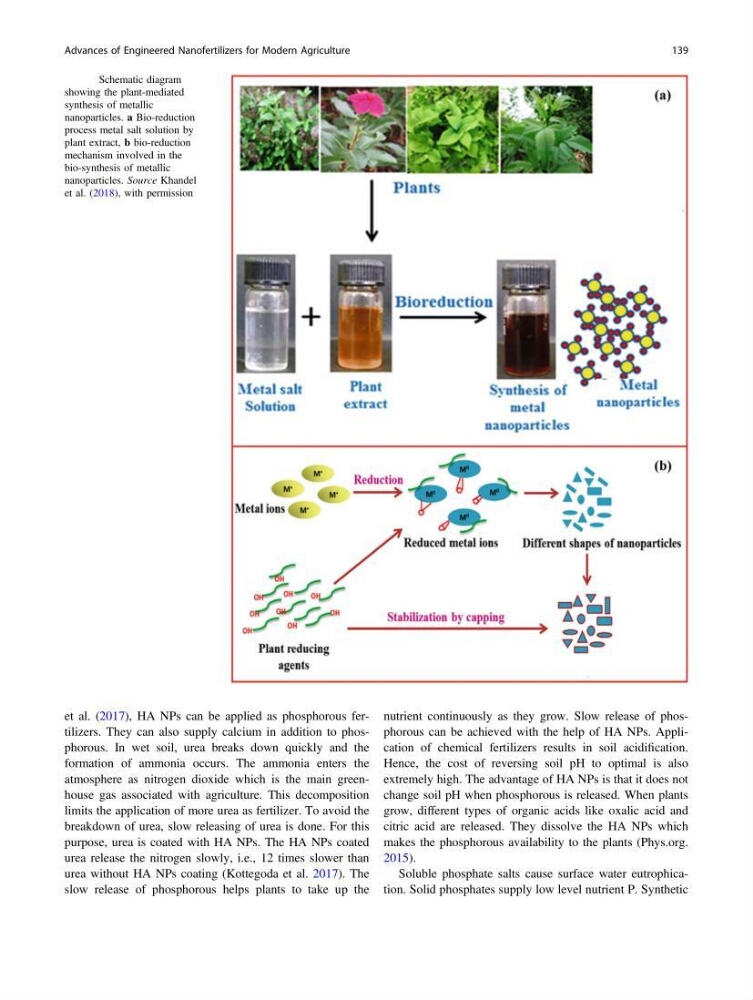
Fig. 5 Schematic diagram
showing the plant-mediated
synthesis of metallic
nanoparticles. a Bio-reduction
process metal salt solution by
plant extract, b bio-reduction
mechanism involved in the
bio-synthesis of metallic
nanoparticles. Source Khandel
et al. (2018), with permission
Advances of Engineered Nanofertilizers for Modern Agriculture
139
formation of ammonia occurs. The ammonia enters the
atmosphere as nitrogen dioxide which is the main greenhouse gas associated with agriculture. This decomposition
limits the application of more urea as fertilizer. To avoid the
breakdown of urea, slow releasing of urea is done. For this
purpose, urea is coated with HA NPs. The HA NPs coated
urea release the nitrogen slowly, i.e., 12 times slower than
urea without HA NPs coating (Kottegoda et al. 2017). The
slow release of phosphorous helps plants to take up the
nutrient continuously as they grow. Slow release of phosphorous can be achieved with the help of HA NPs. Application of chemical fertilizers results in soil acidification.
Hence, the cost of reversing soil pH to optimal is also
extremely high. The advantage of HA NPs is that it does not
change soil pH when phosphorous is released. When plants
grow, different types of organic acids like oxalic acid and
citric acid are released. They dissolve the HA NPs which
makes the phosphorous availability to the plants (Phys.org.
2015).
Soluble phosphate salts cause surface water eutrophication. Solid phosphates supply low level nutrient P. Synthetic
Fig. 5 Schematic diagram
showing the plant-mediated
synthesis of metallic
nanoparticles. a Bio-reduction
process metal salt solution by
plant extract, b bio-reduction
mechanism involved in the
bio-synthesis of metallic
nanoparticles. Source Khandel
et al. (2018), with permission
Advances of Engineered Nanofertilizers for Modern Agriculture
139