

leaching, evaporation, and degradation) that ultimately
makes loss (Mia et al. 2015; Wang et al. 2015; Yang et al.
2016). In the case of nitrogenous nanofertilizers, the release
of fertilizer-N is regulated by nanoformulations. It reduces
the nutrient loss by improving the interaction of nutrients
with crops and avoiding the interaction of nutrients with
soils, microorganisms, water, and air (Dwivedi et al. 2016;
Panpatte et al. 2016).
Nanofertilizers improve crop growth/yield, nutrient utilization; reduce expenditures of fertilizer and cultivation.
Optimum quantity supply of nanofertilizers enhances crop
growth but beyond that level decreases the crop growth (due
to the toxicity of nutrient). ZnO nanofertilizer enhances the
seed germination and plant growth considerably (Singh et al.
2017). Applying the nano-formulated or nano-entrapped
micronutrients as slow or controlled release fertilizers will
improve the soil health and uptake by plants. It ultimately
enhances the growth and productivity of crops (Peteu et al.
2010). Nanomaterials (like magnesium hydroxide) are utilized for the early germination of seeds. They break the seed
dormancy and they may increase the chlorophyll content of
the plants. Overall, nanomaterials treatment of the seeds
enhances the germination percentage and plant growth as
well. Hence, these nanoparticles can be utilized as the efficient nano-nutrients for the plant growth promotion (Shinde
et al. 2020). Carbon nanomaterials, ZnO nanoparticles, and
iron oxide nanomaterials are applied as pre-soaking and seed
germination technology. For these kinds of applications,
bio-synthesized nanomaterials are the suitable material
instead of chemically synthesized nanomaterials.
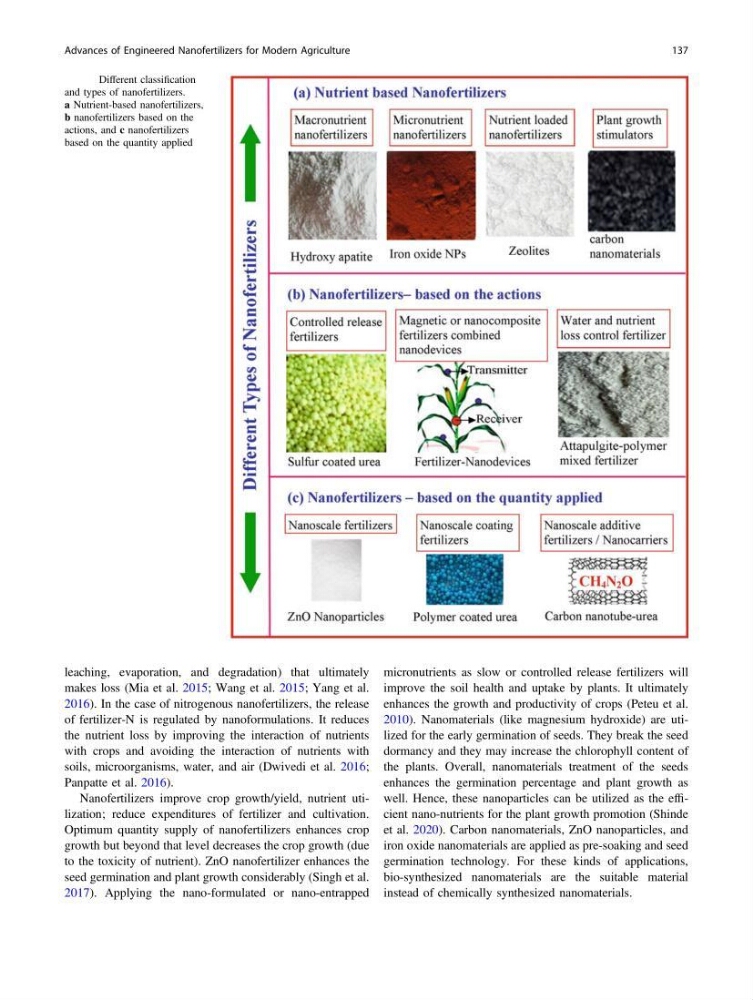
Fig. 3 Different classification
and types of nanofertilizers.
a Nutrient-based nanofertilizers,
b nanofertilizers based on the
actions, and c nanofertilizers
based on the quantity applied
Advances of Engineered Nanofertilizers for Modern Agriculture
137
makes loss (Mia et al. 2015; Wang et al. 2015; Yang et al.
2016). In the case of nitrogenous nanofertilizers, the release
of fertilizer-N is regulated by nanoformulations. It reduces
the nutrient loss by improving the interaction of nutrients
with crops and avoiding the interaction of nutrients with
soils, microorganisms, water, and air (Dwivedi et al. 2016;
Panpatte et al. 2016).
Nanofertilizers improve crop growth/yield, nutrient utilization; reduce expenditures of fertilizer and cultivation.
Optimum quantity supply of nanofertilizers enhances crop
growth but beyond that level decreases the crop growth (due
to the toxicity of nutrient). ZnO nanofertilizer enhances the
seed germination and plant growth considerably (Singh et al.
2017). Applying the nano-formulated or nano-entrapped
micronutrients as slow or controlled release fertilizers will
improve the soil health and uptake by plants. It ultimately
enhances the growth and productivity of crops (Peteu et al.
2010). Nanomaterials (like magnesium hydroxide) are utilized for the early germination of seeds. They break the seed
dormancy and they may increase the chlorophyll content of
the plants. Overall, nanomaterials treatment of the seeds
enhances the germination percentage and plant growth as
well. Hence, these nanoparticles can be utilized as the efficient nano-nutrients for the plant growth promotion (Shinde
et al. 2020). Carbon nanomaterials, ZnO nanoparticles, and
iron oxide nanomaterials are applied as pre-soaking and seed
germination technology. For these kinds of applications,
bio-synthesized nanomaterials are the suitable material
instead of chemically synthesized nanomaterials.
Fig. 3 Different classification
and types of nanofertilizers.
a Nutrient-based nanofertilizers,
b nanofertilizers based on the
actions, and c nanofertilizers
based on the quantity applied
Advances of Engineered Nanofertilizers for Modern Agriculture
137