

intramolecular fashion. In 2005 the total synthesis of (þ)-crocacin D was described
based on an intermolecular copper-catalyzed N-vinylation, which provided efficiently the challenging (Z)-enamide moiety (Scheme 46) [140]. The use of both
Buchwald’s and Ma’s conditions led to similar results.
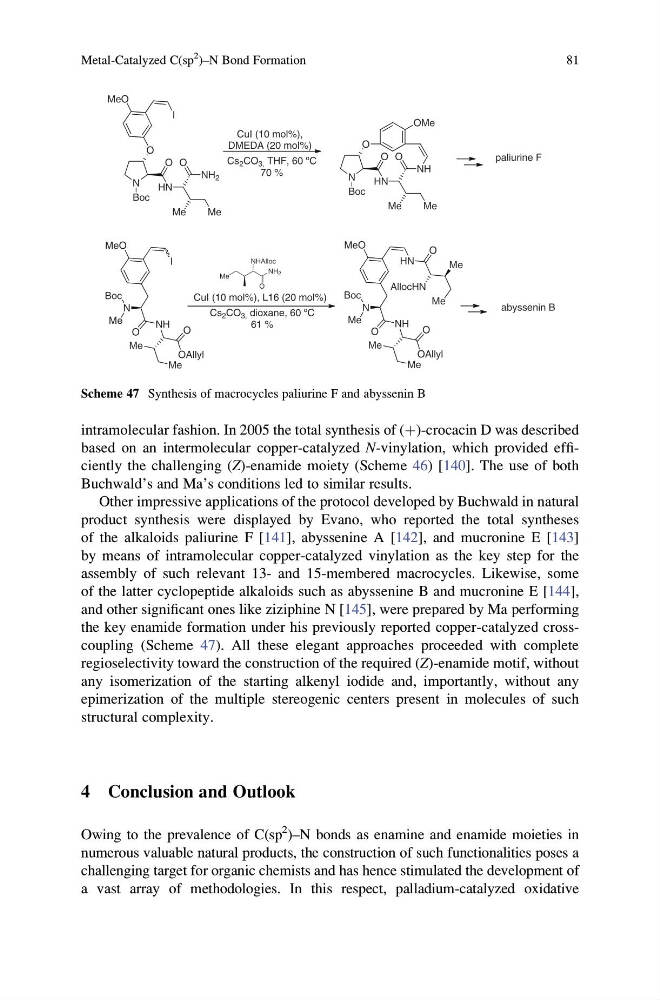
Other impressive applications of the protocol developed by Buchwald in natural
product synthesis were displayed by Evano, who reported the total syntheses
of the alkaloids paliurine F [141], abyssenine A [142], and mucronine E [143]
by means of intramolecular copper-catalyzed vinylation as the key step for the
assembly of such relevant 13- and 15-membered macrocycles. Likewise, some
of the latter cyclopeptide alkaloids such as abyssenine B and mucronine E [144],
and other significant ones like ziziphine N [145], were prepared by Ma performing
the key enamide formation under his previously reported copper-catalyzed crosscoupling (Scheme 47). All these elegant approaches proceeded with complete
regioselectivity toward the construction of the required (Z)-enamide motif, without
any isomerization of the starting alkenyl iodide and, importantly, without any
epimerization of the multiple stereogenic centers present in molecules of such
structural complexity.
4 Conclusion and Outlook
Owing to the prevalence of C(sp
2
)–N bonds as enamine and enamide moieties in
numerous valuable natural products, the construction of such functionalities poses a
challenging target for organic chemists and has hence stimulated the development of
a vast array of methodologies. In this respect, palladium-catalyzed oxidative
HN
NH
O
N
OMe
Boc
O O
Me
Me
HN
NH 2
O
N
Boc
O O
Me
Me
I
MeO
CuI (10 mol%),
DMEDA (20 mol%)
Cs 2 CO 3, THF, 60 ºC
70 %
paliurine F
CuI (10 mol%), L16 (20 mol%)
Cs 2 CO 3, dioxane, 60 ºC
61 %
abyssenin B
N
I
MeO
Boc
Me
NH O
O
Me
Me
OAllyl
Me
NH 2
O
NHAlloc
N
MeO
Boc
Me
NH O
O
Me
Me
OAllyl
HN
O
AllocHN
Me
Me
Scheme 47 Synthesis of macrocycles paliurine F and abyssenin B
Metal-Catalyzed C(sp
2
)–N Bond Formation
81
based on an intermolecular copper-catalyzed N-vinylation, which provided efficiently the challenging (Z)-enamide moiety (Scheme 46) [140]. The use of both
Buchwald’s and Ma’s conditions led to similar results.
Other impressive applications of the protocol developed by Buchwald in natural
product synthesis were displayed by Evano, who reported the total syntheses
of the alkaloids paliurine F [141], abyssenine A [142], and mucronine E [143]
by means of intramolecular copper-catalyzed vinylation as the key step for the
assembly of such relevant 13- and 15-membered macrocycles. Likewise, some
of the latter cyclopeptide alkaloids such as abyssenine B and mucronine E [144],
and other significant ones like ziziphine N [145], were prepared by Ma performing
the key enamide formation under his previously reported copper-catalyzed crosscoupling (Scheme 47). All these elegant approaches proceeded with complete
regioselectivity toward the construction of the required (Z)-enamide motif, without
any isomerization of the starting alkenyl iodide and, importantly, without any
epimerization of the multiple stereogenic centers present in molecules of such
structural complexity.
4 Conclusion and Outlook
Owing to the prevalence of C(sp
2
)–N bonds as enamine and enamide moieties in
numerous valuable natural products, the construction of such functionalities poses a
challenging target for organic chemists and has hence stimulated the development of
a vast array of methodologies. In this respect, palladium-catalyzed oxidative
HN
NH
O
N
OMe
Boc
O O
Me
Me
HN
NH 2
O
N
Boc
O O
Me
Me
I
MeO
CuI (10 mol%),
DMEDA (20 mol%)
Cs 2 CO 3, THF, 60 ºC
70 %
paliurine F
CuI (10 mol%), L16 (20 mol%)
Cs 2 CO 3, dioxane, 60 ºC
61 %
abyssenin B
N
I
MeO
Boc
Me
NH O
O
Me
Me
OAllyl
Me
NH 2
O
NHAlloc
N
MeO
Boc
Me
NH O
O
Me
Me
OAllyl
HN
O
AllocHN
Me
Me
Scheme 47 Synthesis of macrocycles paliurine F and abyssenin B
Metal-Catalyzed C(sp
2
)–N Bond Formation
81