

Porco employed his methodology in the preparation of the salicylate antitumor
macrolides lobatamide C [136, 137] and Oximidine II (Scheme 44) [138]. In both
cases, re-optimization of the reaction conditions was required, and it was observed
that the addition of a stoichiometric amount of diamine ligand (1,10-phenanthroline
and DMEDA) was essential for the process to occur. It is noteworthy that when
starting from a Z-vinyl iodide (synthesis of oximidine II) the amidation proceeded
stereoselectively. Conversely, when starting from a E-vinyl iodide (synthesis of
lobatamide C) a mixture of enamide isomers was obtained.
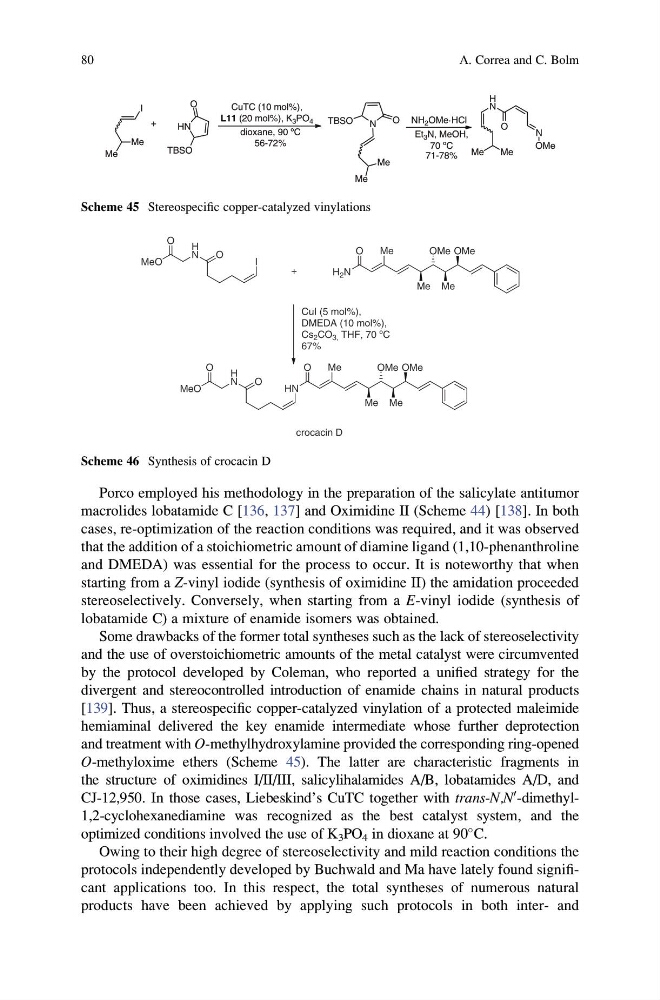
Some drawbacks of the former total syntheses such as the lack of stereoselectivity
and the use of overstoichiometric amounts of the metal catalyst were circumvented
by the protocol developed by Coleman, who reported a unified strategy for the
divergent and stereocontrolled introduction of enamide chains in natural products
[139]. Thus, a stereospecific copper-catalyzed vinylation of a protected maleimide
hemiaminal delivered the key enamide intermediate whose further deprotection
and treatment with O-methylhydroxylamine provided the corresponding ring-opened
O-methyloxime ethers (Scheme 45). The latter are characteristic fragments in
the structure of oximidines I/II/III, salicylihalamides A/B, lobatamides A/D, and
CJ-12,950. In those cases, Liebeskind’s CuTC together with trans-N,N
0 -dimethyl1,2-cyclohexanediamine was recognized as the best catalyst system, and the
optimized conditions involved the use of K 3 PO 4 in dioxane at 90
C.
Owing to their high degree of stereoselectivity and mild reaction conditions the
protocols independently developed by Buchwald and Ma have lately found significant applications too. In this respect, the total syntheses of numerous natural
products have been achieved by applying such protocols in both inter- and
I
HN
O
TBSO
+
CuTC (10 mol%),
L11 (20 mol%), K 3 PO 4
dioxane, 90 ºC
56-72%
N
O
TBSO
Me
Me
Me
Me
Me
H
N
Me
O
N
Et 3 N, MeOH,
70 ºC
71-78%
OMe
NH 2 OMe·HCl
Scheme 45 Stereospecific copper-catalyzed vinylations
MeO
H
N
O
O
I
H 2 N
O
Me Me
OMe
OMe
Me
+
HN
O
Me Me
OMe
OMe
Me
H
N
O
MeO
O
CuI (5 mol%),
DMEDA (10 mol%),
Cs 2 CO 3, THF, 70 ºC
67%
crocacin D
Scheme 46 Synthesis of crocacin D
80
A. Correa and C. Bolm
macrolides lobatamide C [136, 137] and Oximidine II (Scheme 44) [138]. In both
cases, re-optimization of the reaction conditions was required, and it was observed
that the addition of a stoichiometric amount of diamine ligand (1,10-phenanthroline
and DMEDA) was essential for the process to occur. It is noteworthy that when
starting from a Z-vinyl iodide (synthesis of oximidine II) the amidation proceeded
stereoselectively. Conversely, when starting from a E-vinyl iodide (synthesis of
lobatamide C) a mixture of enamide isomers was obtained.
Some drawbacks of the former total syntheses such as the lack of stereoselectivity
and the use of overstoichiometric amounts of the metal catalyst were circumvented
by the protocol developed by Coleman, who reported a unified strategy for the
divergent and stereocontrolled introduction of enamide chains in natural products
[139]. Thus, a stereospecific copper-catalyzed vinylation of a protected maleimide
hemiaminal delivered the key enamide intermediate whose further deprotection
and treatment with O-methylhydroxylamine provided the corresponding ring-opened
O-methyloxime ethers (Scheme 45). The latter are characteristic fragments in
the structure of oximidines I/II/III, salicylihalamides A/B, lobatamides A/D, and
CJ-12,950. In those cases, Liebeskind’s CuTC together with trans-N,N
0 -dimethyl1,2-cyclohexanediamine was recognized as the best catalyst system, and the
optimized conditions involved the use of K 3 PO 4 in dioxane at 90
C.
Owing to their high degree of stereoselectivity and mild reaction conditions the
protocols independently developed by Buchwald and Ma have lately found significant applications too. In this respect, the total syntheses of numerous natural
products have been achieved by applying such protocols in both inter- and
I
HN
O
TBSO
+
CuTC (10 mol%),
L11 (20 mol%), K 3 PO 4
dioxane, 90 ºC
56-72%
N
O
TBSO
Me
Me
Me
Me
Me
H
N
Me
O
N
Et 3 N, MeOH,
70 ºC
71-78%
OMe
NH 2 OMe·HCl
Scheme 45 Stereospecific copper-catalyzed vinylations
MeO
H
N
O
O
I
H 2 N
O
Me Me
OMe
OMe
Me
+
HN
O
Me Me
OMe
OMe
Me
H
N
O
MeO
O
CuI (5 mol%),
DMEDA (10 mol%),
Cs 2 CO 3, THF, 70 ºC
67%
crocacin D
Scheme 46 Synthesis of crocacin D
80
A. Correa and C. Bolm