

importance owing to their application as chiral ligands in the field of asymmetric
catalysis [74]. They found that the methodology introduced by Buchwald and
Hartwig for the N-arylation of amines and amides was suitable for the vinylation of
these appealing substrates affording hence previously unknown N-vinyl
sulfoximines. Thus, a mixture of Pd(OAc) 2 and BINAP in the presence of NaO-tBu proved highly efficient for the coupling of sulfoximine derivatives and vinyl
bromides. Interestingly, a vinyl triflate was also utilized in such cross-coupling. In
that case the replacement of the strong base by the weaker one Cs 2 CO 3 was required
in order to avoid the hydrolysis of the vinylic substrate.
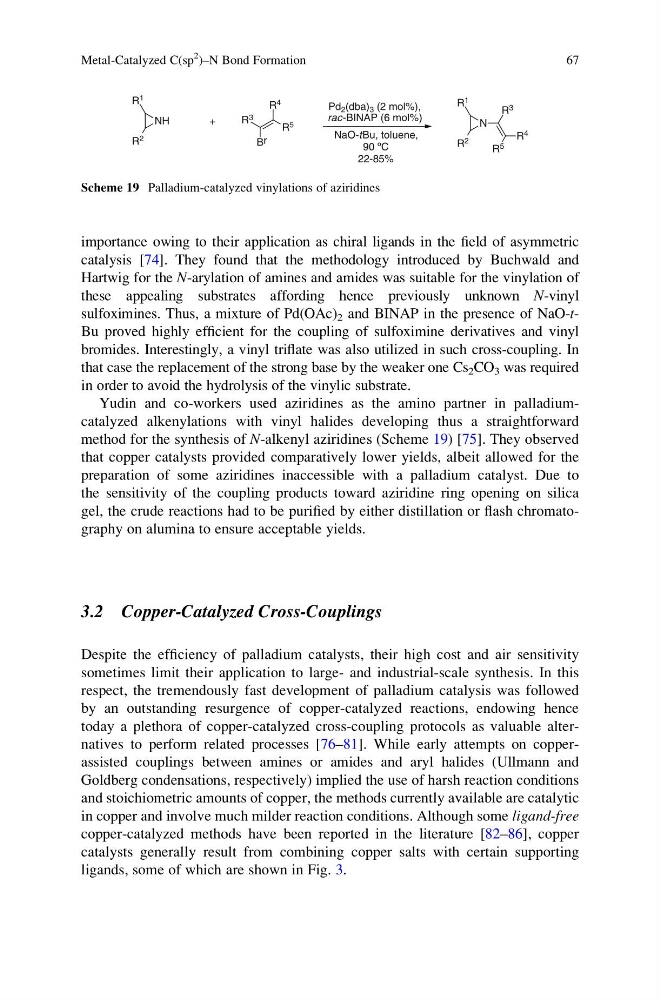
Yudin and co-workers used aziridines as the amino partner in palladiumcatalyzed alkenylations with vinyl halides developing thus a straightforward
method for the synthesis of N-alkenyl aziridines (Scheme 19) [75]. They observed
that copper catalysts provided comparatively lower yields, albeit allowed for the
preparation of some aziridines inaccessible with a palladium catalyst. Due to
the sensitivity of the coupling products toward aziridine ring opening on silica
gel, the crude reactions had to be purified by either distillation or flash chromatography on alumina to ensure acceptable yields.
3.2 Copper-Catalyzed Cross-Couplings
Despite the efficiency of palladium catalysts, their high cost and air sensitivity
sometimes limit their application to large- and industrial-scale synthesis. In this
respect, the tremendously fast development of palladium catalysis was followed
by an outstanding resurgence of copper-catalyzed reactions, endowing hence
today a plethora of copper-catalyzed cross-coupling protocols as valuable alternatives to perform related processes [76–81]. While early attempts on copperassisted couplings between amines or amides and aryl halides (Ullmann and
Goldberg condensations, respectively) implied the use of harsh reaction conditions
and stoichiometric amounts of copper, the methods currently available are catalytic
in copper and involve much milder reaction conditions. Although some ligand-free
copper-catalyzed methods have been reported in the literature [82–86], copper
catalysts generally result from combining copper salts with certain supporting
ligands, some of which are shown in Fig. 3.
Pd 2 (dba) 3 (2 mol%),
rac-BINAP (6 mol%)
NaO-tBu, toluene,
90 ºC
22-85%
+
R 3
B r
R 5
R 4
NH
R 1
R 2
N
R 1
R 2
R 5
R 4
R 3
Scheme 19 Palladium-catalyzed vinylations of aziridines
Metal-Catalyzed C(sp
2
)–N Bond Formation
67
catalysis [74]. They found that the methodology introduced by Buchwald and
Hartwig for the N-arylation of amines and amides was suitable for the vinylation of
these appealing substrates affording hence previously unknown N-vinyl
sulfoximines. Thus, a mixture of Pd(OAc) 2 and BINAP in the presence of NaO-tBu proved highly efficient for the coupling of sulfoximine derivatives and vinyl
bromides. Interestingly, a vinyl triflate was also utilized in such cross-coupling. In
that case the replacement of the strong base by the weaker one Cs 2 CO 3 was required
in order to avoid the hydrolysis of the vinylic substrate.
Yudin and co-workers used aziridines as the amino partner in palladiumcatalyzed alkenylations with vinyl halides developing thus a straightforward
method for the synthesis of N-alkenyl aziridines (Scheme 19) [75]. They observed
that copper catalysts provided comparatively lower yields, albeit allowed for the
preparation of some aziridines inaccessible with a palladium catalyst. Due to
the sensitivity of the coupling products toward aziridine ring opening on silica
gel, the crude reactions had to be purified by either distillation or flash chromatography on alumina to ensure acceptable yields.
3.2 Copper-Catalyzed Cross-Couplings
Despite the efficiency of palladium catalysts, their high cost and air sensitivity
sometimes limit their application to large- and industrial-scale synthesis. In this
respect, the tremendously fast development of palladium catalysis was followed
by an outstanding resurgence of copper-catalyzed reactions, endowing hence
today a plethora of copper-catalyzed cross-coupling protocols as valuable alternatives to perform related processes [76–81]. While early attempts on copperassisted couplings between amines or amides and aryl halides (Ullmann and
Goldberg condensations, respectively) implied the use of harsh reaction conditions
and stoichiometric amounts of copper, the methods currently available are catalytic
in copper and involve much milder reaction conditions. Although some ligand-free
copper-catalyzed methods have been reported in the literature [82–86], copper
catalysts generally result from combining copper salts with certain supporting
ligands, some of which are shown in Fig. 3.
Pd 2 (dba) 3 (2 mol%),
rac-BINAP (6 mol%)
NaO-tBu, toluene,
90 ºC
22-85%
+
R 3
B r
R 5
R 4
NH
R 1
R 2
N
R 1
R 2
R 5
R 4
R 3
Scheme 19 Palladium-catalyzed vinylations of aziridines
Metal-Catalyzed C(sp
2
)–N Bond Formation
67