

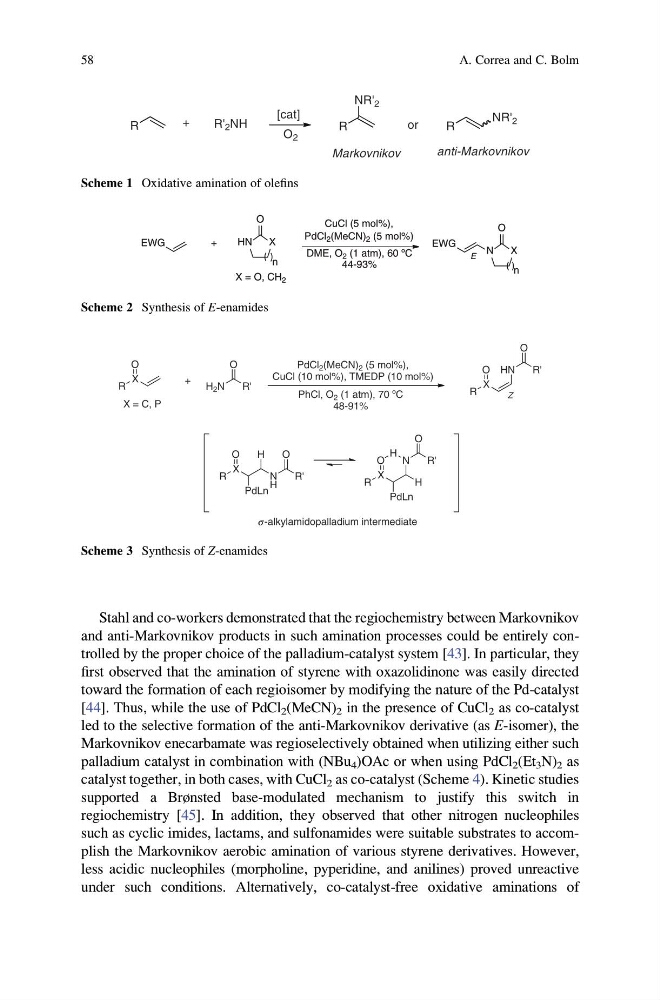
Stahl and co-workers demonstrated that the regiochemistry between Markovnikov
and anti-Markovnikov products in such amination processes could be entirely controlled by the proper choice of the palladium-catalyst system [43]. In particular, they
first observed that the amination of styrene with oxazolidinone was easily directed
toward the formation of each regioisomer by modifying the nature of the Pd-catalyst
[44]. Thus, while the use of PdCl 2 (MeCN) 2 in the presence of CuCl 2 as co-catalyst
led to the selective formation of the anti-Markovnikov derivative (as E-isomer), the
Markovnikov enecarbamate was regioselectively obtained when utilizing either such
palladium catalyst in combination with (NBu 4 )OAc or when using PdCl 2 (Et 3 N) 2 as
catalyst together, in both cases, with CuCl 2 as co-catalyst (Scheme 4). Kinetic studies
supported a Brønsted base-modulated mechanism to justify this switch in
regiochemistry [45]. In addition, they observed that other nitrogen nucleophiles
such as cyclic imides, lactams, and sulfonamides were suitable substrates to accomplish the Markovnikov aerobic amination of various styrene derivatives. However,
less acidic nucleophiles (morpholine, pyperidine, and anilines) proved unreactive
under such conditions. Alternatively, co-catalyst-free oxidative aminations of
X
HN
O
n
+
N
X
O
n
EWG
CuCl (5 mol%),
PdCl 2 (MeCN) 2 (5 mol%)
DME, O 2 (1 atm), 60 ºC
44-93%
X = O, CH 2
EWG
E
Scheme 2 Synthesis of E-enamides
+
PdCl 2 (MeCN) 2 (5 mol%),
CuCl (10 mol%), TMEDP (10 mol%)
PhCl, O 2 (1 atm), 70 ºC
48-91%
X = C, P
X
R
O
H 2 N
R'
O
X
R
O HN
R'
O
Z
X
R
O
N
R'
O
PdLn
H
X
R
O
N
H
O
R'
H
PdLn
H
-alkylamidopalladium intermediate
s
Scheme 3 Synthesis of Z-enamides
R
R' 2 NH
[cat]
O 2
R
NR' 2
R
NR' 2
or
Markovnikov
anti-Markovnikov
+
Scheme 1 Oxidative amination of olefins
58
A. Correa and C. Bolm
and anti-Markovnikov products in such amination processes could be entirely controlled by the proper choice of the palladium-catalyst system [43]. In particular, they
first observed that the amination of styrene with oxazolidinone was easily directed
toward the formation of each regioisomer by modifying the nature of the Pd-catalyst
[44]. Thus, while the use of PdCl 2 (MeCN) 2 in the presence of CuCl 2 as co-catalyst
led to the selective formation of the anti-Markovnikov derivative (as E-isomer), the
Markovnikov enecarbamate was regioselectively obtained when utilizing either such
palladium catalyst in combination with (NBu 4 )OAc or when using PdCl 2 (Et 3 N) 2 as
catalyst together, in both cases, with CuCl 2 as co-catalyst (Scheme 4). Kinetic studies
supported a Brønsted base-modulated mechanism to justify this switch in
regiochemistry [45]. In addition, they observed that other nitrogen nucleophiles
such as cyclic imides, lactams, and sulfonamides were suitable substrates to accomplish the Markovnikov aerobic amination of various styrene derivatives. However,
less acidic nucleophiles (morpholine, pyperidine, and anilines) proved unreactive
under such conditions. Alternatively, co-catalyst-free oxidative aminations of
X
HN
O
n
+
N
X
O
n
EWG
CuCl (5 mol%),
PdCl 2 (MeCN) 2 (5 mol%)
DME, O 2 (1 atm), 60 ºC
44-93%
X = O, CH 2
EWG
E
Scheme 2 Synthesis of E-enamides
+
PdCl 2 (MeCN) 2 (5 mol%),
CuCl (10 mol%), TMEDP (10 mol%)
PhCl, O 2 (1 atm), 70 ºC
48-91%
X = C, P
X
R
O
H 2 N
R'
O
X
R
O HN
R'
O
Z
X
R
O
N
R'
O
PdLn
H
X
R
O
N
H
O
R'
H
PdLn
H
-alkylamidopalladium intermediate
s
Scheme 3 Synthesis of Z-enamides
R
R' 2 NH
[cat]
O 2
R
NR' 2
R
NR' 2
or
Markovnikov
anti-Markovnikov
+
Scheme 1 Oxidative amination of olefins
58
A. Correa and C. Bolm