

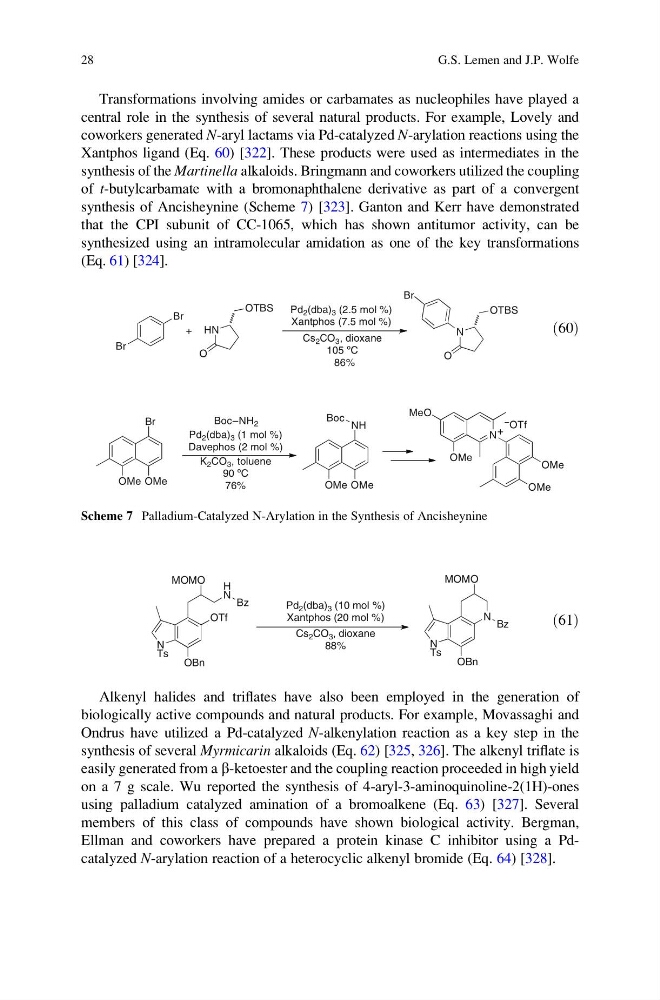
Transformations involving amides or carbamates as nucleophiles have played a
central role in the synthesis of several natural products. For example, Lovely and
coworkers generated N-aryl lactams via Pd-catalyzed N-arylation reactions using the
Xantphos ligand (Eq. 60) [322]. These products were used as intermediates in the
synthesis of the Martinella alkaloids. Bringmann and coworkers utilized the coupling
of t-butylcarbamate with a bromonaphthalene derivative as part of a convergent
synthesis of Ancisheynine (Scheme 7) [323]. Ganton and Kerr have demonstrated
that the CPI subunit of CC-1065, which has shown antitumor activity, can be
synthesized using an intramolecular amidation as one of the key transformations
(Eq. 61) [324].
Br
Br
HN
OTBS
O
+
Pd 2 (dba) 3 (2.5 mol %)
Xantphos (7.5 mol %)
N
OTBS
O
Br
Cs 2 CO 3 , dioxane
105 ºC
86%
ð60Þ
N
Ts
OBn
OTf
H
N
MOMO
Pd 2 (dba) 3 (10 mol %)
Xantphos (20 mol %)
N
Ts
N
MOMO
OBn
Bz
Cs 2 CO 3 , dioxane
88%
Bz
ð61Þ
Alkenyl halides and triflates have also been employed in the generation of
biologically active compounds and natural products. For example, Movassaghi and
Ondrus have utilized a Pd-catalyzed N-alkenylation reaction as a key step in the
synthesis of several Myrmicarin alkaloids (Eq. 62) [325, 326]. The alkenyl triflate is
easily generated from a b-ketoester and the coupling reaction proceeded in high yield
on a 7 g scale. Wu reported the synthesis of 4-aryl-3-aminoquinoline-2(1H)-ones
using palladium catalyzed amination of a bromoalkene (Eq. 63) [327]. Several
members of this class of compounds have shown biological activity. Bergman,
Ellman and coworkers have prepared a protein kinase C inhibitor using a Pdcatalyzed N-arylation reaction of a heterocyclic alkenyl bromide (Eq. 64) [328].
Br
OMe
OMe
Pd 2 (dba) 3 (1 mol %)
Davephos (2 mol %)
NH
OMe
OMe
Boc
N
MeO
OMe
OMe
OMe
– OTf
+
Boc–NH 2
K 2 CO 3 , toluene
90 ºC
76%
Scheme 7 Palladium-Catalyzed N-Arylation in the Synthesis of Ancisheynine
28
G.S. Lemen and J.P. Wolfe
central role in the synthesis of several natural products. For example, Lovely and
coworkers generated N-aryl lactams via Pd-catalyzed N-arylation reactions using the
Xantphos ligand (Eq. 60) [322]. These products were used as intermediates in the
synthesis of the Martinella alkaloids. Bringmann and coworkers utilized the coupling
of t-butylcarbamate with a bromonaphthalene derivative as part of a convergent
synthesis of Ancisheynine (Scheme 7) [323]. Ganton and Kerr have demonstrated
that the CPI subunit of CC-1065, which has shown antitumor activity, can be
synthesized using an intramolecular amidation as one of the key transformations
(Eq. 61) [324].
Br
Br
HN
OTBS
O
+
Pd 2 (dba) 3 (2.5 mol %)
Xantphos (7.5 mol %)
N
OTBS
O
Br
Cs 2 CO 3 , dioxane
105 ºC
86%
ð60Þ
N
Ts
OBn
OTf
H
N
MOMO
Pd 2 (dba) 3 (10 mol %)
Xantphos (20 mol %)
N
Ts
N
MOMO
OBn
Bz
Cs 2 CO 3 , dioxane
88%
Bz
ð61Þ
Alkenyl halides and triflates have also been employed in the generation of
biologically active compounds and natural products. For example, Movassaghi and
Ondrus have utilized a Pd-catalyzed N-alkenylation reaction as a key step in the
synthesis of several Myrmicarin alkaloids (Eq. 62) [325, 326]. The alkenyl triflate is
easily generated from a b-ketoester and the coupling reaction proceeded in high yield
on a 7 g scale. Wu reported the synthesis of 4-aryl-3-aminoquinoline-2(1H)-ones
using palladium catalyzed amination of a bromoalkene (Eq. 63) [327]. Several
members of this class of compounds have shown biological activity. Bergman,
Ellman and coworkers have prepared a protein kinase C inhibitor using a Pdcatalyzed N-arylation reaction of a heterocyclic alkenyl bromide (Eq. 64) [328].
Br
OMe
OMe
Pd 2 (dba) 3 (1 mol %)
Davephos (2 mol %)
NH
OMe
OMe
Boc
N
MeO
OMe
OMe
OMe
– OTf
+
Boc–NH 2
K 2 CO 3 , toluene
90 ºC
76%
Scheme 7 Palladium-Catalyzed N-Arylation in the Synthesis of Ancisheynine
28
G.S. Lemen and J.P. Wolfe