

Pd/Johnphos catalyst at 80
C for 30 min, followed by addition of Dpe-Phos and
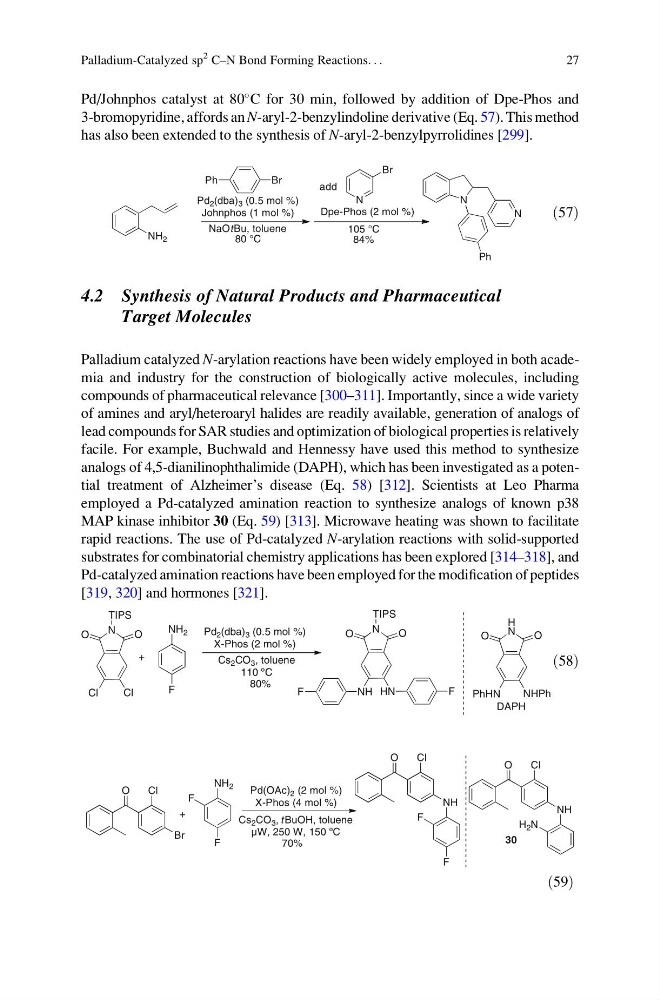
3-bromopyridine, affords an N-aryl-2-benzylindoline derivative (Eq. 57). This method
has also been extended to the synthesis of N-aryl-2-benzylpyrrolidines [299].
NH 2
Pd 2 (dba) 3 (0.5 mol %)
Johnphos (1 mol %)
NaOtBu, toluene
80 °C
Ph
Br
add
Dpe-Phos (2 mol %)
105 °C
84%
N
Br
N
N
Ph
ð57Þ
4.2 Synthesis of Natural Products and Pharmaceutical
Target Molecules
Palladium catalyzed N-arylation reactions have been widely employed in both academia and industry for the construction of biologically active molecules, including
compounds of pharmaceutical relevance [300–311]. Importantly, since a wide variety
of amines and aryl/heteroaryl halides are readily available, generation of analogs of
lead compounds for SAR studies and optimization of biological properties is relatively
facile. For example, Buchwald and Hennessy have used this method to synthesize
analogs of 4,5-dianilinophthalimide (DAPH), which has been investigated as a potential treatment of Alzheimer’s disease (Eq. 58) [312]. Scientists at Leo Pharma
employed a Pd-catalyzed amination reaction to synthesize analogs of known p38
MAP kinase inhibitor 30 (Eq. 59) [313]. Microwave heating was shown to facilitate
rapid reactions. The use of Pd-catalyzed N-arylation reactions with solid-supported
substrates for combinatorial chemistry applications has been explored [314–318], and
Pd-catalyzed amination reactions have been employed for the modification of peptides
[319, 320] and hormones [321].
N
Cl
Cl
O
O
TIPS
NH 2
F
+
Pd 2 (dba) 3 (0.5 mol %)
X-Phos (2 mol %)
N
NH HN
O
O
TIPS
F
F
80%
H
N
PhHN
NHPh
O
O
DAPH
Cs 2 CO 3 , toluene
110 ºC
ð58Þ
O
Cl
Br
NH 2
F
F
Pd(OAc) 2 (2 mol %)
X-Phos (4 mol %)
O
Cl
NH
F
F
70%
O
Cl
NH
H 2 N
30
+
Cs 2 CO 3 , t BuOH, toluene
µW, 250 W, 150 ºC
ð59Þ
Palladium-Catalyzed sp
2 C–N Bond Forming Reactions. . .
27
C for 30 min, followed by addition of Dpe-Phos and
3-bromopyridine, affords an N-aryl-2-benzylindoline derivative (Eq. 57). This method
has also been extended to the synthesis of N-aryl-2-benzylpyrrolidines [299].
NH 2
Pd 2 (dba) 3 (0.5 mol %)
Johnphos (1 mol %)
NaOtBu, toluene
80 °C
Ph
Br
add
Dpe-Phos (2 mol %)
105 °C
84%
N
Br
N
N
Ph
ð57Þ
4.2 Synthesis of Natural Products and Pharmaceutical
Target Molecules
Palladium catalyzed N-arylation reactions have been widely employed in both academia and industry for the construction of biologically active molecules, including
compounds of pharmaceutical relevance [300–311]. Importantly, since a wide variety
of amines and aryl/heteroaryl halides are readily available, generation of analogs of
lead compounds for SAR studies and optimization of biological properties is relatively
facile. For example, Buchwald and Hennessy have used this method to synthesize
analogs of 4,5-dianilinophthalimide (DAPH), which has been investigated as a potential treatment of Alzheimer’s disease (Eq. 58) [312]. Scientists at Leo Pharma
employed a Pd-catalyzed amination reaction to synthesize analogs of known p38
MAP kinase inhibitor 30 (Eq. 59) [313]. Microwave heating was shown to facilitate
rapid reactions. The use of Pd-catalyzed N-arylation reactions with solid-supported
substrates for combinatorial chemistry applications has been explored [314–318], and
Pd-catalyzed amination reactions have been employed for the modification of peptides
[319, 320] and hormones [321].
N
Cl
Cl
O
O
TIPS
NH 2
F
+
Pd 2 (dba) 3 (0.5 mol %)
X-Phos (2 mol %)
N
NH HN
O
O
TIPS
F
F
80%
H
N
PhHN
NHPh
O
O
DAPH
Cs 2 CO 3 , toluene
110 ºC
ð58Þ
O
Cl
Br
NH 2
F
F
Pd(OAc) 2 (2 mol %)
X-Phos (4 mol %)
O
Cl
NH
F
F
70%
O
Cl
NH
H 2 N
30
+
Cs 2 CO 3 , t BuOH, toluene
µW, 250 W, 150 ºC
ð59Þ
Palladium-Catalyzed sp
2 C–N Bond Forming Reactions. . .
27