

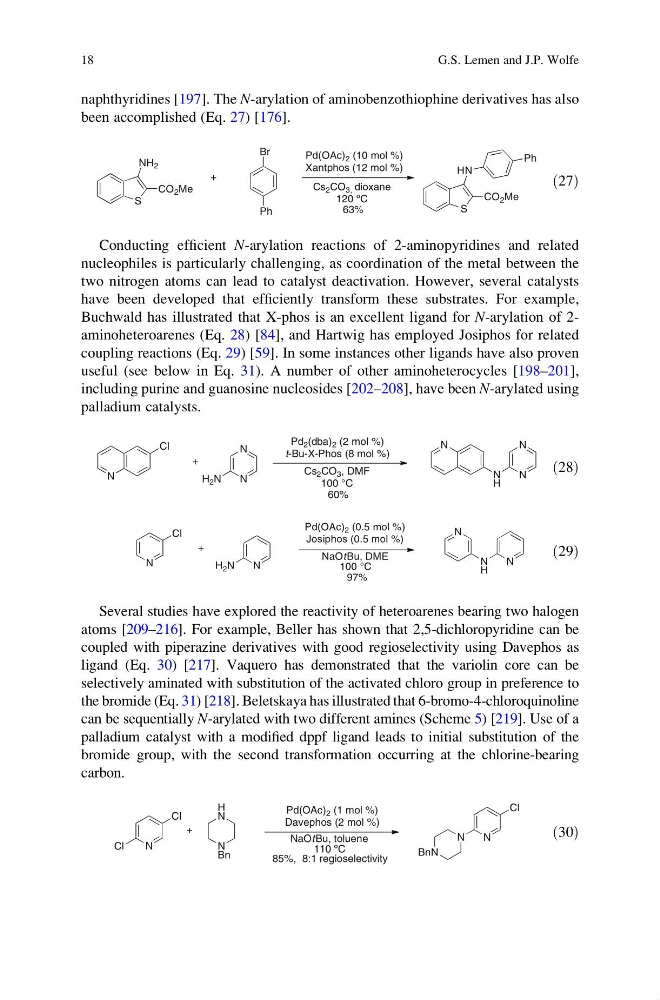
naphthyridines [197]. The N-arylation of aminobenzothiophine derivatives has also
been accomplished (Eq. 27) [176].
S
NH 2
CO 2 Me
Br
+
Ph
Pd(OAc) 2 (10 mol %)
Xantphos (12 mol %)
S
HN
CO 2 Me
Ph
63%
Cs 2 CO 3, dioxane
120 ºC
ð27Þ
Conducting efficient N-arylation reactions of 2-aminopyridines and related
nucleophiles is particularly challenging, as coordination of the metal between the
two nitrogen atoms can lead to catalyst deactivation. However, several catalysts
have been developed that efficiently transform these substrates. For example,
Buchwald has illustrated that X-phos is an excellent ligand for N-arylation of 2aminoheteroarenes (Eq. 28) [84], and Hartwig has employed Josiphos for related
coupling reactions (Eq. 29) [59]. In some instances other ligands have also proven
useful (see below in Eq. 31). A number of other aminoheterocycles [198–201],
including purine and guanosine nucleosides [202–208], have been N-arylated using
palladium catalysts.
Pd 2 (dba) 2 (2 mol %)
t-Bu-X-Phos (8 mol %)
Cl
N
N
H 2 N
+
N
N
N
H
60%
N
N
Cs 2 CO 3 , DMF
100 °C
ð28Þ
Pd(OAc) 2 (0.5 mol %)
Josiphos (0.5 mol %)
N
Cl
N
H 2 N
+
N
N
H
N
97%
NaOtBu, DME
100 °C
ð29Þ
Several studies have explored the reactivity of heteroarenes bearing two halogen
atoms [209–216]. For example, Beller has shown that 2,5-dichloropyridine can be
coupled with piperazine derivatives with good regioselectivity using Davephos as
ligand (Eq. 30) [217]. Vaquero has demonstrated that the variolin core can be
selectively aminated with substitution of the activated chloro group in preference to
the bromide (Eq. 31) [218]. Beletskaya has illustrated that 6-bromo-4-chloroquinoline
can be sequentially N-arylated with two different amines (Scheme 5) [219]. Use of a
palladium catalyst with a modified dppf ligand leads to initial substitution of the
bromide group, with the second transformation occurring at the chlorine-bearing
carbon.
N
Cl
Cl
N
Bn
H
N
+
Pd(OAc) 2 (1 mol %)
Davephos (2 mol %)
N
N
Cl
BnN
85%, 8:1 regioselectivity
NaOtBu, toluene
110 ºC
ð30Þ
18
G.S. Lemen and J.P. Wolfe
been accomplished (Eq. 27) [176].
S
NH 2
CO 2 Me
Br
+
Ph
Pd(OAc) 2 (10 mol %)
Xantphos (12 mol %)
S
HN
CO 2 Me
Ph
63%
Cs 2 CO 3, dioxane
120 ºC
ð27Þ
Conducting efficient N-arylation reactions of 2-aminopyridines and related
nucleophiles is particularly challenging, as coordination of the metal between the
two nitrogen atoms can lead to catalyst deactivation. However, several catalysts
have been developed that efficiently transform these substrates. For example,
Buchwald has illustrated that X-phos is an excellent ligand for N-arylation of 2aminoheteroarenes (Eq. 28) [84], and Hartwig has employed Josiphos for related
coupling reactions (Eq. 29) [59]. In some instances other ligands have also proven
useful (see below in Eq. 31). A number of other aminoheterocycles [198–201],
including purine and guanosine nucleosides [202–208], have been N-arylated using
palladium catalysts.
Pd 2 (dba) 2 (2 mol %)
t-Bu-X-Phos (8 mol %)
Cl
N
N
H 2 N
+
N
N
N
H
60%
N
N
Cs 2 CO 3 , DMF
100 °C
ð28Þ
Pd(OAc) 2 (0.5 mol %)
Josiphos (0.5 mol %)
N
Cl
N
H 2 N
+
N
N
H
N
97%
NaOtBu, DME
100 °C
ð29Þ
Several studies have explored the reactivity of heteroarenes bearing two halogen
atoms [209–216]. For example, Beller has shown that 2,5-dichloropyridine can be
coupled with piperazine derivatives with good regioselectivity using Davephos as
ligand (Eq. 30) [217]. Vaquero has demonstrated that the variolin core can be
selectively aminated with substitution of the activated chloro group in preference to
the bromide (Eq. 31) [218]. Beletskaya has illustrated that 6-bromo-4-chloroquinoline
can be sequentially N-arylated with two different amines (Scheme 5) [219]. Use of a
palladium catalyst with a modified dppf ligand leads to initial substitution of the
bromide group, with the second transformation occurring at the chlorine-bearing
carbon.
N
Cl
Cl
N
Bn
H
N
+
Pd(OAc) 2 (1 mol %)
Davephos (2 mol %)
N
N
Cl
BnN
85%, 8:1 regioselectivity
NaOtBu, toluene
110 ºC
ð30Þ
18
G.S. Lemen and J.P. Wolfe