

involving heteroaryl halides, heteroaryl amines, and azoles have been of longstanding
interest. These substrates can be quite challenging to employ, as pyridine and related
nitrogen heterocycles are good ligands for palladium and can cause catalyst deactivation. Thus, the proper choice of catalyst is essential for successful coupling of these
derivatives. Early studies on the use of heteroaryl halides indicated that chelating
ligands or bulky, electron-rich ligands provided satisfactory results in many cases
[163–165]. Azoles, including pyrrole and indole, can also be N-arylated under appropriate conditions [166, 167].
Heterocycle amination has continued to be an active area of research [168–170].
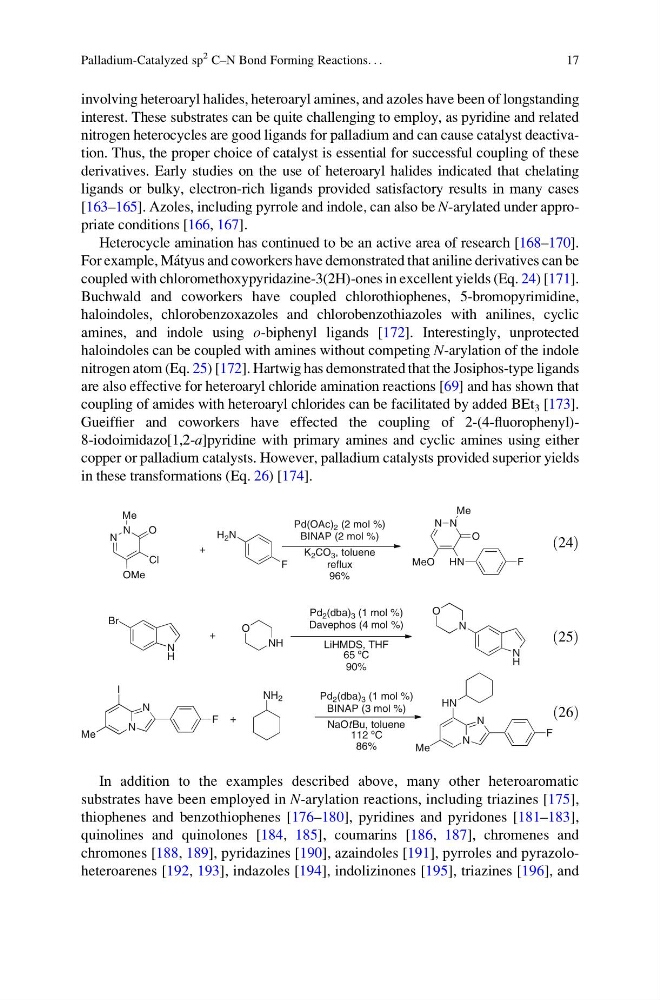
For example, Ma ´tyus and coworkers have demonstrated that aniline derivatives can be
coupled with chloromethoxypyridazine-3(2H)-ones in excellent yields (Eq. 24) [171].
Buchwald and coworkers have coupled chlorothiophenes, 5-bromopyrimidine,
haloindoles, chlorobenzoxazoles and chlorobenzothiazoles with anilines, cyclic
amines, and indole using o-biphenyl ligands [172]. Interestingly, unprotected
haloindoles can be coupled with amines without competing N-arylation of the indole
nitrogen atom (Eq. 25) [172]. Hartwig has demonstrated that the Josiphos-type ligands
are also effective for heteroaryl chloride amination reactions [69] and has shown that
coupling of amides with heteroaryl chlorides can be facilitated by added BEt 3 [173].
Gueiffier and coworkers have effected the coupling of 2-(4-fluorophenyl)8-iodoimidazo[1,2-a]pyridine with primary amines and cyclic amines using either
copper or palladium catalysts. However, palladium catalysts provided superior yields
in these transformations (Eq. 26) [174].
N
N
O
Cl
OMe
Me
+
H 2 N
F
Pd(OAc) 2 (2 mol %)
BINAP (2 mol %)
N
N
O
HN
MeO
Me
F
96%
K 2 CO 3 , toluene
reflux
ð24Þ
N
H
Br
+
O
NH
Pd 2 (dba) 3 (1 mol %)
Davephos (4 mol %)
N
H
N
O
90%
LiHMDS, THF
65 ºC
ð25Þ
N
N
I
Me
F
NH 2
+
Pd 2 (dba) 3 (1 mol %)
BINAP (3 mol %)
N
N
HN
Me
F
86%
NaOtBu, toluene
112 ºC
ð26Þ
In addition to the examples described above, many other heteroaromatic
substrates have been employed in N-arylation reactions, including triazines [175],
thiophenes and benzothiophenes [176–180], pyridines and pyridones [181–183],
quinolines and quinolones [184, 185], coumarins [186, 187], chromenes and
chromones [188, 189], pyridazines [190], azaindoles [191], pyrroles and pyrazoloheteroarenes [192, 193], indazoles [194], indolizinones [195], triazines [196], and
Palladium-Catalyzed sp
2 C–N Bond Forming Reactions. . .
17
interest. These substrates can be quite challenging to employ, as pyridine and related
nitrogen heterocycles are good ligands for palladium and can cause catalyst deactivation. Thus, the proper choice of catalyst is essential for successful coupling of these
derivatives. Early studies on the use of heteroaryl halides indicated that chelating
ligands or bulky, electron-rich ligands provided satisfactory results in many cases
[163–165]. Azoles, including pyrrole and indole, can also be N-arylated under appropriate conditions [166, 167].
Heterocycle amination has continued to be an active area of research [168–170].
For example, Ma ´tyus and coworkers have demonstrated that aniline derivatives can be
coupled with chloromethoxypyridazine-3(2H)-ones in excellent yields (Eq. 24) [171].
Buchwald and coworkers have coupled chlorothiophenes, 5-bromopyrimidine,
haloindoles, chlorobenzoxazoles and chlorobenzothiazoles with anilines, cyclic
amines, and indole using o-biphenyl ligands [172]. Interestingly, unprotected
haloindoles can be coupled with amines without competing N-arylation of the indole
nitrogen atom (Eq. 25) [172]. Hartwig has demonstrated that the Josiphos-type ligands
are also effective for heteroaryl chloride amination reactions [69] and has shown that
coupling of amides with heteroaryl chlorides can be facilitated by added BEt 3 [173].
Gueiffier and coworkers have effected the coupling of 2-(4-fluorophenyl)8-iodoimidazo[1,2-a]pyridine with primary amines and cyclic amines using either
copper or palladium catalysts. However, palladium catalysts provided superior yields
in these transformations (Eq. 26) [174].
N
N
O
Cl
OMe
Me
+
H 2 N
F
Pd(OAc) 2 (2 mol %)
BINAP (2 mol %)
N
N
O
HN
MeO
Me
F
96%
K 2 CO 3 , toluene
reflux
ð24Þ
N
H
Br
+
O
NH
Pd 2 (dba) 3 (1 mol %)
Davephos (4 mol %)
N
H
N
O
90%
LiHMDS, THF
65 ºC
ð25Þ
N
N
I
Me
F
NH 2
+
Pd 2 (dba) 3 (1 mol %)
BINAP (3 mol %)
N
N
HN
Me
F
86%
NaOtBu, toluene
112 ºC
ð26Þ
In addition to the examples described above, many other heteroaromatic
substrates have been employed in N-arylation reactions, including triazines [175],
thiophenes and benzothiophenes [176–180], pyridines and pyridones [181–183],
quinolines and quinolones [184, 185], coumarins [186, 187], chromenes and
chromones [188, 189], pyridazines [190], azaindoles [191], pyrroles and pyrazoloheteroarenes [192, 193], indazoles [194], indolizinones [195], triazines [196], and
Palladium-Catalyzed sp
2 C–N Bond Forming Reactions. . .
17