

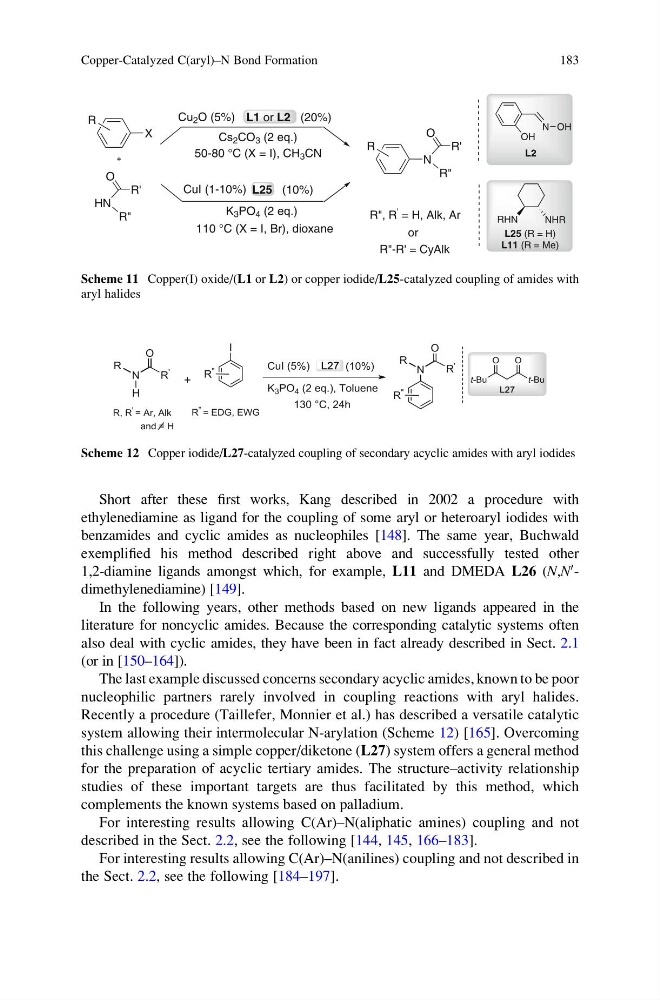
Short after these first works, Kang described in 2002 a procedure with
ethylenediamine as ligand for the coupling of some aryl or heteroaryl iodides with
benzamides and cyclic amides as nucleophiles [148]. The same year, Buchwald
exemplified his method described right above and successfully tested other
1,2-diamine ligands amongst which, for example, L11 and DMEDA L26 (N,N
0 -
dimethylenediamine) [149].
In the following years, other methods based on new ligands appeared in the
literature for noncyclic amides. Because the corresponding catalytic systems often
also deal with cyclic amides, they have been in fact already described in Sect. 2.1
(or in [150–164]).
The last example discussed concerns secondary acyclic amides, known to be poor
nucleophilic partners rarely involved in coupling reactions with aryl halides.
Recently a procedure (Taillefer, Monnier et al.) has described a versatile catalytic
system allowing their intermolecular N-arylation (Scheme 12) [165]. Overcoming
this challenge using a simple copper/diketone (L27) system offers a general method
for the preparation of acyclic tertiary amides. The structure–activity relationship
studies of these important targets are thus facilitated by this method, which
complements the known systems based on palladium.
For interesting results allowing C(Ar)–N(aliphatic amines) coupling and not
described in the Sect. 2.2, see the following [144, 145, 166–183].
For interesting results allowing C(Ar)–N(anilines) coupling and not described in
the Sect. 2.2, see the following [184–197].
Scheme 12 Copper iodide/L27-catalyzed coupling of secondary acyclic amides with aryl iodides
CuI (1-10%) L25 (10%)
K 3 PO 4 (2 eq.)
L25 (R = H)
L11 (R = Me)
X
R
R", R
' = H, Alk, Ar
110 °C (X = I, Br), dioxane
NHR
RHN
OH
N OH
Cu 2 O (5%) L1 or L2 (20%)
Cs 2 CO 3 (2 eq.)
L2
R
R"
HN
50-80 °C (X = I), CH 3 CN
O
R'
R"
N
O
R'
R"-R' = CyAlk
or
Scheme 11 Copper(I) oxide/(L1 or L2) or copper iodide/L25-catalyzed coupling of amides with
aryl halides
Copper-Catalyzed C(aryl)–N Bond Formation
183
ethylenediamine as ligand for the coupling of some aryl or heteroaryl iodides with
benzamides and cyclic amides as nucleophiles [148]. The same year, Buchwald
exemplified his method described right above and successfully tested other
1,2-diamine ligands amongst which, for example, L11 and DMEDA L26 (N,N
0 -
dimethylenediamine) [149].
In the following years, other methods based on new ligands appeared in the
literature for noncyclic amides. Because the corresponding catalytic systems often
also deal with cyclic amides, they have been in fact already described in Sect. 2.1
(or in [150–164]).
The last example discussed concerns secondary acyclic amides, known to be poor
nucleophilic partners rarely involved in coupling reactions with aryl halides.
Recently a procedure (Taillefer, Monnier et al.) has described a versatile catalytic
system allowing their intermolecular N-arylation (Scheme 12) [165]. Overcoming
this challenge using a simple copper/diketone (L27) system offers a general method
for the preparation of acyclic tertiary amides. The structure–activity relationship
studies of these important targets are thus facilitated by this method, which
complements the known systems based on palladium.
For interesting results allowing C(Ar)–N(aliphatic amines) coupling and not
described in the Sect. 2.2, see the following [144, 145, 166–183].
For interesting results allowing C(Ar)–N(anilines) coupling and not described in
the Sect. 2.2, see the following [184–197].
Scheme 12 Copper iodide/L27-catalyzed coupling of secondary acyclic amides with aryl iodides
CuI (1-10%) L25 (10%)
K 3 PO 4 (2 eq.)
L25 (R = H)
L11 (R = Me)
X
R
R", R
' = H, Alk, Ar
110 °C (X = I, Br), dioxane
NHR
RHN
OH
N OH
Cu 2 O (5%) L1 or L2 (20%)
Cs 2 CO 3 (2 eq.)
L2
R
R"
HN
50-80 °C (X = I), CH 3 CN
O
R'
R"
N
O
R'
R"-R' = CyAlk
or
Scheme 11 Copper(I) oxide/(L1 or L2) or copper iodide/L25-catalyzed coupling of amides with
aryl halides
Copper-Catalyzed C(aryl)–N Bond Formation
183