

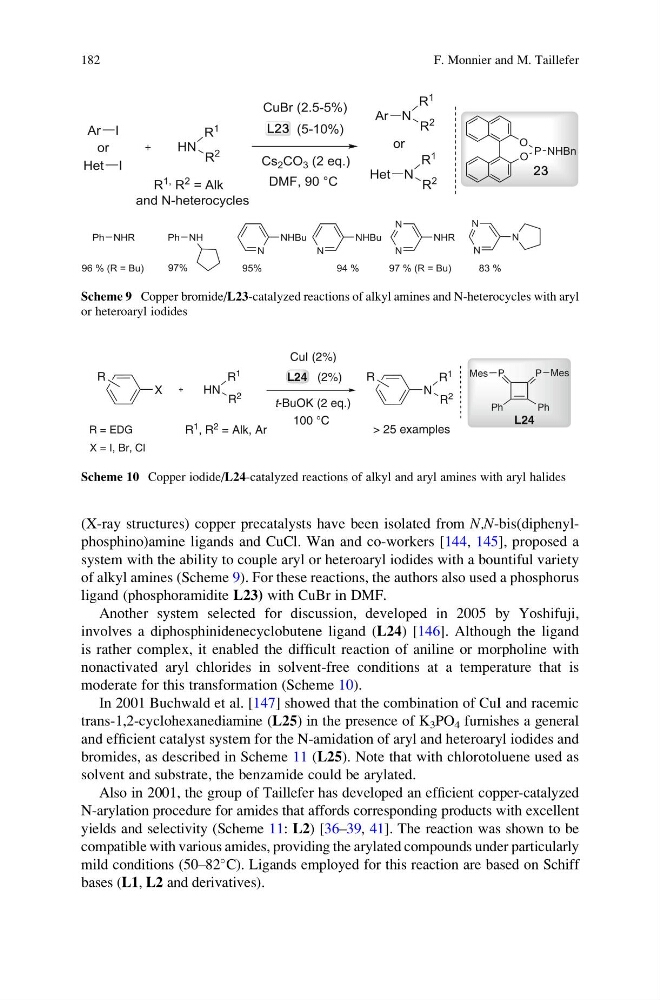
(X-ray structures) copper precatalysts have been isolated from N,N-bis(diphenylphosphino)amine ligands and CuCl. Wan and co-workers [144, 145], proposed a
system with the ability to couple aryl or heteroaryl iodides with a bountiful variety
of alkyl amines (Scheme 9). For these reactions, the authors also used a phosphorus
ligand (phosphoramidite L23) with CuBr in DMF.
Another system selected for discussion, developed in 2005 by Yoshifuji,
involves a diphosphinidenecyclobutene ligand (L24) [146]. Although the ligand
is rather complex, it enabled the difficult reaction of aniline or morpholine with
nonactivated aryl chlorides in solvent-free conditions at a temperature that is
moderate for this transformation (Scheme 10).
In 2001 Buchwald et al. [147] showed that the combination of CuI and racemic
trans-1,2-cyclohexanediamine (L25) in the presence of K 3 PO 4 furnishes a general
and efficient catalyst system for the N-amidation of aryl and heteroaryl iodides and
bromides, as described in Scheme 11 (L25). Note that with chlorotoluene used as
solvent and substrate, the benzamide could be arylated.
Also in 2001, the group of Taillefer has developed an efficient copper-catalyzed
N-arylation procedure for amides that affords corresponding products with excellent
yields and selectivity (Scheme 11: L2) [36–39, 41]. The reaction was shown to be
compatible with various amides, providing the arylated compounds under particularly
mild conditions (50–82
C). Ligands employed for this reaction are based on Schiff
bases (L1, L2 and derivatives).
Scheme 9 Copper bromide/L23-catalyzed reactions of alkyl amines and N-heterocycles with aryl
or heteroaryl iodides
CuI (2%)
L24 (2%)
t-BuOK (2 eq.)
L24
X
R
R
R = EDG
R 2
HN
> 25 examples
R
1
, R
2 = Alk, Ar
R
1
R
2
N
R 1
100 °C
X = I, Br, Cl
Ph
Ph
P
P
Mes
Mes
Scheme 10 Copper iodide/L24-catalyzed reactions of alkyl and aryl amines with aryl halides
182
F. Monnier and M. Taillefer
system with the ability to couple aryl or heteroaryl iodides with a bountiful variety
of alkyl amines (Scheme 9). For these reactions, the authors also used a phosphorus
ligand (phosphoramidite L23) with CuBr in DMF.
Another system selected for discussion, developed in 2005 by Yoshifuji,
involves a diphosphinidenecyclobutene ligand (L24) [146]. Although the ligand
is rather complex, it enabled the difficult reaction of aniline or morpholine with
nonactivated aryl chlorides in solvent-free conditions at a temperature that is
moderate for this transformation (Scheme 10).
In 2001 Buchwald et al. [147] showed that the combination of CuI and racemic
trans-1,2-cyclohexanediamine (L25) in the presence of K 3 PO 4 furnishes a general
and efficient catalyst system for the N-amidation of aryl and heteroaryl iodides and
bromides, as described in Scheme 11 (L25). Note that with chlorotoluene used as
solvent and substrate, the benzamide could be arylated.
Also in 2001, the group of Taillefer has developed an efficient copper-catalyzed
N-arylation procedure for amides that affords corresponding products with excellent
yields and selectivity (Scheme 11: L2) [36–39, 41]. The reaction was shown to be
compatible with various amides, providing the arylated compounds under particularly
mild conditions (50–82
C). Ligands employed for this reaction are based on Schiff
bases (L1, L2 and derivatives).
Scheme 9 Copper bromide/L23-catalyzed reactions of alkyl amines and N-heterocycles with aryl
or heteroaryl iodides
CuI (2%)
L24 (2%)
t-BuOK (2 eq.)
L24
X
R
R
R = EDG
R 2
HN
> 25 examples
R
1
, R
2 = Alk, Ar
R
1
R
2
N
R 1
100 °C
X = I, Br, Cl
Ph
Ph
P
P
Mes
Mes
Scheme 10 Copper iodide/L24-catalyzed reactions of alkyl and aryl amines with aryl halides
182
F. Monnier and M. Taillefer