

catalyst revealed that the catalyst was stable even after fifth recycle, and no leaching
of copper or tungsten occurred. The catalyst was found to give a higher turnover
number (TON) of 69 compared to its homogeneous counterparts (TON 27).
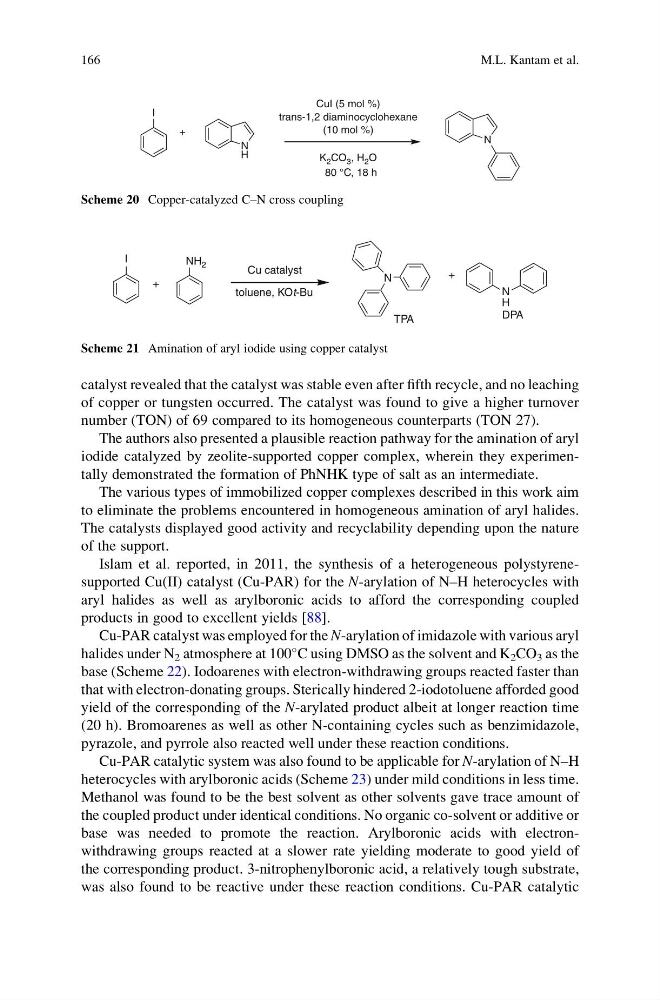
The authors also presented a plausible reaction pathway for the amination of aryl
iodide catalyzed by zeolite-supported copper complex, wherein they experimentally demonstrated the formation of PhNHK type of salt as an intermediate.
The various types of immobilized copper complexes described in this work aim
to eliminate the problems encountered in homogeneous amination of aryl halides.
The catalysts displayed good activity and recyclability depending upon the nature
of the support.
Islam et al. reported, in 2011, the synthesis of a heterogeneous polystyrenesupported Cu(II) catalyst (Cu-PAR) for the N-arylation of N–H heterocycles with
aryl halides as well as arylboronic acids to afford the corresponding coupled
products in good to excellent yields [88].
Cu-PAR catalyst was employed for the N-arylation of imidazole with various aryl
halides under N 2 atmosphere at 100
C using DMSO as the solvent and K 2 CO 3 as the
base (Scheme 22). Iodoarenes with electron-withdrawing groups reacted faster than
that with electron-donating groups. Sterically hindered 2-iodotoluene afforded good
yield of the corresponding of the N-arylated product albeit at longer reaction time
(20 h). Bromoarenes as well as other N-containing cycles such as benzimidazole,
pyrazole, and pyrrole also reacted well under these reaction conditions.
Cu-PAR catalytic system was also found to be applicable for N-arylation of N–H
heterocycles with arylboronic acids (Scheme 23) under mild conditions in less time.
Methanol was found to be the best solvent as other solvents gave trace amount of
the coupled product under identical conditions. No organic co-solvent or additive or
base was needed to promote the reaction. Arylboronic acids with electronwithdrawing groups reacted at a slower rate yielding moderate to good yield of
the corresponding product. 3-nitrophenylboronic acid, a relatively tough substrate,
was also found to be reactive under these reaction conditions. Cu-PAR catalytic
I
N
H
N
CuI (5 mol %)
trans-1,2 diaminocyclohexane
(10 mol %)
K 2 CO 3 , H 2 O
80 °C, 18 h
+
Scheme 20 Copper-catalyzed C–N cross coupling
I
NH 2
N
N
H
Cu catalyst
toluene, KOt-Bu
+
+
TPA
DPA
Scheme 21 Amination of aryl iodide using copper catalyst
166
M.L. Kantam et al.
of copper or tungsten occurred. The catalyst was found to give a higher turnover
number (TON) of 69 compared to its homogeneous counterparts (TON 27).
The authors also presented a plausible reaction pathway for the amination of aryl
iodide catalyzed by zeolite-supported copper complex, wherein they experimentally demonstrated the formation of PhNHK type of salt as an intermediate.
The various types of immobilized copper complexes described in this work aim
to eliminate the problems encountered in homogeneous amination of aryl halides.
The catalysts displayed good activity and recyclability depending upon the nature
of the support.
Islam et al. reported, in 2011, the synthesis of a heterogeneous polystyrenesupported Cu(II) catalyst (Cu-PAR) for the N-arylation of N–H heterocycles with
aryl halides as well as arylboronic acids to afford the corresponding coupled
products in good to excellent yields [88].
Cu-PAR catalyst was employed for the N-arylation of imidazole with various aryl
halides under N 2 atmosphere at 100
C using DMSO as the solvent and K 2 CO 3 as the
base (Scheme 22). Iodoarenes with electron-withdrawing groups reacted faster than
that with electron-donating groups. Sterically hindered 2-iodotoluene afforded good
yield of the corresponding of the N-arylated product albeit at longer reaction time
(20 h). Bromoarenes as well as other N-containing cycles such as benzimidazole,
pyrazole, and pyrrole also reacted well under these reaction conditions.
Cu-PAR catalytic system was also found to be applicable for N-arylation of N–H
heterocycles with arylboronic acids (Scheme 23) under mild conditions in less time.
Methanol was found to be the best solvent as other solvents gave trace amount of
the coupled product under identical conditions. No organic co-solvent or additive or
base was needed to promote the reaction. Arylboronic acids with electronwithdrawing groups reacted at a slower rate yielding moderate to good yield of
the corresponding product. 3-nitrophenylboronic acid, a relatively tough substrate,
was also found to be reactive under these reaction conditions. Cu-PAR catalytic
I
N
H
N
CuI (5 mol %)
trans-1,2 diaminocyclohexane
(10 mol %)
K 2 CO 3 , H 2 O
80 °C, 18 h
+
Scheme 20 Copper-catalyzed C–N cross coupling
I
NH 2
N
N
H
Cu catalyst
toluene, KOt-Bu
+
+
TPA
DPA
Scheme 21 Amination of aryl iodide using copper catalyst
166
M.L. Kantam et al.