

activity and selectivity remained constant even after five reaction cycles.
Encapsulated Cu(Bipy)-MCM-41 lost its catalytic activity with every reuse
indicating leaching of copper from the support. This is justified from the fact that
wide openings of pore and channel diameter of MCM-41 (~35 A˚˜) results in some
washing of copper complex under the reaction conditions. Thus Cu(Bipy)-MCM-41
loses its heterogeneity and performs as a homogeneous catalyst during the course of
the reaction. Recyclability experiments on tethered Cu(Phen)(PPh 3 )Br-PTA-Y
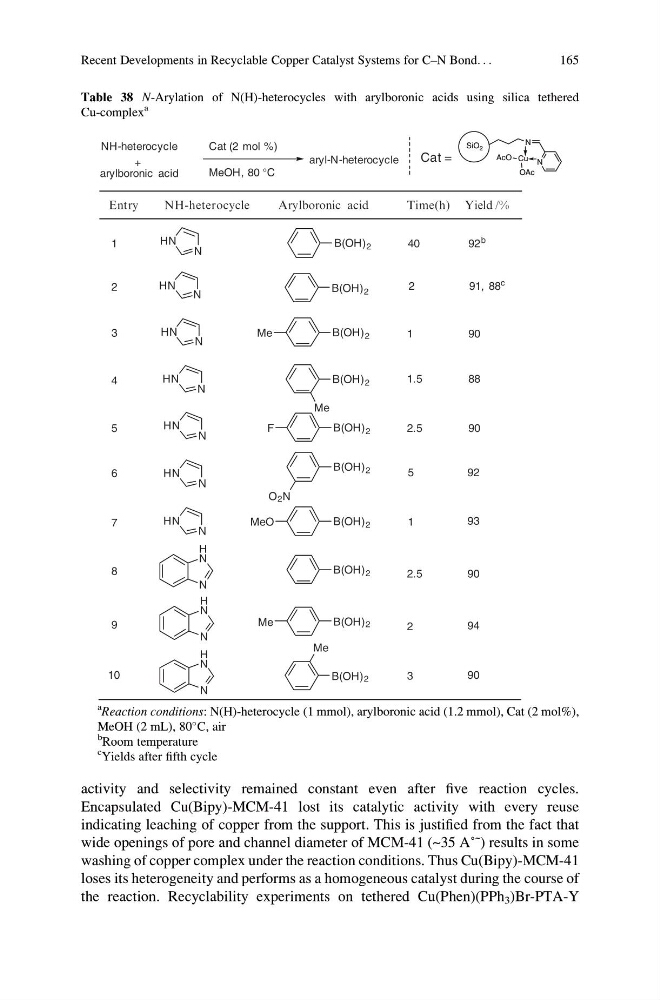
Table 38 N-Arylation of N(H)-heterocycles with arylboronic acids using silica tethered
Cu-complex
a
arylboronic acid
Cat (2 mol %)
MeOH, 80 °C
aryl-N-heterocycle
Cat =
NH-heterocycle
+
B(OH) 2
Entry
1
2
3
4
Arylboronic acid
Time(h)
NH-heterocycle
B(OH) 2
B(OH) 2
B(OH) 2
B(OH) 2
B(OH) 2
B(OH) 2
5
9
10
N
HN
N
HN
N
HN
N
HN
N
HN
40
2
1
1.5
2.5
2
3
Me
F
B(OH) 2
6
O 2 N
B(OH) 2
7
B(OH) 2
8
N
HN
N
H
N
5
1
2.5
Yield /%
92 b
91, 88 c
90
88
90
94
90
92
93
90
N
H
N
N
H
N
N
HN
Me
MeO
Me
Me
SiO 2
N
N
Cu
AcO
OAc
a
Reaction conditions: N(H)-heterocycle (1 mmol), arylboronic acid (1.2 mmol), Cat (2 mol%),
MeOH (2 mL), 80
C, air
b
Room temperature
c
Yields after fifth cycle
Recent Developments in Recyclable Copper Catalyst Systems for C–N Bond. . .
165
Encapsulated Cu(Bipy)-MCM-41 lost its catalytic activity with every reuse
indicating leaching of copper from the support. This is justified from the fact that
wide openings of pore and channel diameter of MCM-41 (~35 A˚˜) results in some
washing of copper complex under the reaction conditions. Thus Cu(Bipy)-MCM-41
loses its heterogeneity and performs as a homogeneous catalyst during the course of
the reaction. Recyclability experiments on tethered Cu(Phen)(PPh 3 )Br-PTA-Y
Table 38 N-Arylation of N(H)-heterocycles with arylboronic acids using silica tethered
Cu-complex
a
arylboronic acid
Cat (2 mol %)
MeOH, 80 °C
aryl-N-heterocycle
Cat =
NH-heterocycle
+
B(OH) 2
Entry
1
2
3
4
Arylboronic acid
Time(h)
NH-heterocycle
B(OH) 2
B(OH) 2
B(OH) 2
B(OH) 2
B(OH) 2
B(OH) 2
5
9
10
N
HN
N
HN
N
HN
N
HN
N
HN
40
2
1
1.5
2.5
2
3
Me
F
B(OH) 2
6
O 2 N
B(OH) 2
7
B(OH) 2
8
N
HN
N
H
N
5
1
2.5
Yield /%
92 b
91, 88 c
90
88
90
94
90
92
93
90
N
H
N
N
H
N
N
HN
Me
MeO
Me
Me
SiO 2
N
N
Cu
AcO
OAc
a
Reaction conditions: N(H)-heterocycle (1 mmol), arylboronic acid (1.2 mmol), Cat (2 mol%),
MeOH (2 mL), 80
C, air
b
Room temperature
c
Yields after fifth cycle
Recent Developments in Recyclable Copper Catalyst Systems for C–N Bond. . .
165