

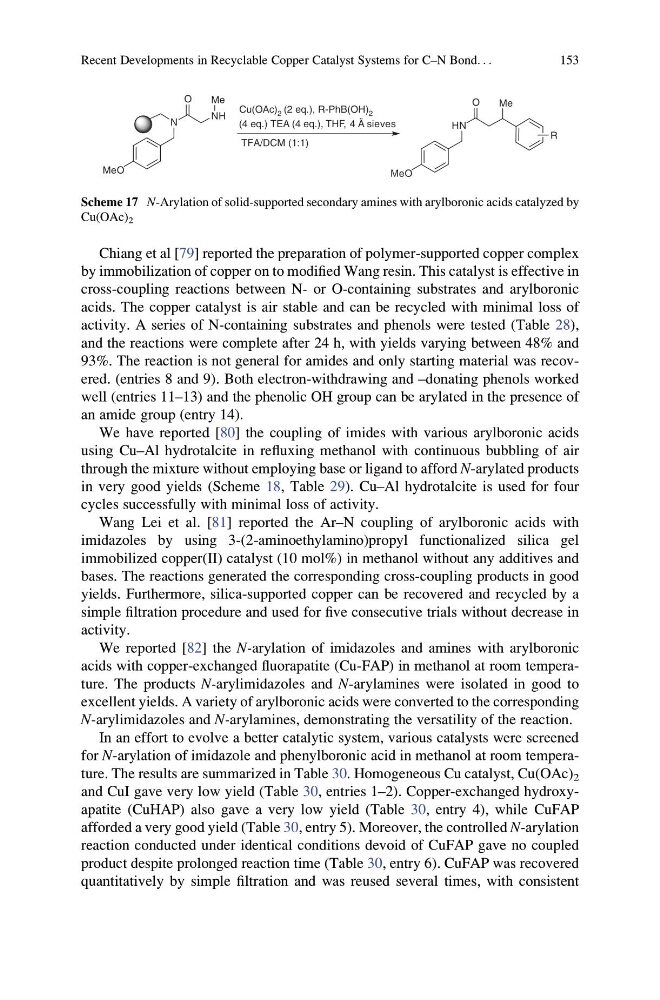
Chiang et al [79] reported the preparation of polymer-supported copper complex
by immobilization of copper on to modified Wang resin. This catalyst is effective in
cross-coupling reactions between N- or O-containing substrates and arylboronic
acids. The copper catalyst is air stable and can be recycled with minimal loss of
activity. A series of N-containing substrates and phenols were tested (Table 28),
and the reactions were complete after 24 h, with yields varying between 48% and
93%. The reaction is not general for amides and only starting material was recovered. (entries 8 and 9). Both electron-withdrawing and –donating phenols worked
well (entries 11–13) and the phenolic OH group can be arylated in the presence of
an amide group (entry 14).
We have reported [80] the coupling of imides with various arylboronic acids
using Cu–Al hydrotalcite in refluxing methanol with continuous bubbling of air
through the mixture without employing base or ligand to afford N-arylated products
in very good yields (Scheme 18, Table 29). Cu–Al hydrotalcite is used for four
cycles successfully with minimal loss of activity.
Wang Lei et al. [81] reported the Ar–N coupling of arylboronic acids with
imidazoles by using 3-(2-aminoethylamino)propyl functionalized silica gel
immobilized copper(II) catalyst (10 mol%) in methanol without any additives and
bases. The reactions generated the corresponding cross-coupling products in good
yields. Furthermore, silica-supported copper can be recovered and recycled by a
simple filtration procedure and used for five consecutive trials without decrease in
activity.
We reported [82] the N-arylation of imidazoles and amines with arylboronic
acids with copper-exchanged fluorapatite (Cu-FAP) in methanol at room temperature. The products N-arylimidazoles and N-arylamines were isolated in good to
excellent yields. A variety of arylboronic acids were converted to the corresponding
N-arylimidazoles and N-arylamines, demonstrating the versatility of the reaction.
In an effort to evolve a better catalytic system, various catalysts were screened
for N-arylation of imidazole and phenylboronic acid in methanol at room temperature. The results are summarized in Table 30. Homogeneous Cu catalyst, Cu(OAc) 2
and CuI gave very low yield (Table 30, entries 1–2). Copper-exchanged hydroxyapatite (CuHAP) also gave a very low yield (Table 30, entry 4), while CuFAP
afforded a very good yield (Table 30, entry 5). Moreover, the controlled N-arylation
reaction conducted under identical conditions devoid of CuFAP gave no coupled
product despite prolonged reaction time (Table 30, entry 6). CuFAP was recovered
quantitatively by simple filtration and was reused several times, with consistent
N
MeO
O
NH
Me
HN
MeO
O
Me
R
Cu(OAc) 2 (2 eq.), R-PhB(OH) 2
(4 eq.) TEA (4 eq.), THF, 4 Ä sieves
TFA/DCM (1:1)
Scheme 17 N-Arylation of solid-supported secondary amines with arylboronic acids catalyzed by
Cu(OAc) 2
Recent Developments in Recyclable Copper Catalyst Systems for C–N Bond. . .
153
by immobilization of copper on to modified Wang resin. This catalyst is effective in
cross-coupling reactions between N- or O-containing substrates and arylboronic
acids. The copper catalyst is air stable and can be recycled with minimal loss of
activity. A series of N-containing substrates and phenols were tested (Table 28),
and the reactions were complete after 24 h, with yields varying between 48% and
93%. The reaction is not general for amides and only starting material was recovered. (entries 8 and 9). Both electron-withdrawing and –donating phenols worked
well (entries 11–13) and the phenolic OH group can be arylated in the presence of
an amide group (entry 14).
We have reported [80] the coupling of imides with various arylboronic acids
using Cu–Al hydrotalcite in refluxing methanol with continuous bubbling of air
through the mixture without employing base or ligand to afford N-arylated products
in very good yields (Scheme 18, Table 29). Cu–Al hydrotalcite is used for four
cycles successfully with minimal loss of activity.
Wang Lei et al. [81] reported the Ar–N coupling of arylboronic acids with
imidazoles by using 3-(2-aminoethylamino)propyl functionalized silica gel
immobilized copper(II) catalyst (10 mol%) in methanol without any additives and
bases. The reactions generated the corresponding cross-coupling products in good
yields. Furthermore, silica-supported copper can be recovered and recycled by a
simple filtration procedure and used for five consecutive trials without decrease in
activity.
We reported [82] the N-arylation of imidazoles and amines with arylboronic
acids with copper-exchanged fluorapatite (Cu-FAP) in methanol at room temperature. The products N-arylimidazoles and N-arylamines were isolated in good to
excellent yields. A variety of arylboronic acids were converted to the corresponding
N-arylimidazoles and N-arylamines, demonstrating the versatility of the reaction.
In an effort to evolve a better catalytic system, various catalysts were screened
for N-arylation of imidazole and phenylboronic acid in methanol at room temperature. The results are summarized in Table 30. Homogeneous Cu catalyst, Cu(OAc) 2
and CuI gave very low yield (Table 30, entries 1–2). Copper-exchanged hydroxyapatite (CuHAP) also gave a very low yield (Table 30, entry 4), while CuFAP
afforded a very good yield (Table 30, entry 5). Moreover, the controlled N-arylation
reaction conducted under identical conditions devoid of CuFAP gave no coupled
product despite prolonged reaction time (Table 30, entry 6). CuFAP was recovered
quantitatively by simple filtration and was reused several times, with consistent
N
MeO
O
NH
Me
HN
MeO
O
Me
R
Cu(OAc) 2 (2 eq.), R-PhB(OH) 2
(4 eq.) TEA (4 eq.), THF, 4 Ä sieves
TFA/DCM (1:1)
Scheme 17 N-Arylation of solid-supported secondary amines with arylboronic acids catalyzed by
Cu(OAc) 2
Recent Developments in Recyclable Copper Catalyst Systems for C–N Bond. . .
153