

18 C–N Bond Forming Cross-Coupling Reactions Using
Arylboronic Acids
Significant improvement in copper-catalyzed N-arylation is realized after the introduction of arylboronic acids as the aryl donors independently by Lam et al. [69, 70],
Chan et al. [71], and Evans et al. [72] utilizing stoichiometric amount of Cu(OAc) 2 .
Combs et al. [73] reported the first examples of polymer-supported arylheteroaryl C–N cross-coupling reactions and dramatically decreased reaction
times upon microwave irradiation. The methodology provides easy access to
N-arylated heterocycles from heterocycles bearing an N–H bond and readily
available arylboronic acids in the presence of copper(II) acetate and pyridine.
Later Combs et al. [74] reported a general and mild method for the N-arylation of
sulfonamides on solid supports. Copper acetate, triethylamine-mediated coupling
of arylboronic acids at room temperature to solid-supported sulfonamides gave
good to excellent yields of the desired N-arylsulfonamides. Sulfonamide bond
cleavage of the o, p-dinitrobenzene(N-aryl) sulfonamide provides a route to
N-arylated secondary amine products.
N-arylated primary and secondary aliphatic amines are important substituents in
many biologically active compounds. The predominance of arylpiperidines and
arylpiperazines in CNS drugs is particularly noteworthy [75–77].
Copper acetate, triethylamine-mediated CN cross-coupling reaction of
arylboronic acids at room temperature to solid-supported primary and secondary
amines gave good to excellent yields of the desired N-arylated products [78]. This
method demonstrates the generality of this methodology for the solid-phase
synthesis of combinatorial libraries (Scheme 17).
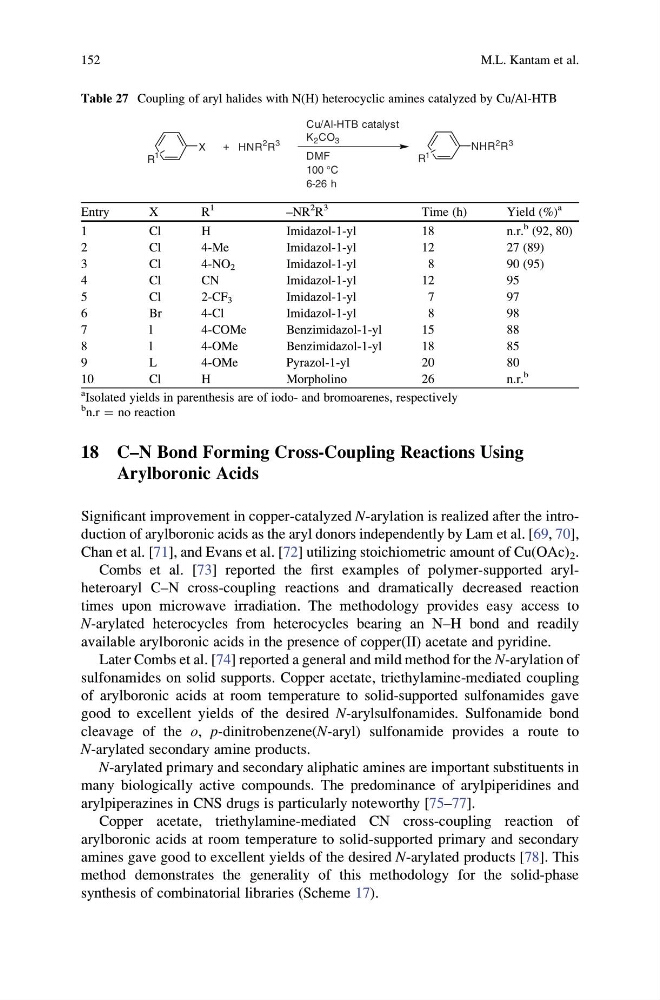
Table 27 Coupling of aryl halides with N(H) heterocyclic amines catalyzed by Cu/Al-HTB
DMF
100 °C
6-26 h
X
NHR
2 R
3
Cu/Al-HTB catalyst
K 2 CO 3
R
1
+ HNR
2 R
3
R
1
Entry
X
R
1
–NR
2
R
3
Time (h)
Yield (%)
a
1
Cl
H
Imidazol-1-yl
18
n.r.
b (92, 80)
2
Cl
4-Me
Imidazol-1-yl
12
27 (89)
3
Cl
4-NO 2
Imidazol-1-yl
8
90 (95)
4
Cl
CN
Imidazol-1-yl
12
95
5
Cl
2-CF 3
Imidazol-1-yl
7
97
6
Br
4-Cl
Imidazol-1-yl
8
98
7
l
4-COMe
Benzimidazol-1-yl
15
88
8
l
4-OMe
Benzimidazol-1-yl
18
85
9
L
4-OMe
Pyrazol-1-yl
20
80
10
Cl
H
Morpholino
26
n.r.
b
a
Isolated yields in parenthesis are of iodo- and bromoarenes, respectively
b
n.r ¼ no reaction
152
M.L. Kantam et al.
Arylboronic Acids
Significant improvement in copper-catalyzed N-arylation is realized after the introduction of arylboronic acids as the aryl donors independently by Lam et al. [69, 70],
Chan et al. [71], and Evans et al. [72] utilizing stoichiometric amount of Cu(OAc) 2 .
Combs et al. [73] reported the first examples of polymer-supported arylheteroaryl C–N cross-coupling reactions and dramatically decreased reaction
times upon microwave irradiation. The methodology provides easy access to
N-arylated heterocycles from heterocycles bearing an N–H bond and readily
available arylboronic acids in the presence of copper(II) acetate and pyridine.
Later Combs et al. [74] reported a general and mild method for the N-arylation of
sulfonamides on solid supports. Copper acetate, triethylamine-mediated coupling
of arylboronic acids at room temperature to solid-supported sulfonamides gave
good to excellent yields of the desired N-arylsulfonamides. Sulfonamide bond
cleavage of the o, p-dinitrobenzene(N-aryl) sulfonamide provides a route to
N-arylated secondary amine products.
N-arylated primary and secondary aliphatic amines are important substituents in
many biologically active compounds. The predominance of arylpiperidines and
arylpiperazines in CNS drugs is particularly noteworthy [75–77].
Copper acetate, triethylamine-mediated CN cross-coupling reaction of
arylboronic acids at room temperature to solid-supported primary and secondary
amines gave good to excellent yields of the desired N-arylated products [78]. This
method demonstrates the generality of this methodology for the solid-phase
synthesis of combinatorial libraries (Scheme 17).
Table 27 Coupling of aryl halides with N(H) heterocyclic amines catalyzed by Cu/Al-HTB
DMF
100 °C
6-26 h
X
NHR
2 R
3
Cu/Al-HTB catalyst
K 2 CO 3
R
1
+ HNR
2 R
3
R
1
Entry
X
R
1
–NR
2
R
3
Time (h)
Yield (%)
a
1
Cl
H
Imidazol-1-yl
18
n.r.
b (92, 80)
2
Cl
4-Me
Imidazol-1-yl
12
27 (89)
3
Cl
4-NO 2
Imidazol-1-yl
8
90 (95)
4
Cl
CN
Imidazol-1-yl
12
95
5
Cl
2-CF 3
Imidazol-1-yl
7
97
6
Br
4-Cl
Imidazol-1-yl
8
98
7
l
4-COMe
Benzimidazol-1-yl
15
88
8
l
4-OMe
Benzimidazol-1-yl
18
85
9
L
4-OMe
Pyrazol-1-yl
20
80
10
Cl
H
Morpholino
26
n.r.
b
a
Isolated yields in parenthesis are of iodo- and bromoarenes, respectively
b
n.r ¼ no reaction
152
M.L. Kantam et al.