

2-chloropyrimidine also provided excellent yields, as can be seen from Table 17
(entries 7 and 9). The sterically bulky 4-chlorobenzophenone was converted to the
corresponding N-arylated product (entry 8) with excellent yields. This catalytic
system is completely inactive in the case of un-activated chloroarenes such as
chlorobenzene.
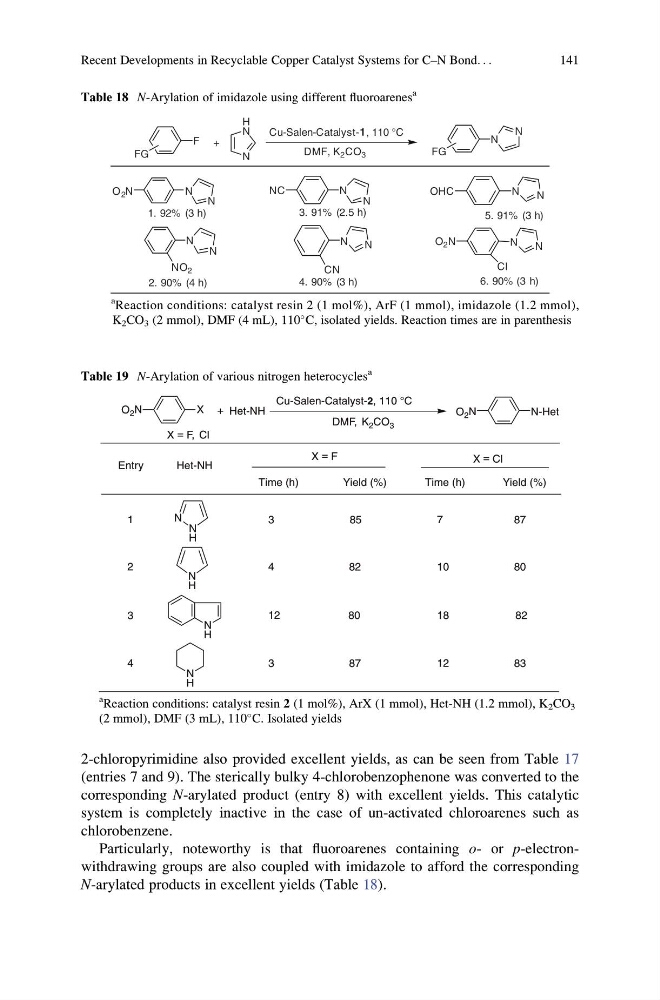
Particularly, noteworthy is that fluoroarenes containing o- or p-electronwithdrawing groups are also coupled with imidazole to afford the corresponding
N-arylated products in excellent yields (Table 18).
Table 18 N-Arylation of imidazole using different fluoroarenes
a
O 2 N
N
N
N
NC
N
CN
N
OHC
1. 92% (3 h)
2. 90% (4 h)
3. 91% (2.5 h)
4. 90% (3 h)
5. 91% (3 h)
N
Cl
O 2 N
6. 90% (3 h)
NO 2
N
N
N
N
N
N
DMF, K 2 CO 3
+
N
H
N
N
N
Cu-Salen-Catalyst-1, 110 °C
FG
F
FG
a Reaction conditions: catalyst resin 2 (1 mol%), ArF (1 mmol), imidazole (1.2 mmol),
K 2 CO 3 (2 mmol), DMF (4 mL), 110
C, isolated yields. Reaction times are in parenthesis
Table 19 N-Arylation of various nitrogen heterocycles
a
Entry
Het-NH
X = F
X = Cl
Time (h)
Time (h)
Yield (%)
Yield (%)
1
2
3
4
N
N
H
N
H
N
H
N
H
3
8 5
7
87
4
12
3
82
80
87
10
18
12
80
82
83
DMF, K 2 CO 3
+
N-Het
Cu-Salen-Catalyst-2, 110 °C
X
O 2 N
O 2 N
X = F, Cl
Het-NH
a
Reaction conditions: catalyst resin 2 (1 mol%), ArX (1 mmol), Het-NH (1.2 mmol), K 2 CO 3
(2 mmol), DMF (3 mL), 110
C. Isolated yields
Recent Developments in Recyclable Copper Catalyst Systems for C–N Bond. . .
141
(entries 7 and 9). The sterically bulky 4-chlorobenzophenone was converted to the
corresponding N-arylated product (entry 8) with excellent yields. This catalytic
system is completely inactive in the case of un-activated chloroarenes such as
chlorobenzene.
Particularly, noteworthy is that fluoroarenes containing o- or p-electronwithdrawing groups are also coupled with imidazole to afford the corresponding
N-arylated products in excellent yields (Table 18).
Table 18 N-Arylation of imidazole using different fluoroarenes
a
O 2 N
N
N
N
NC
N
CN
N
OHC
1. 92% (3 h)
2. 90% (4 h)
3. 91% (2.5 h)
4. 90% (3 h)
5. 91% (3 h)
N
Cl
O 2 N
6. 90% (3 h)
NO 2
N
N
N
N
N
N
DMF, K 2 CO 3
+
N
H
N
N
N
Cu-Salen-Catalyst-1, 110 °C
FG
F
FG
a Reaction conditions: catalyst resin 2 (1 mol%), ArF (1 mmol), imidazole (1.2 mmol),
K 2 CO 3 (2 mmol), DMF (4 mL), 110
C, isolated yields. Reaction times are in parenthesis
Table 19 N-Arylation of various nitrogen heterocycles
a
Entry
Het-NH
X = F
X = Cl
Time (h)
Time (h)
Yield (%)
Yield (%)
1
2
3
4
N
N
H
N
H
N
H
N
H
3
8 5
7
87
4
12
3
82
80
87
10
18
12
80
82
83
DMF, K 2 CO 3
+
N-Het
Cu-Salen-Catalyst-2, 110 °C
X
O 2 N
O 2 N
X = F, Cl
Het-NH
a
Reaction conditions: catalyst resin 2 (1 mol%), ArX (1 mmol), Het-NH (1.2 mmol), K 2 CO 3
(2 mmol), DMF (3 mL), 110
C. Isolated yields
Recent Developments in Recyclable Copper Catalyst Systems for C–N Bond. . .
141