

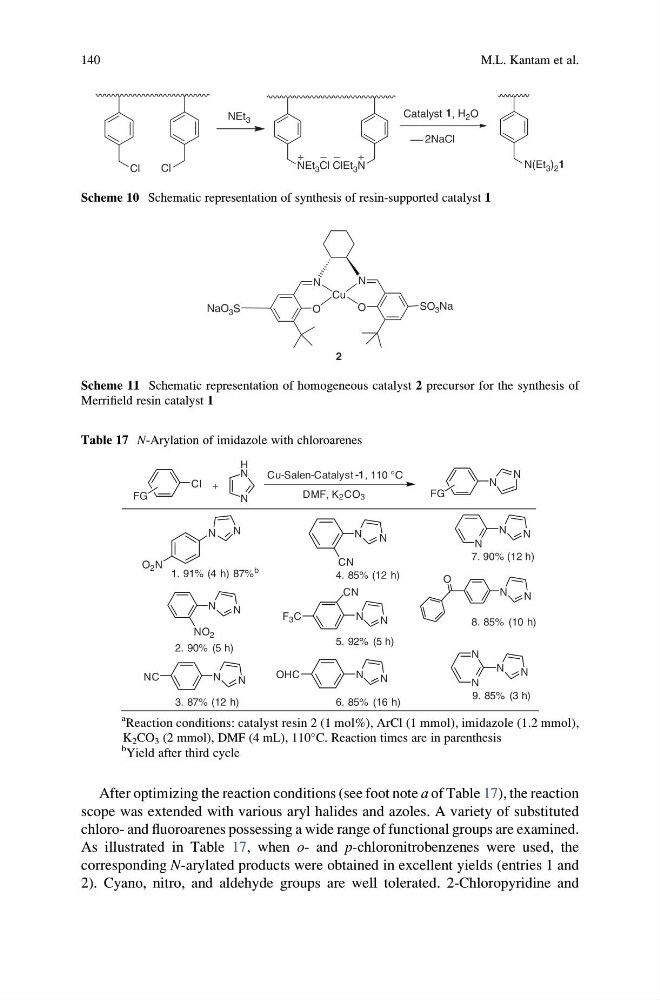
After optimizing the reaction conditions (see foot note a of Table 17), the reaction
scope was extended with various aryl halides and azoles. A variety of substituted
chloro- and fluoroarenes possessing a wide range of functional groups are examined.
As illustrated in Table 17, when o- and p-chloronitrobenzenes were used, the
corresponding N-arylated products were obtained in excellent yields (entries 1 and
2). Cyano, nitro, and aldehyde groups are well tolerated. 2-Chloropyridine and
Cl
Cl
NEt 3
NEt 3 Cl ClEt 3 N
Catalyst 1, H 2 O
2NaCl
N(Et 3 ) 2 1
+ _
+
_
Scheme 10 Schematic representation of synthesis of resin-supported catalyst 1
N
N
O
O
SO 3 Na
NaO 3 S
Cu
2
Scheme 11 Schematic representation of homogeneous catalyst 2 precursor for the synthesis of
Merrifield resin catalyst 1
Table 17 N-Arylation of imidazole with chloroarenes
N
O 2 N
N
N
NC
N
CN
N
OHC
N
N
N
N
N
1. 91% (4 h) 87% b
2. 90% (5 h)
3. 87% (12 h)
4. 85% (12 h)
CN
N
F 3 C
5. 92% (5 h)
6. 85% (16 h)
7. 90% (12 h)
8. 85% (10 h)
9. 85% (3 h)
O
N
NO 2
N
N
N
N
N
N
N
N
N
DMF, K 2 CO 3
+
N
H
N
N
N
Cu-Salen-Catalyst -1, 110 °C
FG
Cl
FG
a Reaction conditions: catalyst resin 2 (1 mol%), ArCl (1 mmol), imidazole (1.2 mmol),
K 2 CO 3 (2 mmol), DMF (4 mL), 110
C. Reaction times are in parenthesis
b
Yield after third cycle
140
M.L. Kantam et al.
scope was extended with various aryl halides and azoles. A variety of substituted
chloro- and fluoroarenes possessing a wide range of functional groups are examined.
As illustrated in Table 17, when o- and p-chloronitrobenzenes were used, the
corresponding N-arylated products were obtained in excellent yields (entries 1 and
2). Cyano, nitro, and aldehyde groups are well tolerated. 2-Chloropyridine and
Cl
Cl
NEt 3
NEt 3 Cl ClEt 3 N
Catalyst 1, H 2 O
2NaCl
N(Et 3 ) 2 1
+ _
+
_
Scheme 10 Schematic representation of synthesis of resin-supported catalyst 1
N
N
O
O
SO 3 Na
NaO 3 S
Cu
2
Scheme 11 Schematic representation of homogeneous catalyst 2 precursor for the synthesis of
Merrifield resin catalyst 1
Table 17 N-Arylation of imidazole with chloroarenes
N
O 2 N
N
N
NC
N
CN
N
OHC
N
N
N
N
N
1. 91% (4 h) 87% b
2. 90% (5 h)
3. 87% (12 h)
4. 85% (12 h)
CN
N
F 3 C
5. 92% (5 h)
6. 85% (16 h)
7. 90% (12 h)
8. 85% (10 h)
9. 85% (3 h)
O
N
NO 2
N
N
N
N
N
N
N
N
N
DMF, K 2 CO 3
+
N
H
N
N
N
Cu-Salen-Catalyst -1, 110 °C
FG
Cl
FG
a Reaction conditions: catalyst resin 2 (1 mol%), ArCl (1 mmol), imidazole (1.2 mmol),
K 2 CO 3 (2 mmol), DMF (4 mL), 110
C. Reaction times are in parenthesis
b
Yield after third cycle
140
M.L. Kantam et al.