

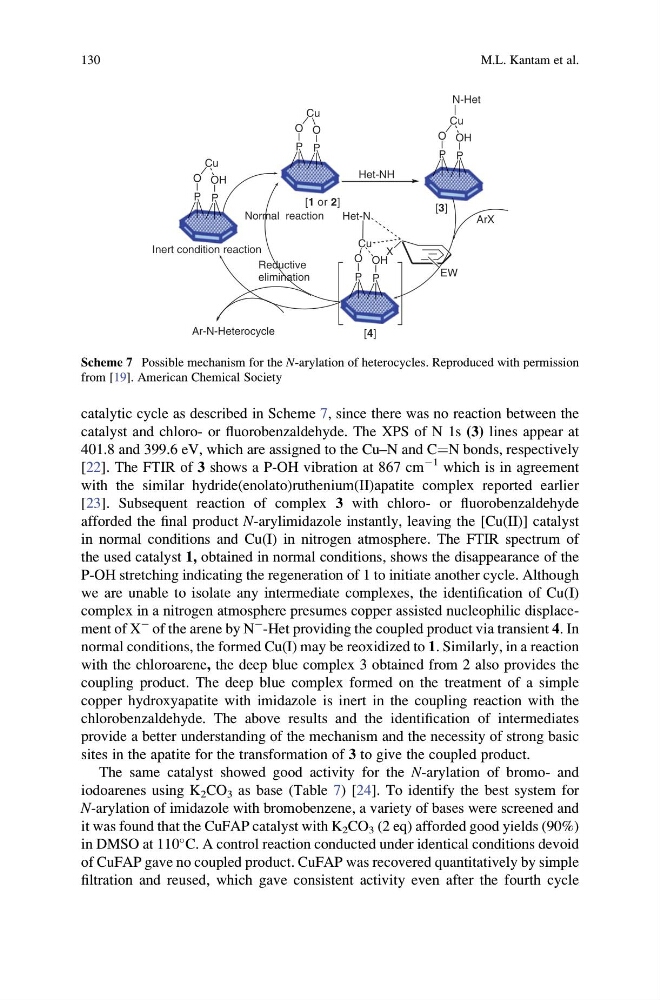
catalytic cycle as described in Scheme 7, since there was no reaction between the
catalyst and chloro- or fluorobenzaldehyde. The XPS of N 1s (3) lines appear at
401.8 and 399.6 eV, which are assigned to the Cu–N and C¼N bonds, respectively
[22]. The FTIR of 3 shows a P-OH vibration at 867 cm
À1 which is in agreement
with the similar hydride(enolato)ruthenium(II)apatite complex reported earlier
[23]. Subsequent reaction of complex 3 with chloro- or fluorobenzaldehyde
afforded the final product N-arylimidazole instantly, leaving the [Cu(II)] catalyst
in normal conditions and Cu(I) in nitrogen atmosphere. The FTIR spectrum of
the used catalyst 1, obtained in normal conditions, shows the disappearance of the
P-OH stretching indicating the regeneration of 1 to initiate another cycle. Although
we are unable to isolate any intermediate complexes, the identification of Cu(I)
complex in a nitrogen atmosphere presumes copper assisted nucleophilic displacement of X
À of the arene by N
À -Het providing the coupled product via transient 4. In
normal conditions, the formed Cu(I) may be reoxidized to 1. Similarly, in a reaction
with the chloroarene, the deep blue complex 3 obtained from 2 also provides the
coupling product. The deep blue complex formed on the treatment of a simple
copper hydroxyapatite with imidazole is inert in the coupling reaction with the
chlorobenzaldehyde. The above results and the identification of intermediates
provide a better understanding of the mechanism and the necessity of strong basic
sites in the apatite for the transformation of 3 to give the coupled product.
The same catalyst showed good activity for the N-arylation of bromo- and
iodoarenes using K 2 CO 3 as base (Table 7) [24]. To identify the best system for
N-arylation of imidazole with bromobenzene, a variety of bases were screened and
it was found that the CuFAP catalyst with K 2 CO 3 (2 eq) afforded good yields (90%)
in DMSO at 110
C. A control reaction conducted under identical conditions devoid
of CuFAP gave no coupled product. CuFAP was recovered quantitatively by simple
filtration and reused, which gave consistent activity even after the fourth cycle
P P
O O
Cu
P P
O OH
Cu
P P
O OH
Cu
Het-NH
Ar-N-Heterocycle
Reductive
elimination
Normal reaction
Inert condition reaction
N-Het
[1 or 2]
[3]
[4]
P P
O OH
Cu
Het-N
X
EW
ArX
Scheme 7 Possible mechanism for the N-arylation of heterocycles. Reproduced with permission
from [19]. American Chemical Society
130
M.L. Kantam et al.
catalyst and chloro- or fluorobenzaldehyde. The XPS of N 1s (3) lines appear at
401.8 and 399.6 eV, which are assigned to the Cu–N and C¼N bonds, respectively
[22]. The FTIR of 3 shows a P-OH vibration at 867 cm
À1 which is in agreement
with the similar hydride(enolato)ruthenium(II)apatite complex reported earlier
[23]. Subsequent reaction of complex 3 with chloro- or fluorobenzaldehyde
afforded the final product N-arylimidazole instantly, leaving the [Cu(II)] catalyst
in normal conditions and Cu(I) in nitrogen atmosphere. The FTIR spectrum of
the used catalyst 1, obtained in normal conditions, shows the disappearance of the
P-OH stretching indicating the regeneration of 1 to initiate another cycle. Although
we are unable to isolate any intermediate complexes, the identification of Cu(I)
complex in a nitrogen atmosphere presumes copper assisted nucleophilic displacement of X
À of the arene by N
À -Het providing the coupled product via transient 4. In
normal conditions, the formed Cu(I) may be reoxidized to 1. Similarly, in a reaction
with the chloroarene, the deep blue complex 3 obtained from 2 also provides the
coupling product. The deep blue complex formed on the treatment of a simple
copper hydroxyapatite with imidazole is inert in the coupling reaction with the
chlorobenzaldehyde. The above results and the identification of intermediates
provide a better understanding of the mechanism and the necessity of strong basic
sites in the apatite for the transformation of 3 to give the coupled product.
The same catalyst showed good activity for the N-arylation of bromo- and
iodoarenes using K 2 CO 3 as base (Table 7) [24]. To identify the best system for
N-arylation of imidazole with bromobenzene, a variety of bases were screened and
it was found that the CuFAP catalyst with K 2 CO 3 (2 eq) afforded good yields (90%)
in DMSO at 110
C. A control reaction conducted under identical conditions devoid
of CuFAP gave no coupled product. CuFAP was recovered quantitatively by simple
filtration and reused, which gave consistent activity even after the fourth cycle
P P
O O
Cu
P P
O OH
Cu
P P
O OH
Cu
Het-NH
Ar-N-Heterocycle
Reductive
elimination
Normal reaction
Inert condition reaction
N-Het
[1 or 2]
[3]
[4]
P P
O OH
Cu
Het-N
X
EW
ArX
Scheme 7 Possible mechanism for the N-arylation of heterocycles. Reproduced with permission
from [19]. American Chemical Society
130
M.L. Kantam et al.