

58
3 Materials and Methods
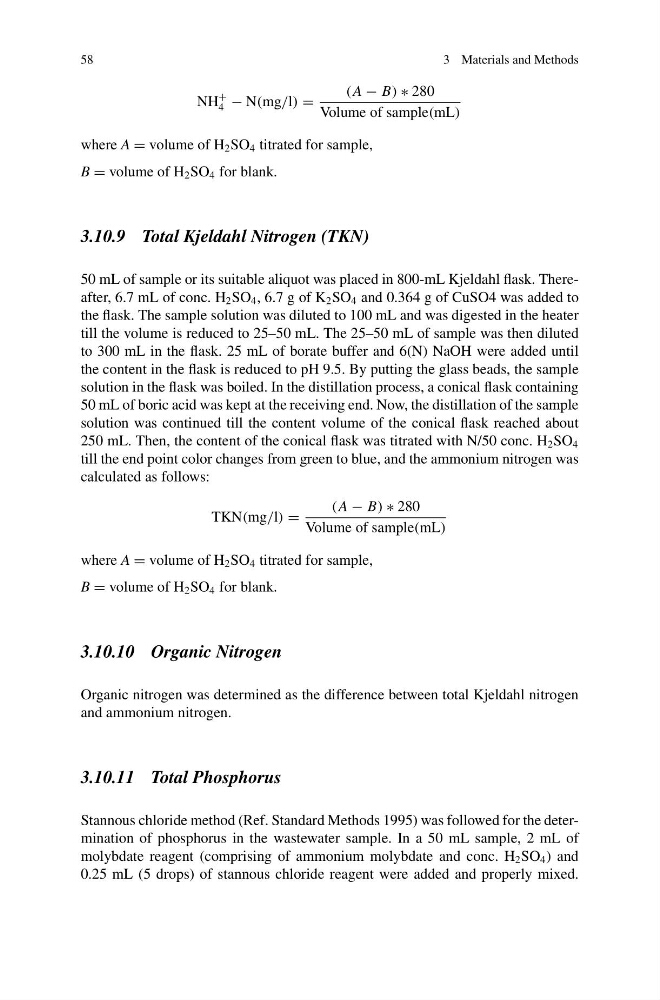
NH
+
4 − N(mg/l) =
(A − B) ∗ 280
Volume of sample(mL)
where A = volume of H 2 SO 4 titrated for sample,
B = volume of H 2 SO 4 for blank.
3.10.9 Total Kjeldahl Nitrogen (TKN)
50 mL of sample or its suitable aliquot was placed in 800-mL Kjeldahl flask. Thereafter, 6.7 mL of conc. H 2 SO 4 , 6.7 g of K 2 SO 4 and 0.364 g of CuSO4 was added to
the flask. The sample solution was diluted to 100 mL and was digested in the heater
till the volume is reduced to 25–50 mL. The 25–50 mL of sample was then diluted
to 300 mL in the flask. 25 mL of borate buffer and 6(N) NaOH were added until
the content in the flask is reduced to pH 9.5. By putting the glass beads, the sample
solution in the flask was boiled. In the distillation process, a conical flask containing
50 mL of boric acid was kept at the receiving end. Now, the distillation of the sample
solution was continued till the content volume of the conical flask reached about
250 mL. Then, the content of the conical flask was titrated with N/50 conc. H 2 SO 4
till the end point color changes from green to blue, and the ammonium nitrogen was
calculated as follows:
TKN(mg/l) =
(A − B) ∗ 280
Volume of sample(mL)
where A = volume of H 2 SO 4 titrated for sample,
B = volume of H 2 SO 4 for blank.
3.10.10 Organic Nitrogen
Organic nitrogen was determined as the difference between total Kjeldahl nitrogen
and ammonium nitrogen.
3.10.11 Total Phosphorus
Stannous chloride method (Ref. Standard Methods 1995) was followed for the determination of phosphorus in the wastewater sample. In a 50 mL sample, 2 mL of
molybdate reagent (comprising of ammonium molybdate and conc. H 2 SO 4 ) and
0.25 mL (5 drops) of stannous chloride reagent were added and properly mixed.
3 Materials and Methods
NH
+
4 − N(mg/l) =
(A − B) ∗ 280
Volume of sample(mL)
where A = volume of H 2 SO 4 titrated for sample,
B = volume of H 2 SO 4 for blank.
3.10.9 Total Kjeldahl Nitrogen (TKN)
50 mL of sample or its suitable aliquot was placed in 800-mL Kjeldahl flask. Thereafter, 6.7 mL of conc. H 2 SO 4 , 6.7 g of K 2 SO 4 and 0.364 g of CuSO4 was added to
the flask. The sample solution was diluted to 100 mL and was digested in the heater
till the volume is reduced to 25–50 mL. The 25–50 mL of sample was then diluted
to 300 mL in the flask. 25 mL of borate buffer and 6(N) NaOH were added until
the content in the flask is reduced to pH 9.5. By putting the glass beads, the sample
solution in the flask was boiled. In the distillation process, a conical flask containing
50 mL of boric acid was kept at the receiving end. Now, the distillation of the sample
solution was continued till the content volume of the conical flask reached about
250 mL. Then, the content of the conical flask was titrated with N/50 conc. H 2 SO 4
till the end point color changes from green to blue, and the ammonium nitrogen was
calculated as follows:
TKN(mg/l) =
(A − B) ∗ 280
Volume of sample(mL)
where A = volume of H 2 SO 4 titrated for sample,
B = volume of H 2 SO 4 for blank.
3.10.10 Organic Nitrogen
Organic nitrogen was determined as the difference between total Kjeldahl nitrogen
and ammonium nitrogen.
3.10.11 Total Phosphorus
Stannous chloride method (Ref. Standard Methods 1995) was followed for the determination of phosphorus in the wastewater sample. In a 50 mL sample, 2 mL of
molybdate reagent (comprising of ammonium molybdate and conc. H 2 SO 4 ) and
0.25 mL (5 drops) of stannous chloride reagent were added and properly mixed.