

56
3 Materials and Methods
where A is the sample and filter paper weight (gm)
B is the weight of the filter paper (gm)
C is the final weight of the crucible along with residue (gm)
D is the initial weight of the crucible (gm).
3.10.4 Alkalinity
Alkalinity is the acid neutralizing capacity and is equivalent to the sum of all titratable
bases. Alkalinity values provide guidance in applying proper doses of chemicals in
water and wastewater treatment processes, particularly in coagulation, softening and
operational control of anaerobic digestion. The alkalinity of wastewater is primarily
a function of carbonate, bicarbonate and hydroxide ions content and is represented
as an indication of the concentrations of these ions. Titration was done with the
bromocresol green indicator and was continued till the color of the sample sharp
changes from blue to green which indicates the complete neutralization of the ions
constituting the total alkalinity.
3.10.5 Total Solids
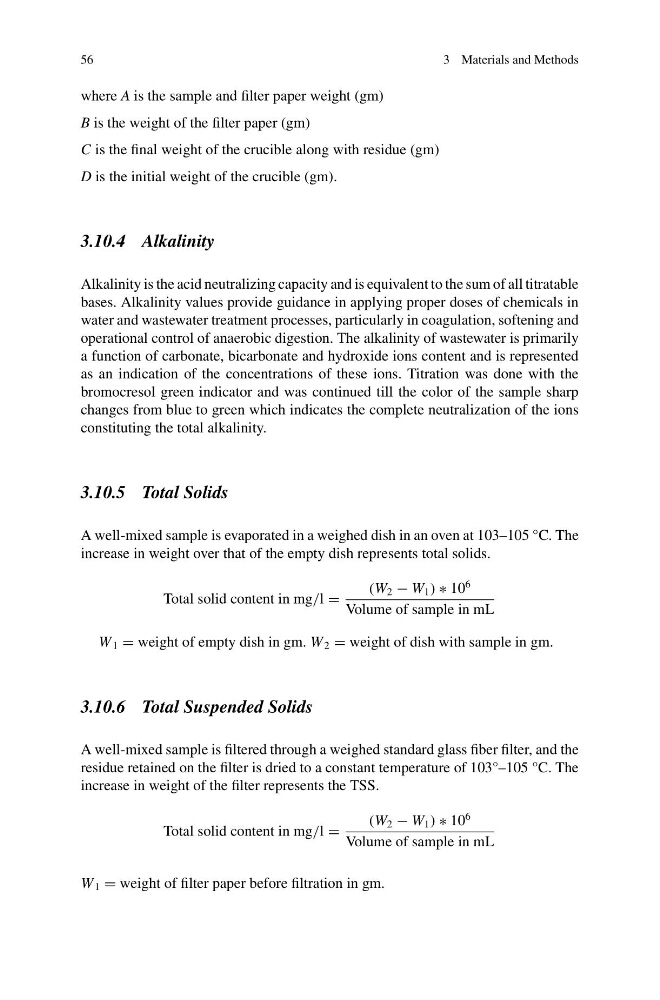
A well-mixed sample is evaporated in a weighed dish in an oven at 103–105 °C. The
increase in weight over that of the empty dish represents total solids.
Total solid content in mg/l =
(W 2 − W 1 ) ∗ 10
6
Volume of sample in mL
W 1 = weight of empty dish in gm. W 2 = weight of dish with sample in gm.
3.10.6 Total Suspended Solids
A well-mixed sample is filtered through a weighed standard glass fiber filter, and the
residue retained on the filter is dried to a constant temperature of 103°–105 °C. The
increase in weight of the filter represents the TSS.
Total solid content in mg/l =
(W 2 − W 1 ) ∗ 10
6
Volume of sample in mL
W 1 = weight of filter paper before filtration in gm.
3 Materials and Methods
where A is the sample and filter paper weight (gm)
B is the weight of the filter paper (gm)
C is the final weight of the crucible along with residue (gm)
D is the initial weight of the crucible (gm).
3.10.4 Alkalinity
Alkalinity is the acid neutralizing capacity and is equivalent to the sum of all titratable
bases. Alkalinity values provide guidance in applying proper doses of chemicals in
water and wastewater treatment processes, particularly in coagulation, softening and
operational control of anaerobic digestion. The alkalinity of wastewater is primarily
a function of carbonate, bicarbonate and hydroxide ions content and is represented
as an indication of the concentrations of these ions. Titration was done with the
bromocresol green indicator and was continued till the color of the sample sharp
changes from blue to green which indicates the complete neutralization of the ions
constituting the total alkalinity.
3.10.5 Total Solids
A well-mixed sample is evaporated in a weighed dish in an oven at 103–105 °C. The
increase in weight over that of the empty dish represents total solids.
Total solid content in mg/l =
(W 2 − W 1 ) ∗ 10
6
Volume of sample in mL
W 1 = weight of empty dish in gm. W 2 = weight of dish with sample in gm.
3.10.6 Total Suspended Solids
A well-mixed sample is filtered through a weighed standard glass fiber filter, and the
residue retained on the filter is dried to a constant temperature of 103°–105 °C. The
increase in weight of the filter represents the TSS.
Total solid content in mg/l =
(W 2 − W 1 ) ∗ 10
6
Volume of sample in mL
W 1 = weight of filter paper before filtration in gm.