

18
2 Advantages of Hybrid Bioreactor
The mathematical model of a hybrid bioreactor is an integration of the biofilm
model and the classical suspended-growth model. Out of these two models,
suspended-growth model is almost unique and simple, which is based on Monod’s
growth kinetics. But, the analysis of Biofilm model appears to be cumbersome on
account of its complexity [59, 60]. Besides, the characteristic of biofilm uptake is
quite different from the suspended-growth biomass [61]. Although there are many
existing models on biofilm, the procedure of solution is very tedious and the results of
outputs are found approximate. There is a limited number of models in the integrated
biofilm and suspended-growth process.
2.5.2 Mathematical Modeling of Suspended-Growth Process
In 1982, a task group was formed by International Association on Water Pollution
Research and Control (IAWPRC) to facilitate the application of models for designing
and operating activated sludge systems. Many models have since been developed to
describe various complex activated sludge systems. Grady [62] initially presented a
single sludge system model, which consisted of seven processes including carbon
oxidation, nitrification, and denitrification, which was the outline for a model, agreed
upon by the task group. The single sludge system model was developed to describe a
single sludge system with the matrix approach proposed by IAWQ (Bidstrup 1988).
A preliminary model was evaluated by Dold and Marais (1986) and this led to the
development of Activated Sludge Model No. 1 (ASM1). Modifications to that model
were made and adopted as a final version of ASM1 [62].
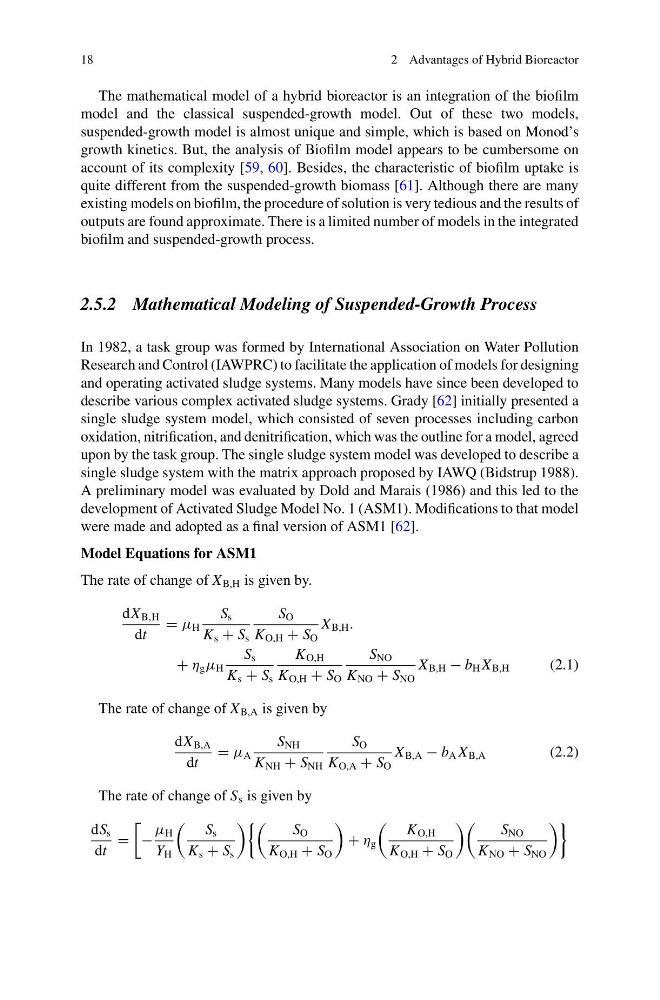
Model Equations for ASM1
The rate of change of X B,H is given by.
dX B,H
dt
= μ H
S s
K s + S s
S O
K O,H + S O
X B,H .
+ η g μ H
S s
K s + S s
K O,H
K O,H + S O
S NO
K NO + S NO
X B,H − b H X B,H
(2.1)
The rate of change of X B,A is given by
dX B,A
dt
= μ A
S NH
K NH + S NH
S O
K O,A + S O
X B,A − b A X B,A
(2.2)
The rate of change of S s is given by
dS s
dt
=
−
μ H
Y H
S s
K s + S s
S O
K O,H + S O
+ η g
K O,H
K O,H + S O
S NO
K NO + S NO
2 Advantages of Hybrid Bioreactor
The mathematical model of a hybrid bioreactor is an integration of the biofilm
model and the classical suspended-growth model. Out of these two models,
suspended-growth model is almost unique and simple, which is based on Monod’s
growth kinetics. But, the analysis of Biofilm model appears to be cumbersome on
account of its complexity [59, 60]. Besides, the characteristic of biofilm uptake is
quite different from the suspended-growth biomass [61]. Although there are many
existing models on biofilm, the procedure of solution is very tedious and the results of
outputs are found approximate. There is a limited number of models in the integrated
biofilm and suspended-growth process.
2.5.2 Mathematical Modeling of Suspended-Growth Process
In 1982, a task group was formed by International Association on Water Pollution
Research and Control (IAWPRC) to facilitate the application of models for designing
and operating activated sludge systems. Many models have since been developed to
describe various complex activated sludge systems. Grady [62] initially presented a
single sludge system model, which consisted of seven processes including carbon
oxidation, nitrification, and denitrification, which was the outline for a model, agreed
upon by the task group. The single sludge system model was developed to describe a
single sludge system with the matrix approach proposed by IAWQ (Bidstrup 1988).
A preliminary model was evaluated by Dold and Marais (1986) and this led to the
development of Activated Sludge Model No. 1 (ASM1). Modifications to that model
were made and adopted as a final version of ASM1 [62].
Model Equations for ASM1
The rate of change of X B,H is given by.
dX B,H
dt
= μ H
S s
K s + S s
S O
K O,H + S O
X B,H .
+ η g μ H
S s
K s + S s
K O,H
K O,H + S O
S NO
K NO + S NO
X B,H − b H X B,H
(2.1)
The rate of change of X B,A is given by
dX B,A
dt
= μ A
S NH
K NH + S NH
S O
K O,A + S O
X B,A − b A X B,A
(2.2)
The rate of change of S s is given by
dS s
dt
=
−
μ H
Y H
S s
K s + S s
S O
K O,H + S O
+ η g
K O,H
K O,H + S O
S NO
K NO + S NO