

2.5 Mathematical Modeling of Aerobic Fixed-Bed Hybrid Bioreactor
17
complicated biological fundamentals, but is also essential for process design [50–52],
process start-up [53], dynamic predictions [54–56], process control [57] and process
optimization [58]. Hybrid bioreactor model is essentially based on integration of both
the suspended- and attached-growth kinetics, where two types of microorganism act
simultaneously. There are limited number of methods available for solving problems
on hybrid bioreactor system. This is because the biological reactions involving the
conversion of the substrates by both suspended- and attached-growth biomass in a
concurrent way are highly complex. In general, this model is assumed to be consisting
of traditional suspended growth and biofilm models out of which solution of latter
one is much tedious and cumbersome. Although hybrid bioreactor exhibiting both
suspended and attached growth is widely used for biological treatment of wastewater, the reliable analysis for predictions pertinent to the performance of the said
reactor is still unknown. Mostly the kinetic models assuming single growth, i.e., either
suspended or attached were derived. Even where the competition for rate-limiting
substrates between two growths (both suspended and attached) were considered, no
unique accurate solution was obtained from the steady-state substrate and biomass
balance equations Reliable analysis for the appropriate process design leading to
predictions pertinent to the performance of the said reactor is really a challenge to
the researchers.
2.5.1 Concept of Modeling of Hybrid Bioreactor
In this reactor, a fraction of substrate is used by suspended biomass and the remaining
by attached biomass resulting in competition between the two growths for the
substrate.
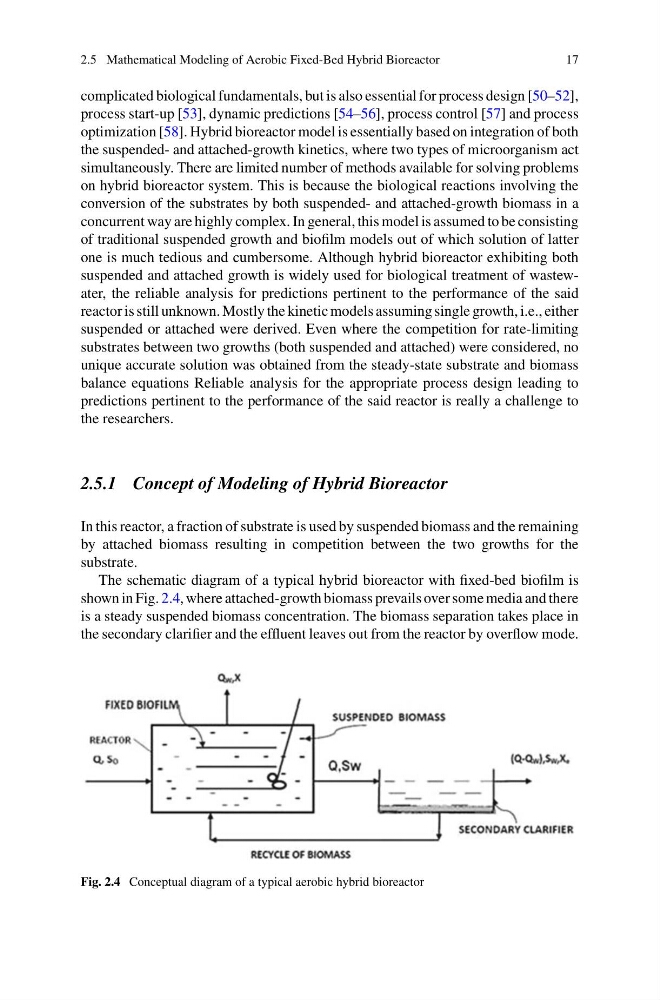
The schematic diagram of a typical hybrid bioreactor with fixed-bed biofilm is
shown in Fig. 2.4, where attached-growth biomass prevails over some media and there
is a steady suspended biomass concentration. The biomass separation takes place in
the secondary clarifier and the effluent leaves out from the reactor by overflow mode.
Fig. 2.4 Conceptual diagram of a typical aerobic hybrid bioreactor
17
complicated biological fundamentals, but is also essential for process design [50–52],
process start-up [53], dynamic predictions [54–56], process control [57] and process
optimization [58]. Hybrid bioreactor model is essentially based on integration of both
the suspended- and attached-growth kinetics, where two types of microorganism act
simultaneously. There are limited number of methods available for solving problems
on hybrid bioreactor system. This is because the biological reactions involving the
conversion of the substrates by both suspended- and attached-growth biomass in a
concurrent way are highly complex. In general, this model is assumed to be consisting
of traditional suspended growth and biofilm models out of which solution of latter
one is much tedious and cumbersome. Although hybrid bioreactor exhibiting both
suspended and attached growth is widely used for biological treatment of wastewater, the reliable analysis for predictions pertinent to the performance of the said
reactor is still unknown. Mostly the kinetic models assuming single growth, i.e., either
suspended or attached were derived. Even where the competition for rate-limiting
substrates between two growths (both suspended and attached) were considered, no
unique accurate solution was obtained from the steady-state substrate and biomass
balance equations Reliable analysis for the appropriate process design leading to
predictions pertinent to the performance of the said reactor is really a challenge to
the researchers.
2.5.1 Concept of Modeling of Hybrid Bioreactor
In this reactor, a fraction of substrate is used by suspended biomass and the remaining
by attached biomass resulting in competition between the two growths for the
substrate.
The schematic diagram of a typical hybrid bioreactor with fixed-bed biofilm is
shown in Fig. 2.4, where attached-growth biomass prevails over some media and there
is a steady suspended biomass concentration. The biomass separation takes place in
the secondary clarifier and the effluent leaves out from the reactor by overflow mode.
Fig. 2.4 Conceptual diagram of a typical aerobic hybrid bioreactor