

Fungal Production of Single Cell Oil Using Defatted Oilseed …
55
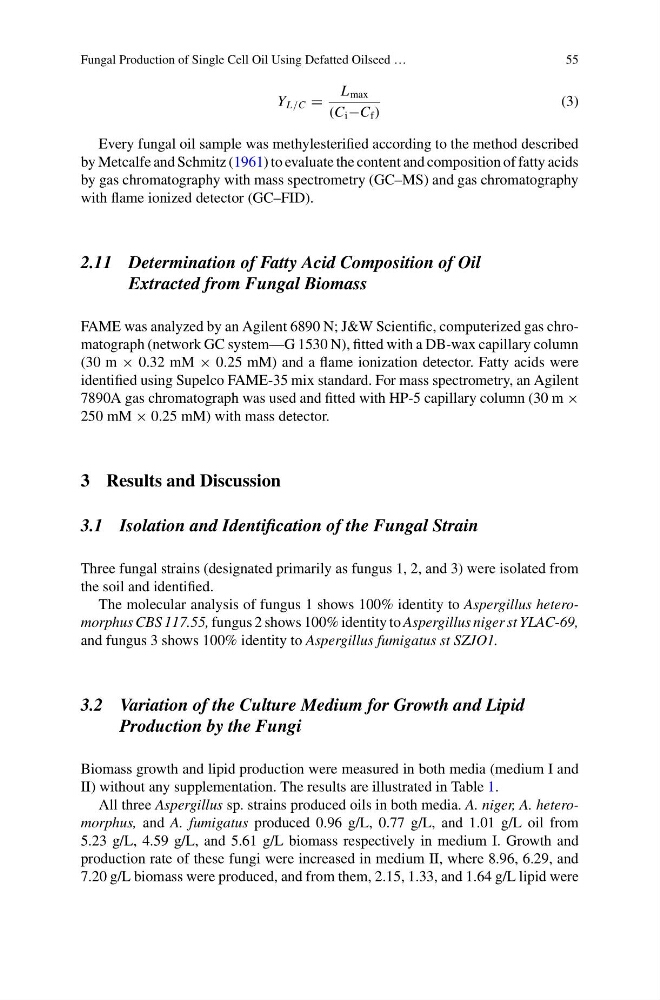
Y L/C =
L max
(C i −C f )
(3)
Every fungal oil sample was methylesterified according to the method described
by Metcalfe and Schmitz (1961) to evaluate the content and composition of fatty acids
by gas chromatography with mass spectrometry (GC–MS) and gas chromatography
with flame ionized detector (GC–FID).
2.11 Determination of Fatty Acid Composition of Oil
Extracted from Fungal Biomass
FAME was analyzed by an Agilent 6890 N; J&W Scientific, computerized gas chromatograph (network GC system—G 1530 N), fitted with a DB-wax capillary column
(30 m × 0.32 mM × 0.25 mM) and a flame ionization detector. Fatty acids were
identified using Supelco FAME-35 mix standard. For mass spectrometry, an Agilent
7890A gas chromatograph was used and fitted with HP-5 capillary column (30 m ×
250 mM × 0.25 mM) with mass detector.
3 Results and Discussion
3.1 Isolation and Identification of the Fungal Strain
Three fungal strains (designated primarily as fungus 1, 2, and 3) were isolated from
the soil and identified.
The molecular analysis of fungus 1 shows 100% identity to Aspergillus heteromorphus CBS 117.55, fungus 2 shows 100% identity to Aspergillus niger st YLAC-69,
and fungus 3 shows 100% identity to Aspergillus fumigatus st SZJO1.
3.2 Variation of the Culture Medium for Growth and Lipid
Production by the Fungi
Biomass growth and lipid production were measured in both media (medium I and
II) without any supplementation. The results are illustrated in Table 1.
All three Aspergillus sp. strains produced oils in both media. A. niger, A. heteromorphus, and A. fumigatus produced 0.96 g/L, 0.77 g/L, and 1.01 g/L oil from
5.23 g/L, 4.59 g/L, and 5.61 g/L biomass respectively in medium I. Growth and
production rate of these fungi were increased in medium II, where 8.96, 6.29, and
7.20 g/L biomass were produced, and from them, 2.15, 1.33, and 1.64 g/L lipid were
55
Y L/C =
L max
(C i −C f )
(3)
Every fungal oil sample was methylesterified according to the method described
by Metcalfe and Schmitz (1961) to evaluate the content and composition of fatty acids
by gas chromatography with mass spectrometry (GC–MS) and gas chromatography
with flame ionized detector (GC–FID).
2.11 Determination of Fatty Acid Composition of Oil
Extracted from Fungal Biomass
FAME was analyzed by an Agilent 6890 N; J&W Scientific, computerized gas chromatograph (network GC system—G 1530 N), fitted with a DB-wax capillary column
(30 m × 0.32 mM × 0.25 mM) and a flame ionization detector. Fatty acids were
identified using Supelco FAME-35 mix standard. For mass spectrometry, an Agilent
7890A gas chromatograph was used and fitted with HP-5 capillary column (30 m ×
250 mM × 0.25 mM) with mass detector.
3 Results and Discussion
3.1 Isolation and Identification of the Fungal Strain
Three fungal strains (designated primarily as fungus 1, 2, and 3) were isolated from
the soil and identified.
The molecular analysis of fungus 1 shows 100% identity to Aspergillus heteromorphus CBS 117.55, fungus 2 shows 100% identity to Aspergillus niger st YLAC-69,
and fungus 3 shows 100% identity to Aspergillus fumigatus st SZJO1.
3.2 Variation of the Culture Medium for Growth and Lipid
Production by the Fungi
Biomass growth and lipid production were measured in both media (medium I and
II) without any supplementation. The results are illustrated in Table 1.
All three Aspergillus sp. strains produced oils in both media. A. niger, A. heteromorphus, and A. fumigatus produced 0.96 g/L, 0.77 g/L, and 1.01 g/L oil from
5.23 g/L, 4.59 g/L, and 5.61 g/L biomass respectively in medium I. Growth and
production rate of these fungi were increased in medium II, where 8.96, 6.29, and
7.20 g/L biomass were produced, and from them, 2.15, 1.33, and 1.64 g/L lipid were