

46
M. Maity et al.
Table 3 Effect of
β-galactosidase on lactose
hydrolysis (%) of cheese
Sample
Lactose hydrolysis efficiency%
3 h
4 h
Control cheese
7.47 ± 0.31 a
7.89 ± 1.34 a
Cheese from
β-galactosidase-treated milk
72.60 ± 2.15 a 81.90 ± 0.34 a
Samples were analyzed in triplicate. Values are calculated as mean
± SD. Values displayed by same letters in the same column are
significantly different (P < 0.05) from each other
Table 2 exhibited the effect of pH on lactose hydrolysis efficiency of cow milk. It
was observed that maximum lactose hydrolysis efficiency of milk (79.23 ± 0.20%)
was achieved at pH 7. β-galactosidase from Kluveromyces marxianus leads to 86.8%
dairy whey lactose hydrolysis at pH 7 (Rajakala and Selvi 2006).
3.3.2 Estimation of Lactose Hydrolysis After Cheese Preparation
Cheese can be made from various sources of milk (cow, buffalo, goat, and sheep).
Depending on source, the appearance, color, and flavor of cheese vary. The main
sugar in milk is lactose. This partially purified β-galactosidase displayed hydrolytic
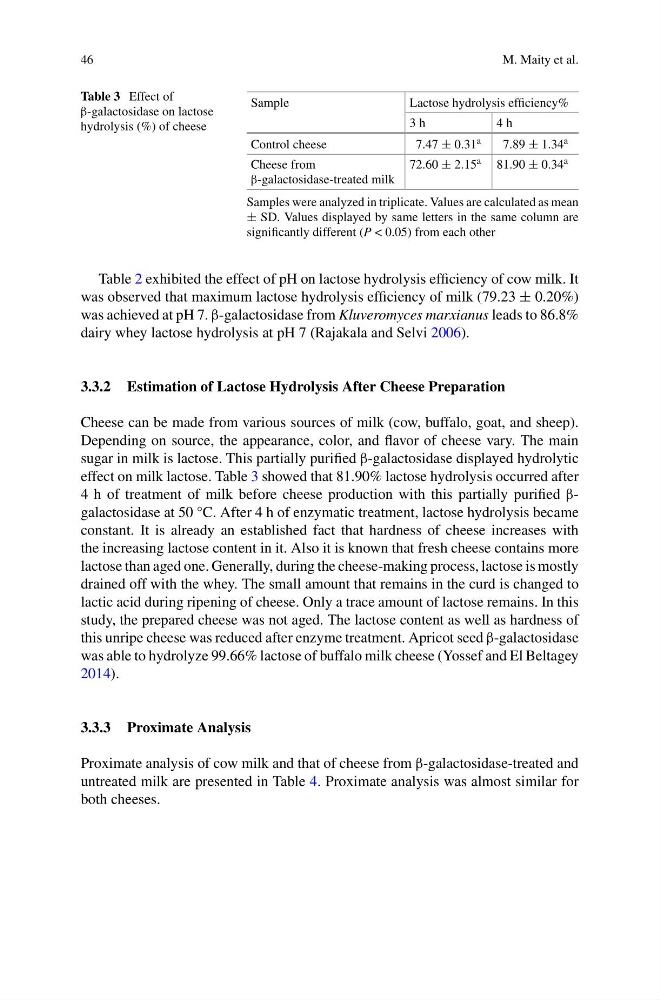
effect on milk lactose. Table 3 showed that 81.90% lactose hydrolysis occurred after
4 h of treatment of milk before cheese production with this partially purified βgalactosidase at 50 °C. After 4 h of enzymatic treatment, lactose hydrolysis became
constant. It is already an established fact that hardness of cheese increases with
the increasing lactose content in it. Also it is known that fresh cheese contains more
lactose than aged one. Generally, during the cheese-making process, lactose is mostly
drained off with the whey. The small amount that remains in the curd is changed to
lactic acid during ripening of cheese. Only a trace amount of lactose remains. In this
study, the prepared cheese was not aged. The lactose content as well as hardness of
this unripe cheese was reduced after enzyme treatment. Apricot seed β-galactosidase
was able to hydrolyze 99.66% lactose of buffalo milk cheese (Yossef and El Beltagey
2014).
3.3.3 Proximate Analysis
Proximate analysis of cow milk and that of cheese from β-galactosidase-treated and
untreated milk are presented in Table 4. Proximate analysis was almost similar for
both cheeses.
M. Maity et al.
Table 3 Effect of
β-galactosidase on lactose
hydrolysis (%) of cheese
Sample
Lactose hydrolysis efficiency%
3 h
4 h
Control cheese
7.47 ± 0.31 a
7.89 ± 1.34 a
Cheese from
β-galactosidase-treated milk
72.60 ± 2.15 a 81.90 ± 0.34 a
Samples were analyzed in triplicate. Values are calculated as mean
± SD. Values displayed by same letters in the same column are
significantly different (P < 0.05) from each other
Table 2 exhibited the effect of pH on lactose hydrolysis efficiency of cow milk. It
was observed that maximum lactose hydrolysis efficiency of milk (79.23 ± 0.20%)
was achieved at pH 7. β-galactosidase from Kluveromyces marxianus leads to 86.8%
dairy whey lactose hydrolysis at pH 7 (Rajakala and Selvi 2006).
3.3.2 Estimation of Lactose Hydrolysis After Cheese Preparation
Cheese can be made from various sources of milk (cow, buffalo, goat, and sheep).
Depending on source, the appearance, color, and flavor of cheese vary. The main
sugar in milk is lactose. This partially purified β-galactosidase displayed hydrolytic
effect on milk lactose. Table 3 showed that 81.90% lactose hydrolysis occurred after
4 h of treatment of milk before cheese production with this partially purified βgalactosidase at 50 °C. After 4 h of enzymatic treatment, lactose hydrolysis became
constant. It is already an established fact that hardness of cheese increases with
the increasing lactose content in it. Also it is known that fresh cheese contains more
lactose than aged one. Generally, during the cheese-making process, lactose is mostly
drained off with the whey. The small amount that remains in the curd is changed to
lactic acid during ripening of cheese. Only a trace amount of lactose remains. In this
study, the prepared cheese was not aged. The lactose content as well as hardness of
this unripe cheese was reduced after enzyme treatment. Apricot seed β-galactosidase
was able to hydrolyze 99.66% lactose of buffalo milk cheese (Yossef and El Beltagey
2014).
3.3.3 Proximate Analysis
Proximate analysis of cow milk and that of cheese from β-galactosidase-treated and
untreated milk are presented in Table 4. Proximate analysis was almost similar for
both cheeses.