

34
K. Sinha et al.
30
40
50
60
70
0
1000
2000
3000
4000
5000
6000
7000
8000
Intensity (a.u.)
2-Theta (degree)
ZnO
(100)
(002)
(101)
(110)
(200)
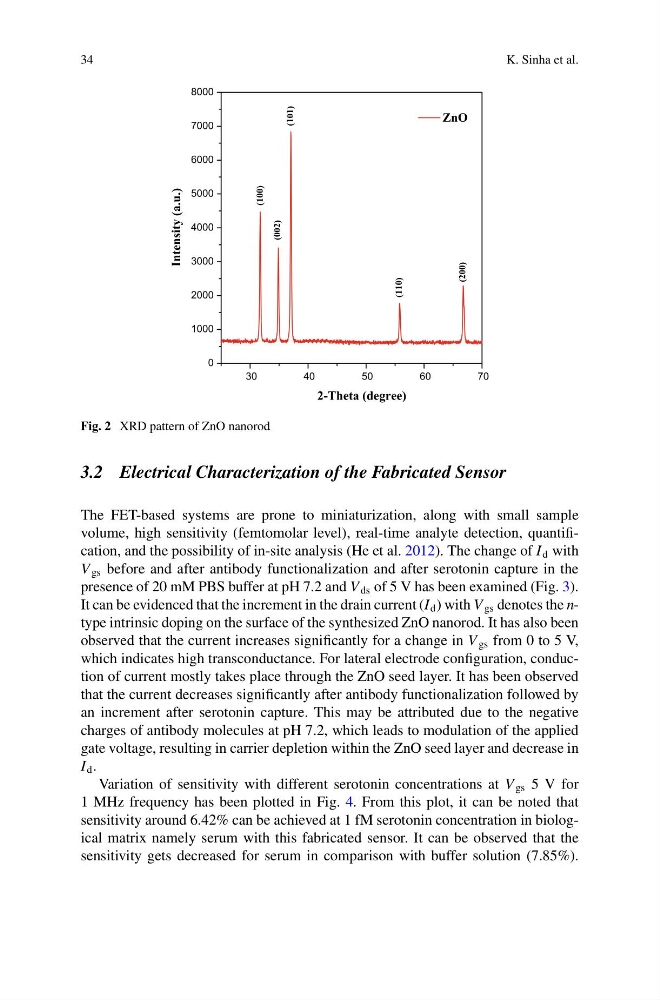
Fig. 2 XRD pattern of ZnO nanorod
3.2 Electrical Characterization of the Fabricated Sensor
The FET-based systems are prone to miniaturization, along with small sample
volume, high sensitivity (femtomolar level), real-time analyte detection, quantification, and the possibility of in-site analysis (He et al. 2012). The change of I d with
V gs before and after antibody functionalization and after serotonin capture in the
presence of 20 mM PBS buffer at pH 7.2 and V ds of 5 V has been examined (Fig. 3).
It can be evidenced that the increment in the drain current (I d ) with V gs denotes the ntype intrinsic doping on the surface of the synthesized ZnO nanorod. It has also been
observed that the current increases significantly for a change in V gs from 0 to 5 V,
which indicates high transconductance. For lateral electrode configuration, conduction of current mostly takes place through the ZnO seed layer. It has been observed
that the current decreases significantly after antibody functionalization followed by
an increment after serotonin capture. This may be attributed due to the negative
charges of antibody molecules at pH 7.2, which leads to modulation of the applied
gate voltage, resulting in carrier depletion within the ZnO seed layer and decrease in
I d .
Variation of sensitivity with different serotonin concentrations at V gs 5 V for
1 MHz frequency has been plotted in Fig. 4. From this plot, it can be noted that
sensitivity around 6.42% can be achieved at 1 fM serotonin concentration in biological matrix namely serum with this fabricated sensor. It can be observed that the
sensitivity gets decreased for serum in comparison with buffer solution (7.85%).
K. Sinha et al.
30
40
50
60
70
0
1000
2000
3000
4000
5000
6000
7000
8000
Intensity (a.u.)
2-Theta (degree)
ZnO
(100)
(002)
(101)
(110)
(200)
Fig. 2 XRD pattern of ZnO nanorod
3.2 Electrical Characterization of the Fabricated Sensor
The FET-based systems are prone to miniaturization, along with small sample
volume, high sensitivity (femtomolar level), real-time analyte detection, quantification, and the possibility of in-site analysis (He et al. 2012). The change of I d with
V gs before and after antibody functionalization and after serotonin capture in the
presence of 20 mM PBS buffer at pH 7.2 and V ds of 5 V has been examined (Fig. 3).
It can be evidenced that the increment in the drain current (I d ) with V gs denotes the ntype intrinsic doping on the surface of the synthesized ZnO nanorod. It has also been
observed that the current increases significantly for a change in V gs from 0 to 5 V,
which indicates high transconductance. For lateral electrode configuration, conduction of current mostly takes place through the ZnO seed layer. It has been observed
that the current decreases significantly after antibody functionalization followed by
an increment after serotonin capture. This may be attributed due to the negative
charges of antibody molecules at pH 7.2, which leads to modulation of the applied
gate voltage, resulting in carrier depletion within the ZnO seed layer and decrease in
I d .
Variation of sensitivity with different serotonin concentrations at V gs 5 V for
1 MHz frequency has been plotted in Fig. 4. From this plot, it can be noted that
sensitivity around 6.42% can be achieved at 1 fM serotonin concentration in biological matrix namely serum with this fabricated sensor. It can be observed that the
sensitivity gets decreased for serum in comparison with buffer solution (7.85%).