

Reduced Graphene Oxide (RGO)-Based Nanocatalyst for Inhibition …
473
5 Summary and Future Scope
In this article, we were focusing on the part of the antibacterial activity of graphene- or
RGO-based composites for wastewater remediation. The effectivity of RGO metal
nanocatalysts for E. coli inhibition was properly reviewed. Not only that the role
graphene for effective photocatalyst development as well as antibacterial property
enhancement was shortly described and explained. Bactericidal effect of RGO-based
nanocatalyst, namely, RGO–Ag, RGO–Fe, RGO–Cu, RGO–ZnO, RGO–TiO 2 were
evaluated and their comparative analysis was done based on their performance.
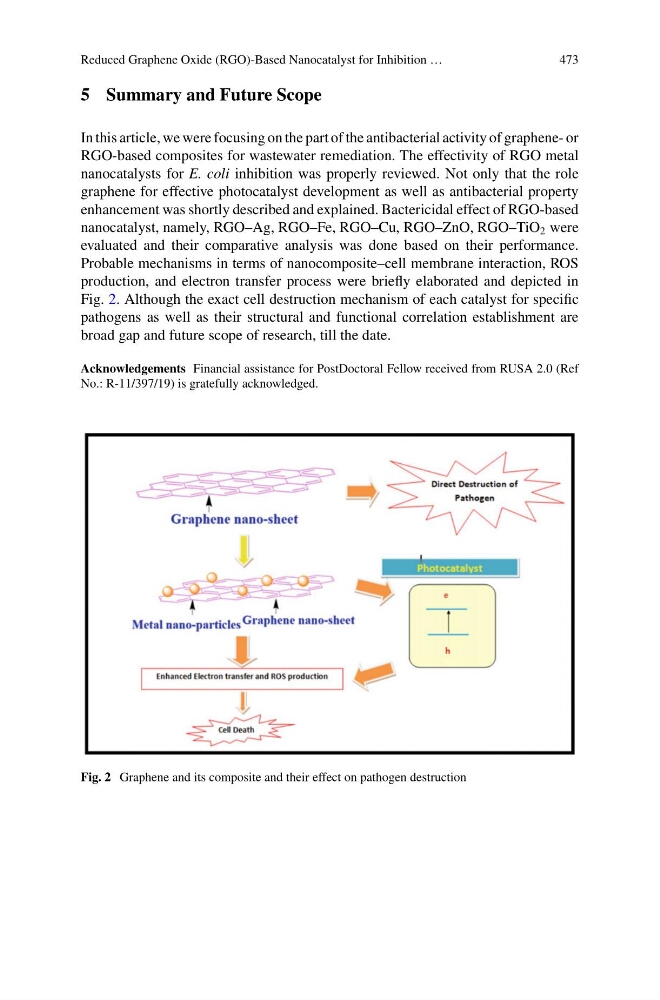
Probable mechanisms in terms of nanocomposite–cell membrane interaction, ROS
production, and electron transfer process were briefly elaborated and depicted in
Fig. 2. Although the exact cell destruction mechanism of each catalyst for specific
pathogens as well as their structural and functional correlation establishment are
broad gap and future scope of research, till the date.
Acknowledgements Financial assistance for PostDoctoral Fellow received from RUSA 2.0 (Ref
No.: R-11/397/19) is gratefully acknowledged.
Fig. 2 Graphene and its composite and their effect on pathogen destruction
473
5 Summary and Future Scope
In this article, we were focusing on the part of the antibacterial activity of graphene- or
RGO-based composites for wastewater remediation. The effectivity of RGO metal
nanocatalysts for E. coli inhibition was properly reviewed. Not only that the role
graphene for effective photocatalyst development as well as antibacterial property
enhancement was shortly described and explained. Bactericidal effect of RGO-based
nanocatalyst, namely, RGO–Ag, RGO–Fe, RGO–Cu, RGO–ZnO, RGO–TiO 2 were
evaluated and their comparative analysis was done based on their performance.
Probable mechanisms in terms of nanocomposite–cell membrane interaction, ROS
production, and electron transfer process were briefly elaborated and depicted in
Fig. 2. Although the exact cell destruction mechanism of each catalyst for specific
pathogens as well as their structural and functional correlation establishment are
broad gap and future scope of research, till the date.
Acknowledgements Financial assistance for PostDoctoral Fellow received from RUSA 2.0 (Ref
No.: R-11/397/19) is gratefully acknowledged.
Fig. 2 Graphene and its composite and their effect on pathogen destruction