

26
D. Dasgupta Mandal et al.
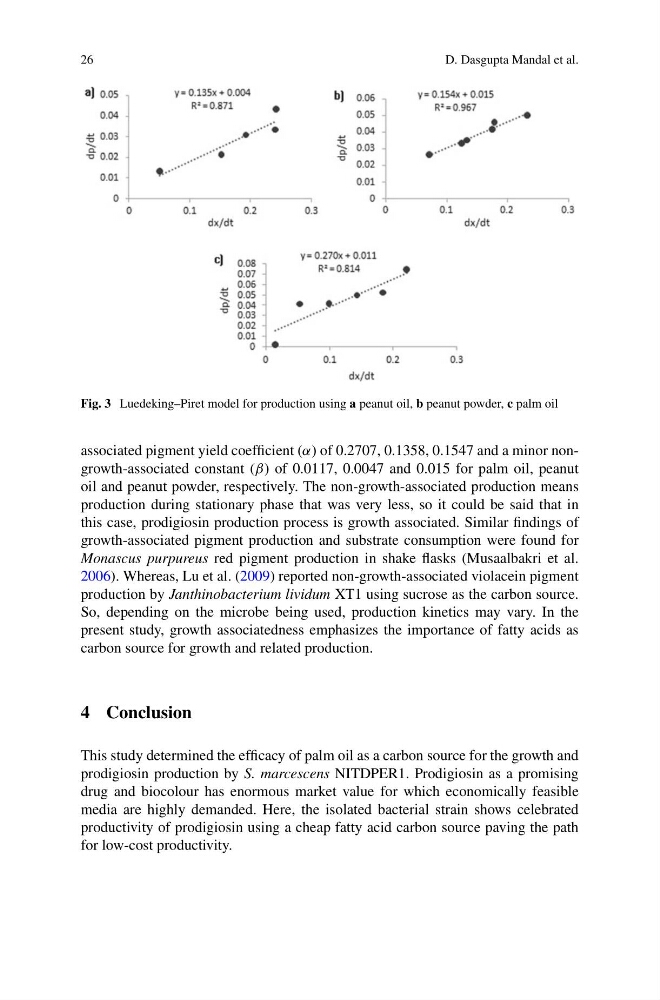
Fig. 3 Luedeking–Piret model for production using a peanut oil, b peanut powder, c palm oil
associated pigment yield coefficient (α) of 0.2707, 0.1358, 0.1547 and a minor nongrowth-associated constant (β) of 0.0117, 0.0047 and 0.015 for palm oil, peanut
oil and peanut powder, respectively. The non-growth-associated production means
production during stationary phase that was very less, so it could be said that in
this case, prodigiosin production process is growth associated. Similar findings of
growth-associated pigment production and substrate consumption were found for
Monascus purpureus red pigment production in shake flasks (Musaalbakri et al.
2006). Whereas, Lu et al. (2009) reported non-growth-associated violacein pigment
production by Janthinobacterium lividum XT1 using sucrose as the carbon source.
So, depending on the microbe being used, production kinetics may vary. In the
present study, growth associatedness emphasizes the importance of fatty acids as
carbon source for growth and related production.
4 Conclusion
This study determined the efficacy of palm oil as a carbon source for the growth and
prodigiosin production by S. marcescens NITDPER1. Prodigiosin as a promising
drug and biocolour has enormous market value for which economically feasible
media are highly demanded. Here, the isolated bacterial strain shows celebrated
productivity of prodigiosin using a cheap fatty acid carbon source paving the path
for low-cost productivity.
D. Dasgupta Mandal et al.
Fig. 3 Luedeking–Piret model for production using a peanut oil, b peanut powder, c palm oil
associated pigment yield coefficient (α) of 0.2707, 0.1358, 0.1547 and a minor nongrowth-associated constant (β) of 0.0117, 0.0047 and 0.015 for palm oil, peanut
oil and peanut powder, respectively. The non-growth-associated production means
production during stationary phase that was very less, so it could be said that in
this case, prodigiosin production process is growth associated. Similar findings of
growth-associated pigment production and substrate consumption were found for
Monascus purpureus red pigment production in shake flasks (Musaalbakri et al.
2006). Whereas, Lu et al. (2009) reported non-growth-associated violacein pigment
production by Janthinobacterium lividum XT1 using sucrose as the carbon source.
So, depending on the microbe being used, production kinetics may vary. In the
present study, growth associatedness emphasizes the importance of fatty acids as
carbon source for growth and related production.
4 Conclusion
This study determined the efficacy of palm oil as a carbon source for the growth and
prodigiosin production by S. marcescens NITDPER1. Prodigiosin as a promising
drug and biocolour has enormous market value for which economically feasible
media are highly demanded. Here, the isolated bacterial strain shows celebrated
productivity of prodigiosin using a cheap fatty acid carbon source paving the path
for low-cost productivity.