

Utilization of Low-Cost Fatty Acid Sources by Bacterial Isolate …
25
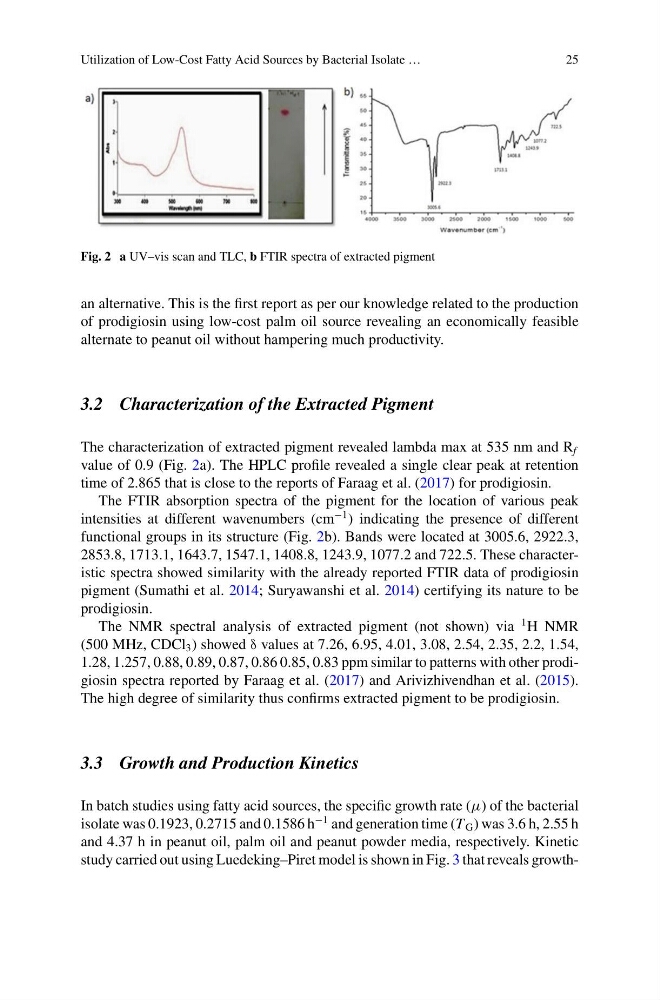
Fig. 2 a UV–vis scan and TLC, b FTIR spectra of extracted pigment
an alternative. This is the first report as per our knowledge related to the production
of prodigiosin using low-cost palm oil source revealing an economically feasible
alternate to peanut oil without hampering much productivity.
3.2 Characterization of the Extracted Pigment
The characterization of extracted pigment revealed lambda max at 535 nm and R f
value of 0.9 (Fig. 2a). The HPLC profile revealed a single clear peak at retention
time of 2.865 that is close to the reports of Faraag et al. (2017) for prodigiosin.
The FTIR absorption spectra of the pigment for the location of various peak
intensities at different wavenumbers (cm
−1 ) indicating the presence of different
functional groups in its structure (Fig. 2b). Bands were located at 3005.6, 2922.3,
2853.8, 1713.1, 1643.7, 1547.1, 1408.8, 1243.9, 1077.2 and 722.5. These characteristic spectra showed similarity with the already reported FTIR data of prodigiosin
pigment (Sumathi et al. 2014; Suryawanshi et al. 2014) certifying its nature to be
prodigiosin.
The NMR spectral analysis of extracted pigment (not shown) via
1 H NMR
(500 MHz, CDCl 3 ) showed δ values at 7.26, 6.95, 4.01, 3.08, 2.54, 2.35, 2.2, 1.54,
1.28, 1.257, 0.88, 0.89, 0.87, 0.86 0.85, 0.83 ppm similar to patterns with other prodigiosin spectra reported by Faraag et al. (2017) and Arivizhivendhan et al. (2015).
The high degree of similarity thus confirms extracted pigment to be prodigiosin.
3.3 Growth and Production Kinetics
In batch studies using fatty acid sources, the specific growth rate (μ) of the bacterial
isolate was 0.1923, 0.2715 and 0.1586 h
−1 and generation time (T G ) was 3.6 h, 2.55 h
and 4.37 h in peanut oil, palm oil and peanut powder media, respectively. Kinetic
study carried out using Luedeking–Piret model is shown in Fig. 3 that reveals growth-
25
Fig. 2 a UV–vis scan and TLC, b FTIR spectra of extracted pigment
an alternative. This is the first report as per our knowledge related to the production
of prodigiosin using low-cost palm oil source revealing an economically feasible
alternate to peanut oil without hampering much productivity.
3.2 Characterization of the Extracted Pigment
The characterization of extracted pigment revealed lambda max at 535 nm and R f
value of 0.9 (Fig. 2a). The HPLC profile revealed a single clear peak at retention
time of 2.865 that is close to the reports of Faraag et al. (2017) for prodigiosin.
The FTIR absorption spectra of the pigment for the location of various peak
intensities at different wavenumbers (cm
−1 ) indicating the presence of different
functional groups in its structure (Fig. 2b). Bands were located at 3005.6, 2922.3,
2853.8, 1713.1, 1643.7, 1547.1, 1408.8, 1243.9, 1077.2 and 722.5. These characteristic spectra showed similarity with the already reported FTIR data of prodigiosin
pigment (Sumathi et al. 2014; Suryawanshi et al. 2014) certifying its nature to be
prodigiosin.
The NMR spectral analysis of extracted pigment (not shown) via
1 H NMR
(500 MHz, CDCl 3 ) showed δ values at 7.26, 6.95, 4.01, 3.08, 2.54, 2.35, 2.2, 1.54,
1.28, 1.257, 0.88, 0.89, 0.87, 0.86 0.85, 0.83 ppm similar to patterns with other prodigiosin spectra reported by Faraag et al. (2017) and Arivizhivendhan et al. (2015).
The high degree of similarity thus confirms extracted pigment to be prodigiosin.
3.3 Growth and Production Kinetics
In batch studies using fatty acid sources, the specific growth rate (μ) of the bacterial
isolate was 0.1923, 0.2715 and 0.1586 h
−1 and generation time (T G ) was 3.6 h, 2.55 h
and 4.37 h in peanut oil, palm oil and peanut powder media, respectively. Kinetic
study carried out using Luedeking–Piret model is shown in Fig. 3 that reveals growth-