

Performance and Kinetic Studies of Dairy Effluent Using Mixed Culture …
385
2 months. The pH value was maintained as 7.5–8 by adjusting with exact amount of
acetic acid (0.01 N). During this acclimatization phase, biomass growth was noticed
by checking SVI and also by gas formation aspect, which indicated that the biomass
was in active stage.
2.2 Collection of Field Sample
Real-life dairy wastewater sample was also collected from a local dairy processing
unit. Besides packaged milk, this dairy unit also produces curd, lassi, paneer buttermilk and ghee. The plant produces effluent with flow rate of 90–100 m
3 /d on daily
average basis. Effluents were collected six times in different months during the study
phase. The samples were brought to the Civil Engineering Department Laboratory,
Jadavpur University and kept in a sample preservation unit at a temperature of 4 °C.
Each sample was tested for the characterization of parameters viz. pH, alkalinity,
DO, MLSS, SCOD, NH 4
+ –N, NO 3
− –N as per ‘Standard Methods’ (APHA 1998).
2.3 Experimental Setup
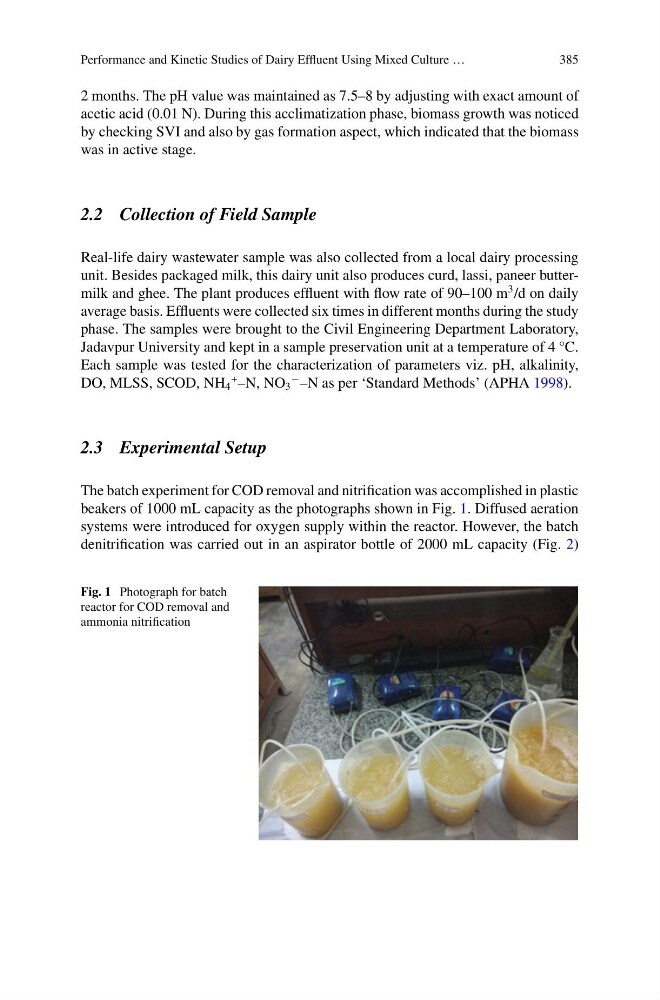
The batch experiment for COD removal and nitrification was accomplished in plastic
beakers of 1000 mL capacity as the photographs shown in Fig. 1. Diffused aeration
systems were introduced for oxygen supply within the reactor. However, the batch
denitrification was carried out in an aspirator bottle of 2000 mL capacity (Fig. 2)
Fig. 1 Photograph for batch
reactor for COD removal and
ammonia nitrification
385
2 months. The pH value was maintained as 7.5–8 by adjusting with exact amount of
acetic acid (0.01 N). During this acclimatization phase, biomass growth was noticed
by checking SVI and also by gas formation aspect, which indicated that the biomass
was in active stage.
2.2 Collection of Field Sample
Real-life dairy wastewater sample was also collected from a local dairy processing
unit. Besides packaged milk, this dairy unit also produces curd, lassi, paneer buttermilk and ghee. The plant produces effluent with flow rate of 90–100 m
3 /d on daily
average basis. Effluents were collected six times in different months during the study
phase. The samples were brought to the Civil Engineering Department Laboratory,
Jadavpur University and kept in a sample preservation unit at a temperature of 4 °C.
Each sample was tested for the characterization of parameters viz. pH, alkalinity,
DO, MLSS, SCOD, NH 4
+ –N, NO 3
− –N as per ‘Standard Methods’ (APHA 1998).
2.3 Experimental Setup
The batch experiment for COD removal and nitrification was accomplished in plastic
beakers of 1000 mL capacity as the photographs shown in Fig. 1. Diffused aeration
systems were introduced for oxygen supply within the reactor. However, the batch
denitrification was carried out in an aspirator bottle of 2000 mL capacity (Fig. 2)
Fig. 1 Photograph for batch
reactor for COD removal and
ammonia nitrification