

Bioconversion of Mandarin Orange Peels by Aspergillus oryzae …
1 7
2.11 GC–MS Analysis of Flavors Obtained from Spoiled
Mandarin Peel Oils and Bioconversion of Standard
Aromatic Volatiles
Flavor compounds obtained from fungus-infected mandarins peel oils and bioconversion of standard aromatic volatiles were extracted by direct solvent extraction
method (Nwobi et al. 2006) and determined by GC–MS analysis as described earlier
in Sects. 2.4 and 2.5.
3 Results and Discussion
3.1 Gas Chromatography–Mass Spectrometry (GC–MS)
Analysis of Essential Oils of Fresh Mandarin Peel
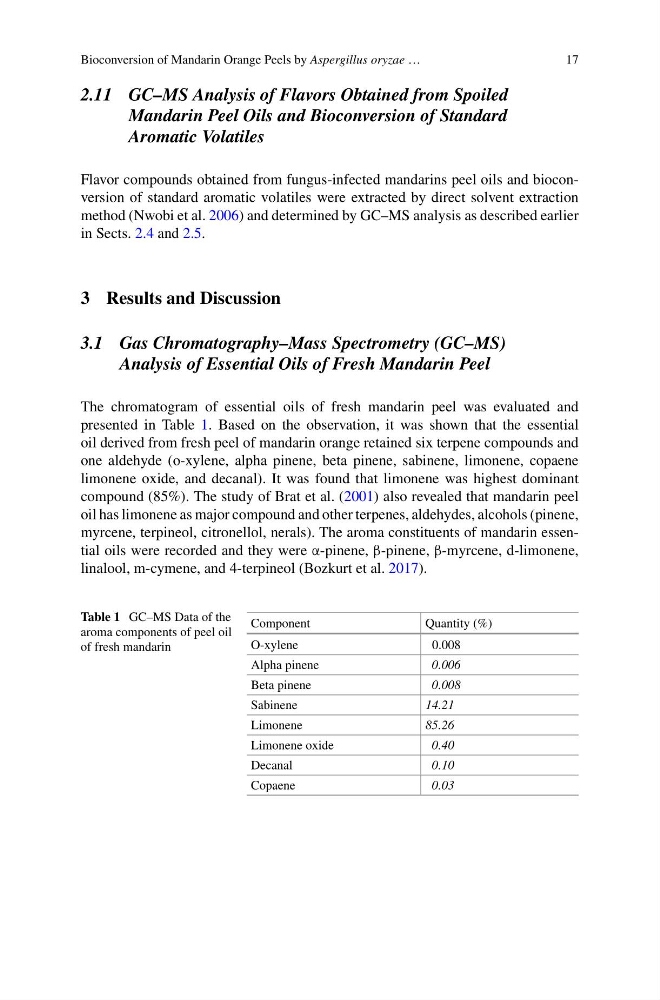
The chromatogram of essential oils of fresh mandarin peel was evaluated and
presented in Table 1. Based on the observation, it was shown that the essential
oil derived from fresh peel of mandarin orange retained six terpene compounds and
one aldehyde (o-xylene, alpha pinene, beta pinene, sabinene, limonene, copaene
limonene oxide, and decanal). It was found that limonene was highest dominant
compound (85%). The study of Brat et al. (2001) also revealed that mandarin peel
oil has limonene as major compound and other terpenes, aldehydes, alcohols (pinene,
myrcene, terpineol, citronellol, nerals). The aroma constituents of mandarin essential oils were recorded and they were α-pinene, β-pinene, β-myrcene, d-limonene,
linalool, m-cymene, and 4-terpineol (Bozkurt et al. 2017).
Table 1 GC–MS Data of the
aroma components of peel oil
of fresh mandarin
Component
Quantity (%)
O-xylene
0.008
Alpha pinene
0.006
Beta pinene
0.008
Sabinene
14.21
Limonene
85.26
Limonene oxide
0.40
Decanal
0.10
Copaene
0.03
1 7
2.11 GC–MS Analysis of Flavors Obtained from Spoiled
Mandarin Peel Oils and Bioconversion of Standard
Aromatic Volatiles
Flavor compounds obtained from fungus-infected mandarins peel oils and bioconversion of standard aromatic volatiles were extracted by direct solvent extraction
method (Nwobi et al. 2006) and determined by GC–MS analysis as described earlier
in Sects. 2.4 and 2.5.
3 Results and Discussion
3.1 Gas Chromatography–Mass Spectrometry (GC–MS)
Analysis of Essential Oils of Fresh Mandarin Peel
The chromatogram of essential oils of fresh mandarin peel was evaluated and
presented in Table 1. Based on the observation, it was shown that the essential
oil derived from fresh peel of mandarin orange retained six terpene compounds and
one aldehyde (o-xylene, alpha pinene, beta pinene, sabinene, limonene, copaene
limonene oxide, and decanal). It was found that limonene was highest dominant
compound (85%). The study of Brat et al. (2001) also revealed that mandarin peel
oil has limonene as major compound and other terpenes, aldehydes, alcohols (pinene,
myrcene, terpineol, citronellol, nerals). The aroma constituents of mandarin essential oils were recorded and they were α-pinene, β-pinene, β-myrcene, d-limonene,
linalool, m-cymene, and 4-terpineol (Bozkurt et al. 2017).
Table 1 GC–MS Data of the
aroma components of peel oil
of fresh mandarin
Component
Quantity (%)
O-xylene
0.008
Alpha pinene
0.006
Beta pinene
0.008
Sabinene
14.21
Limonene
85.26
Limonene oxide
0.40
Decanal
0.10
Copaene
0.03