

324
R. S. Purty et al.
function of an organism. A carefully and efficiently synthesized nanoparticle size
varies from around 20–150 nm. The size of the synthesized nanoparticle was found
to be around 279.2 nm that is bit large as compared with the expected size but still was
in nanometer range and can perform all the characteristic nanoparticle properties.
Dye degradation test was such an example, where the activity of the nanoparticles
degraded the dye although the time of degradation was more as compared with the
time mentioned in other manuscripts (Nasikhudin et al. 2018). Also the synthesized
nanoparticles were able to stop the growth of the bacterial colonies by interfering with
the survival mechanism of bacterium and ultimately causing their death. Further, it
could be said that nanoparticles in future could possibly replace the chemical methods
to kill different microbes, specially the microbes related to cash crops and food
industry. Antimicrobial clothes can also be reproduced by the process of nanocoating.
We were able to synthesize the TiO 2 nanoparticle, though not of desired size,
but it had all the properties of a nanoparticle. The qualitative dye degradation was
successfully performed as it was able to degrade the dye which is seen in Fig. 7. The
result of UV–vis spectrophotometer was found to be good from which we concluded
that it is of nanosize. DLS reading confirmed the same by giving the exact size of
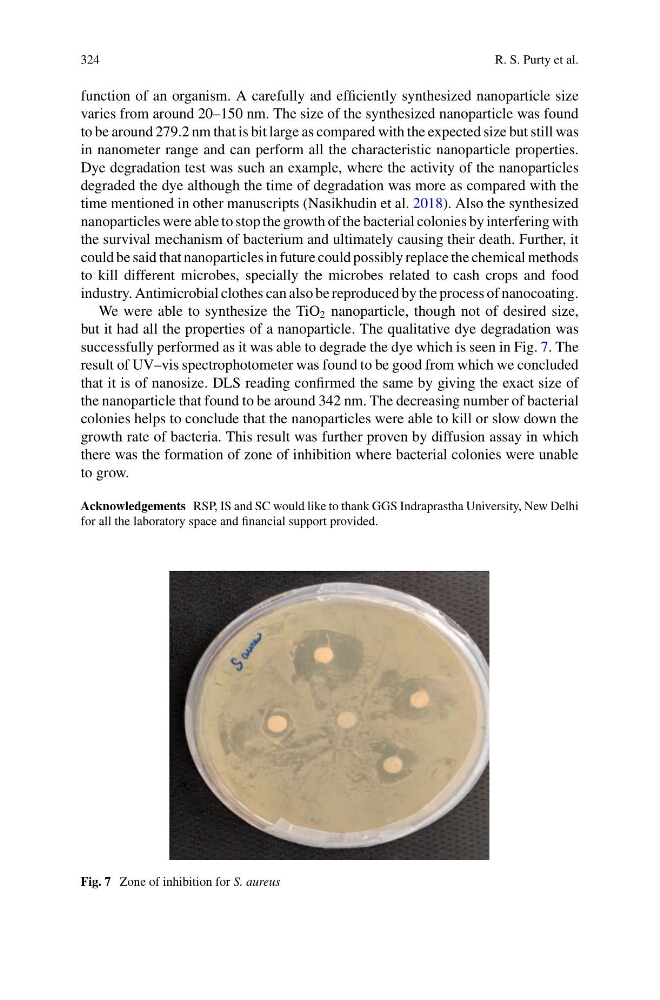
the nanoparticle that found to be around 342 nm. The decreasing number of bacterial
colonies helps to conclude that the nanoparticles were able to kill or slow down the
growth rate of bacteria. This result was further proven by diffusion assay in which
there was the formation of zone of inhibition where bacterial colonies were unable
to grow.
Acknowledgements RSP, IS and SC would like to thank GGS Indraprastha University, New Delhi
for all the laboratory space and financial support provided.
Fig. 7 Zone of inhibition for S. aureus
R. S. Purty et al.
function of an organism. A carefully and efficiently synthesized nanoparticle size
varies from around 20–150 nm. The size of the synthesized nanoparticle was found
to be around 279.2 nm that is bit large as compared with the expected size but still was
in nanometer range and can perform all the characteristic nanoparticle properties.
Dye degradation test was such an example, where the activity of the nanoparticles
degraded the dye although the time of degradation was more as compared with the
time mentioned in other manuscripts (Nasikhudin et al. 2018). Also the synthesized
nanoparticles were able to stop the growth of the bacterial colonies by interfering with
the survival mechanism of bacterium and ultimately causing their death. Further, it
could be said that nanoparticles in future could possibly replace the chemical methods
to kill different microbes, specially the microbes related to cash crops and food
industry. Antimicrobial clothes can also be reproduced by the process of nanocoating.
We were able to synthesize the TiO 2 nanoparticle, though not of desired size,
but it had all the properties of a nanoparticle. The qualitative dye degradation was
successfully performed as it was able to degrade the dye which is seen in Fig. 7. The
result of UV–vis spectrophotometer was found to be good from which we concluded
that it is of nanosize. DLS reading confirmed the same by giving the exact size of
the nanoparticle that found to be around 342 nm. The decreasing number of bacterial
colonies helps to conclude that the nanoparticles were able to kill or slow down the
growth rate of bacteria. This result was further proven by diffusion assay in which
there was the formation of zone of inhibition where bacterial colonies were unable
to grow.
Acknowledgements RSP, IS and SC would like to thank GGS Indraprastha University, New Delhi
for all the laboratory space and financial support provided.
Fig. 7 Zone of inhibition for S. aureus