

Synthesis and Characterization of TiO 2 Nanoparticle and Checking …
323
colony in the control, where no nanopowder was added. From this, it was concluded
that the addition of TiO 2 nanopowder was able to control the growth of E. coli and
S. aureus.
3.4.2 Antimicrobial Efficiency of TiO 2 Nanoparticles by Agar Diffusion
Assay
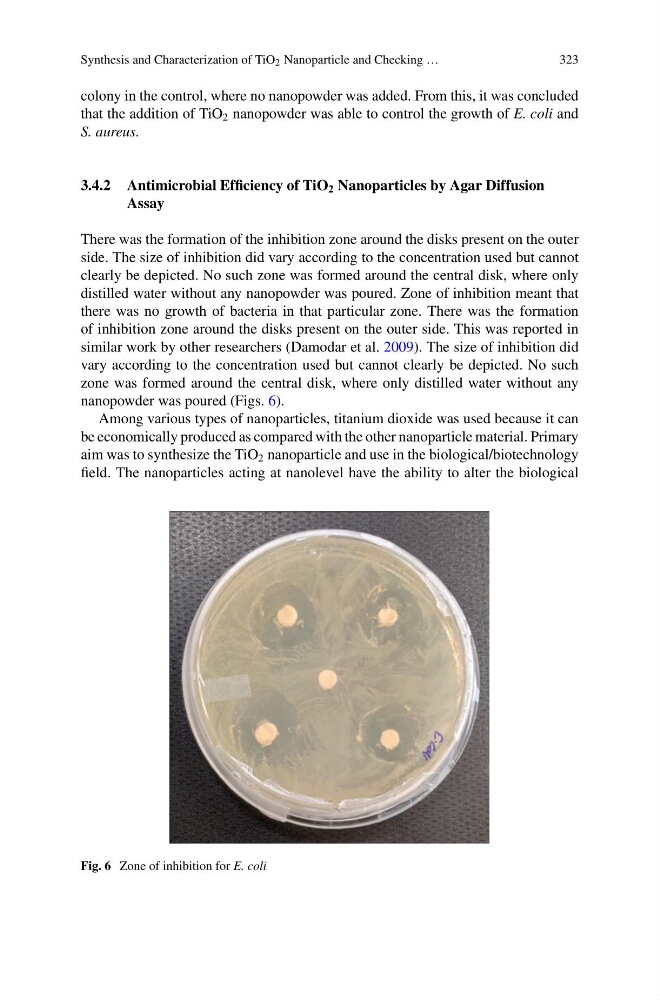
There was the formation of the inhibition zone around the disks present on the outer
side. The size of inhibition did vary according to the concentration used but cannot
clearly be depicted. No such zone was formed around the central disk, where only
distilled water without any nanopowder was poured. Zone of inhibition meant that
there was no growth of bacteria in that particular zone. There was the formation
of inhibition zone around the disks present on the outer side. This was reported in
similar work by other researchers (Damodar et al. 2009). The size of inhibition did
vary according to the concentration used but cannot clearly be depicted. No such
zone was formed around the central disk, where only distilled water without any
nanopowder was poured (Figs. 6).
Among various types of nanoparticles, titanium dioxide was used because it can
be economically produced as compared with the other nanoparticle material. Primary
aim was to synthesize the TiO 2 nanoparticle and use in the biological/biotechnology
field. The nanoparticles acting at nanolevel have the ability to alter the biological
Fig. 6 Zone of inhibition for E. coli
323
colony in the control, where no nanopowder was added. From this, it was concluded
that the addition of TiO 2 nanopowder was able to control the growth of E. coli and
S. aureus.
3.4.2 Antimicrobial Efficiency of TiO 2 Nanoparticles by Agar Diffusion
Assay
There was the formation of the inhibition zone around the disks present on the outer
side. The size of inhibition did vary according to the concentration used but cannot
clearly be depicted. No such zone was formed around the central disk, where only
distilled water without any nanopowder was poured. Zone of inhibition meant that
there was no growth of bacteria in that particular zone. There was the formation
of inhibition zone around the disks present on the outer side. This was reported in
similar work by other researchers (Damodar et al. 2009). The size of inhibition did
vary according to the concentration used but cannot clearly be depicted. No such
zone was formed around the central disk, where only distilled water without any
nanopowder was poured (Figs. 6).
Among various types of nanoparticles, titanium dioxide was used because it can
be economically produced as compared with the other nanoparticle material. Primary
aim was to synthesize the TiO 2 nanoparticle and use in the biological/biotechnology
field. The nanoparticles acting at nanolevel have the ability to alter the biological
Fig. 6 Zone of inhibition for E. coli