

308
B. Singh and S. Banerjee
3.6 Antioxidant Activity Estimations
For the CAT assay, the enzyme activity was expressed in mmol of hydrogen peroxide
consumed per minute (Clare et al. 1984).
The APX activity, one unit of the APX was measured as 1 µM of ascorbate
oxidized per minute (Nakano and Asada 1981).
In the glutathione reductase activity, the one unit of GR activity is defined equals
to oxidation of 1 µmol of NADPH (Schaedle and Bassham 1977).
4 Results and Discussion
4.1 Chlorophyll Content and Shoot Growth
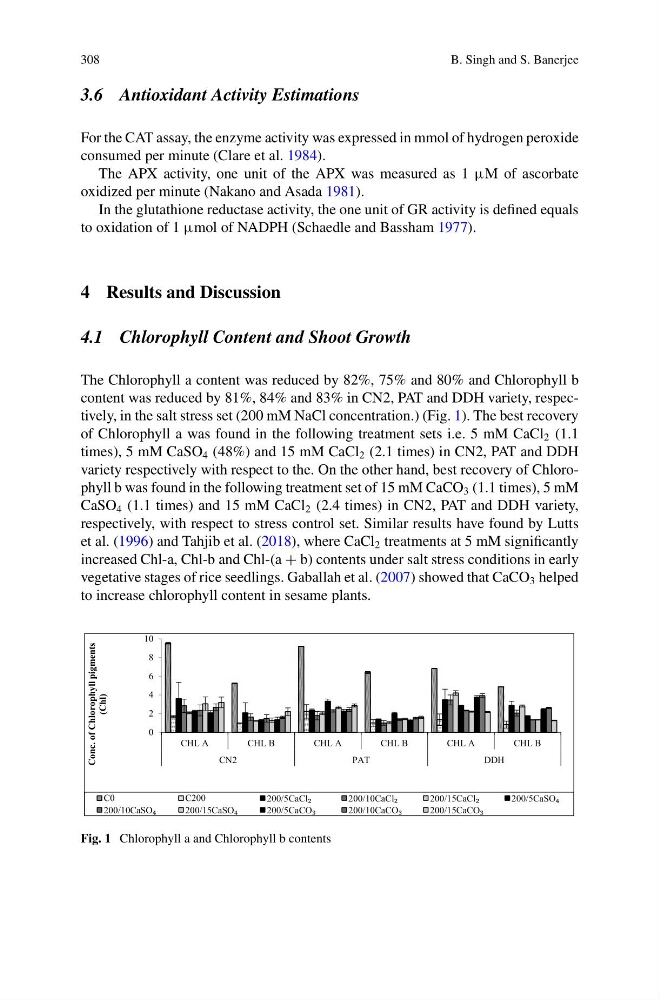
The Chlorophyll a content was reduced by 82%, 75% and 80% and Chlorophyll b
content was reduced by 81%, 84% and 83% in CN2, PAT and DDH variety, respectively, in the salt stress set (200 mM NaCl concentration.) (Fig. 1). The best recovery
of Chlorophyll a was found in the following treatment sets i.e. 5 mM CaCl 2 (1.1
times), 5 mM CaSO 4 (48%) and 15 mM CaCl 2 (2.1 times) in CN2, PAT and DDH
variety respectively with respect to the. On the other hand, best recovery of Chlorophyll b was found in the following treatment set of 15 mM CaCO 3 (1.1 times), 5 mM
CaSO 4 (1.1 times) and 15 mM CaCl 2 (2.4 times) in CN2, PAT and DDH variety,
respectively, with respect to stress control set. Similar results have found by Lutts
et al. (1996) and Tahjib et al. (2018), where CaCl 2 treatments at 5 mM significantly
increased Chl-a, Chl-b and Chl-(a + b) contents under salt stress conditions in early
vegetative stages of rice seedlings. Gaballah et al. (2007) showed that CaCO 3 helped
to increase chlorophyll content in sesame plants.
0
2
4
6
8
10
CHL A
CHL B
CHL A
CHL B
CHL A
CHL B
CN2
PAT
DDH
Conc. of Chlorophyll pigments
(Chl)
C0
C200
200/5CaCl₂
200/10CaCl₂
200/15CaCl₂
200/5CaSO₄
200/10CaSO₄
200/15CaSO₄
200/5CaCO₃
200/10CaCO₃
200/15CaCO₃
Fig. 1 Chlorophyll a and Chlorophyll b contents
B. Singh and S. Banerjee
3.6 Antioxidant Activity Estimations
For the CAT assay, the enzyme activity was expressed in mmol of hydrogen peroxide
consumed per minute (Clare et al. 1984).
The APX activity, one unit of the APX was measured as 1 µM of ascorbate
oxidized per minute (Nakano and Asada 1981).
In the glutathione reductase activity, the one unit of GR activity is defined equals
to oxidation of 1 µmol of NADPH (Schaedle and Bassham 1977).
4 Results and Discussion
4.1 Chlorophyll Content and Shoot Growth
The Chlorophyll a content was reduced by 82%, 75% and 80% and Chlorophyll b
content was reduced by 81%, 84% and 83% in CN2, PAT and DDH variety, respectively, in the salt stress set (200 mM NaCl concentration.) (Fig. 1). The best recovery
of Chlorophyll a was found in the following treatment sets i.e. 5 mM CaCl 2 (1.1
times), 5 mM CaSO 4 (48%) and 15 mM CaCl 2 (2.1 times) in CN2, PAT and DDH
variety respectively with respect to the. On the other hand, best recovery of Chlorophyll b was found in the following treatment set of 15 mM CaCO 3 (1.1 times), 5 mM
CaSO 4 (1.1 times) and 15 mM CaCl 2 (2.4 times) in CN2, PAT and DDH variety,
respectively, with respect to stress control set. Similar results have found by Lutts
et al. (1996) and Tahjib et al. (2018), where CaCl 2 treatments at 5 mM significantly
increased Chl-a, Chl-b and Chl-(a + b) contents under salt stress conditions in early
vegetative stages of rice seedlings. Gaballah et al. (2007) showed that CaCO 3 helped
to increase chlorophyll content in sesame plants.
0
2
4
6
8
10
CHL A
CHL B
CHL A
CHL B
CHL A
CHL B
CN2
PAT
DDH
Conc. of Chlorophyll pigments
(Chl)
C0
C200
200/5CaCl₂
200/10CaCl₂
200/15CaCl₂
200/5CaSO₄
200/10CaSO₄
200/15CaSO₄
200/5CaCO₃
200/10CaCO₃
200/15CaCO₃
Fig. 1 Chlorophyll a and Chlorophyll b contents