

Value Addition of Agricultural Wastes for Improved Production …
269
(105 ± 2.39 IU ml
−1 ), β-glucosidase (72.31 ± 2.38 IU ml
−1 ) respectively] and
co-culture (Endoglucanase (151.34 ± 0.16 IU ml
−1 ), Exoglucananase (108.33 ±
0.26 IU ml
−1 ), β-glucosidase (109.21 ± 2.31 IU ml
−1 )], respectively, cultivations
were used as enzyme source for aforementioned enzymatic saccharification process.
The crude xylanase used for saccharification was obtained from mono-culture of
A. niger (158.67 ± 3.18 IU ml
−1 ) and co-culture (164.67 ± 0.31 IU ml
−1 ) cultivation. The reaction was carried out in magnetic stirrer with hot plate (REMI Q19A,
Mumbai, Maharashtra, India) at 165 rpm by maintaining the temperature at 50 °C for
5 h at pH 4.8 for cellulase and pH 5.4 for xylanase, respectively. The resultant supernatants (hydrolysates) were analysed for reducing sugar content by DNS method
using glucose and xylose as the standard (Miller 1959).
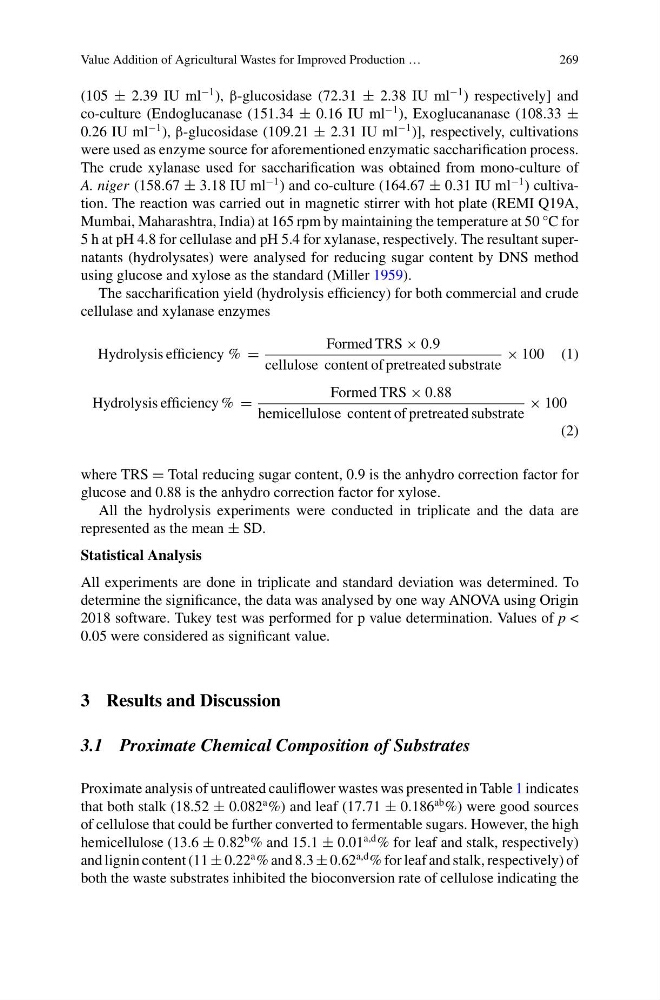
The saccharification yield (hydrolysis efficiency) for both commercial and crude
cellulase and xylanase enzymes
Hydrolysis efficiency % =
Formed TRS × 0.9
cellulose content of pretreated substrate
× 100 (1)
Hydrolysis efficiency % =
Formed TRS × 0.88
hemicellulose content of pretreated substrate
× 100
(2)
where TRS = Total reducing sugar content, 0.9 is the anhydro correction factor for
glucose and 0.88 is the anhydro correction factor for xylose.
All the hydrolysis experiments were conducted in triplicate and the data are
represented as the mean ± SD.
Statistical Analysis
All experiments are done in triplicate and standard deviation was determined. To
determine the significance, the data was analysed by one way ANOVA using Origin
2018 software. Tukey test was performed for p value determination. Values of p <
0.05 were considered as significant value.
3 Results and Discussion
3.1 Proximate Chemical Composition of Substrates
Proximate analysis of untreated cauliflower wastes was presented in Table 1 indicates
that both stalk (18.52 ± 0.082
a %) and leaf (17.71 ± 0.186
ab %) were good sources
of cellulose that could be further converted to fermentable sugars. However, the high
hemicellulose (13.6 ± 0.82
b % and 15.1 ± 0.01
a,d % for leaf and stalk, respectively)
and lignin content (11 ± 0.22
a % and 8.3 ± 0.62
a,d % for leaf and stalk, respectively) of
both the waste substrates inhibited the bioconversion rate of cellulose indicating the
269
(105 ± 2.39 IU ml
−1 ), β-glucosidase (72.31 ± 2.38 IU ml
−1 ) respectively] and
co-culture (Endoglucanase (151.34 ± 0.16 IU ml
−1 ), Exoglucananase (108.33 ±
0.26 IU ml
−1 ), β-glucosidase (109.21 ± 2.31 IU ml
−1 )], respectively, cultivations
were used as enzyme source for aforementioned enzymatic saccharification process.
The crude xylanase used for saccharification was obtained from mono-culture of
A. niger (158.67 ± 3.18 IU ml
−1 ) and co-culture (164.67 ± 0.31 IU ml
−1 ) cultivation. The reaction was carried out in magnetic stirrer with hot plate (REMI Q19A,
Mumbai, Maharashtra, India) at 165 rpm by maintaining the temperature at 50 °C for
5 h at pH 4.8 for cellulase and pH 5.4 for xylanase, respectively. The resultant supernatants (hydrolysates) were analysed for reducing sugar content by DNS method
using glucose and xylose as the standard (Miller 1959).
The saccharification yield (hydrolysis efficiency) for both commercial and crude
cellulase and xylanase enzymes
Hydrolysis efficiency % =
Formed TRS × 0.9
cellulose content of pretreated substrate
× 100 (1)
Hydrolysis efficiency % =
Formed TRS × 0.88
hemicellulose content of pretreated substrate
× 100
(2)
where TRS = Total reducing sugar content, 0.9 is the anhydro correction factor for
glucose and 0.88 is the anhydro correction factor for xylose.
All the hydrolysis experiments were conducted in triplicate and the data are
represented as the mean ± SD.
Statistical Analysis
All experiments are done in triplicate and standard deviation was determined. To
determine the significance, the data was analysed by one way ANOVA using Origin
2018 software. Tukey test was performed for p value determination. Values of p <
0.05 were considered as significant value.
3 Results and Discussion
3.1 Proximate Chemical Composition of Substrates
Proximate analysis of untreated cauliflower wastes was presented in Table 1 indicates
that both stalk (18.52 ± 0.082
a %) and leaf (17.71 ± 0.186
ab %) were good sources
of cellulose that could be further converted to fermentable sugars. However, the high
hemicellulose (13.6 ± 0.82
b % and 15.1 ± 0.01
a,d % for leaf and stalk, respectively)
and lignin content (11 ± 0.22
a % and 8.3 ± 0.62
a,d % for leaf and stalk, respectively) of
both the waste substrates inhibited the bioconversion rate of cellulose indicating the