

Degradable Plastic Composite Film—A Comparison …
255
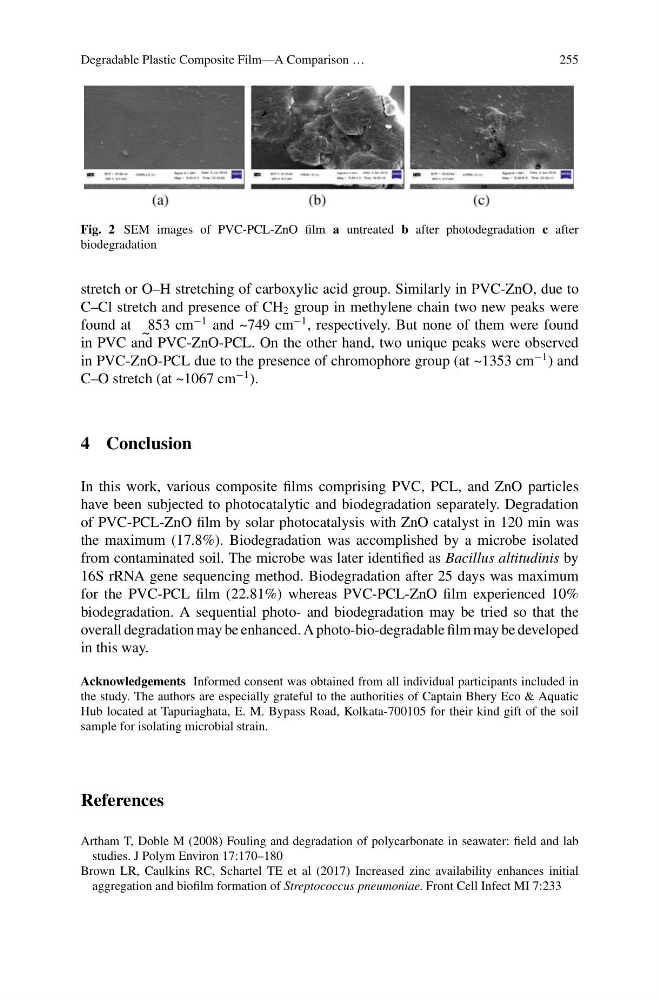
Fig. 2 SEM images of PVC-PCL-ZnO film a untreated b after photodegradation c after
biodegradation
stretch or O–H stretching of carboxylic acid group. Similarly in PVC-ZnO, due to
C–Cl stretch and presence of CH 2 group in methylene chain two new peaks were
found at ~
853 cm
−1 and ~749 cm
−1 , respectively. But none of them were found
in PVC and PVC-ZnO-PCL. On the other hand, two unique peaks were observed
in PVC-ZnO-PCL due to the presence of chromophore group (at ~1353 cm
−1 ) and
C–O stretch (at ~1067 cm
−1 ).
4 Conclusion
In this work, various composite films comprising PVC, PCL, and ZnO particles
have been subjected to photocatalytic and biodegradation separately. Degradation
of PVC-PCL-ZnO film by solar photocatalysis with ZnO catalyst in 120 min was
the maximum (17.8%). Biodegradation was accomplished by a microbe isolated
from contaminated soil. The microbe was later identified as Bacillus altitudinis by
16S rRNA gene sequencing method. Biodegradation after 25 days was maximum
for the PVC-PCL film (22.81%) whereas PVC-PCL-ZnO film experienced 10%
biodegradation. A sequential photo- and biodegradation may be tried so that the
overall degradation may be enhanced. A photo-bio-degradable film may be developed
in this way.
Acknowledgements Informed consent was obtained from all individual participants included in
the study. The authors are especially grateful to the authorities of Captain Bhery Eco & Aquatic
Hub located at Tapuriaghata, E. M. Bypass Road, Kolkata-700105 for their kind gift of the soil
sample for isolating microbial strain.
References
Artham T, Doble M (2008) Fouling and degradation of polycarbonate in seawater: field and lab
studies. J Polym Environ 17:170–180
Brown LR, Caulkins RC, Schartel TE et al (2017) Increased zinc availability enhances initial
aggregation and biofilm formation of Streptococcus pneumoniae. Front Cell Infect MI 7:233
255
Fig. 2 SEM images of PVC-PCL-ZnO film a untreated b after photodegradation c after
biodegradation
stretch or O–H stretching of carboxylic acid group. Similarly in PVC-ZnO, due to
C–Cl stretch and presence of CH 2 group in methylene chain two new peaks were
found at ~
853 cm
−1 and ~749 cm
−1 , respectively. But none of them were found
in PVC and PVC-ZnO-PCL. On the other hand, two unique peaks were observed
in PVC-ZnO-PCL due to the presence of chromophore group (at ~1353 cm
−1 ) and
C–O stretch (at ~1067 cm
−1 ).
4 Conclusion
In this work, various composite films comprising PVC, PCL, and ZnO particles
have been subjected to photocatalytic and biodegradation separately. Degradation
of PVC-PCL-ZnO film by solar photocatalysis with ZnO catalyst in 120 min was
the maximum (17.8%). Biodegradation was accomplished by a microbe isolated
from contaminated soil. The microbe was later identified as Bacillus altitudinis by
16S rRNA gene sequencing method. Biodegradation after 25 days was maximum
for the PVC-PCL film (22.81%) whereas PVC-PCL-ZnO film experienced 10%
biodegradation. A sequential photo- and biodegradation may be tried so that the
overall degradation may be enhanced. A photo-bio-degradable film may be developed
in this way.
Acknowledgements Informed consent was obtained from all individual participants included in
the study. The authors are especially grateful to the authorities of Captain Bhery Eco & Aquatic
Hub located at Tapuriaghata, E. M. Bypass Road, Kolkata-700105 for their kind gift of the soil
sample for isolating microbial strain.
References
Artham T, Doble M (2008) Fouling and degradation of polycarbonate in seawater: field and lab
studies. J Polym Environ 17:170–180
Brown LR, Caulkins RC, Schartel TE et al (2017) Increased zinc availability enhances initial
aggregation and biofilm formation of Streptococcus pneumoniae. Front Cell Infect MI 7:233