

Application of Used Tea as Solid Matrix for Immobilization …
227
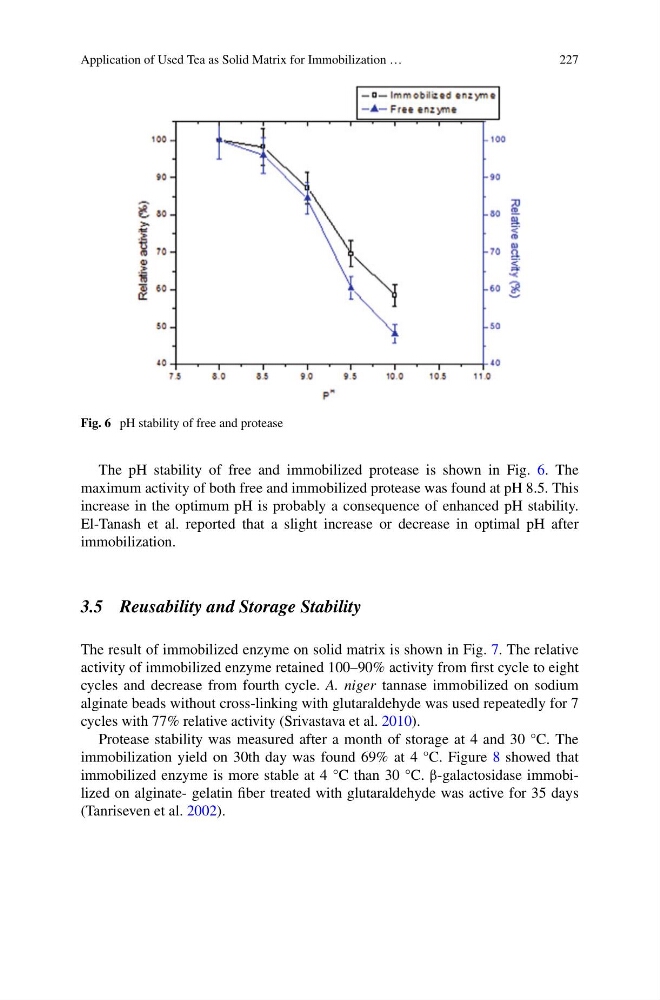
Fig. 6 pH stability of free and protease
The pH stability of free and immobilized protease is shown in Fig. 6. The
maximum activity of both free and immobilized protease was found at pH 8.5. This
increase in the optimum pH is probably a consequence of enhanced pH stability.
El-Tanash et al. reported that a slight increase or decrease in optimal pH after
immobilization.
3.5 Reusability and Storage Stability
The result of immobilized enzyme on solid matrix is shown in Fig. 7. The relative
activity of immobilized enzyme retained 100–90% activity from first cycle to eight
cycles and decrease from fourth cycle. A. niger tannase immobilized on sodium
alginate beads without cross-linking with glutaraldehyde was used repeatedly for 7
cycles with 77% relative activity (Srivastava et al. 2010).
Protease stability was measured after a month of storage at 4 and 30 °C. The
immobilization yield on 30th day was found 69% at 4 °C. Figure 8 showed that
immobilized enzyme is more stable at 4 °C than 30 °C. β-galactosidase immobilized on alginate- gelatin fiber treated with glutaraldehyde was active for 35 days
(Tanriseven et al. 2002).
227
Fig. 6 pH stability of free and protease
The pH stability of free and immobilized protease is shown in Fig. 6. The
maximum activity of both free and immobilized protease was found at pH 8.5. This
increase in the optimum pH is probably a consequence of enhanced pH stability.
El-Tanash et al. reported that a slight increase or decrease in optimal pH after
immobilization.
3.5 Reusability and Storage Stability
The result of immobilized enzyme on solid matrix is shown in Fig. 7. The relative
activity of immobilized enzyme retained 100–90% activity from first cycle to eight
cycles and decrease from fourth cycle. A. niger tannase immobilized on sodium
alginate beads without cross-linking with glutaraldehyde was used repeatedly for 7
cycles with 77% relative activity (Srivastava et al. 2010).
Protease stability was measured after a month of storage at 4 and 30 °C. The
immobilization yield on 30th day was found 69% at 4 °C. Figure 8 showed that
immobilized enzyme is more stable at 4 °C than 30 °C. β-galactosidase immobilized on alginate- gelatin fiber treated with glutaraldehyde was active for 35 days
(Tanriseven et al. 2002).